 Globe Quest
 Human Quest · LearningSign in
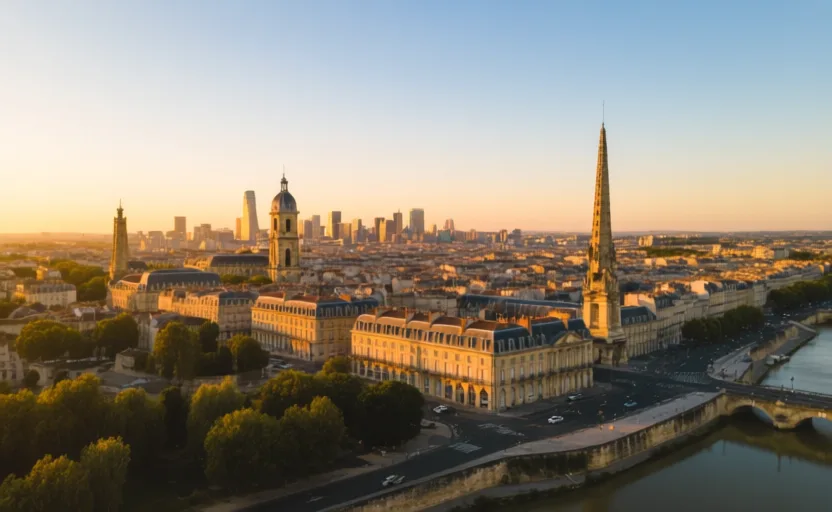 Bordeaux · AI city illustration · Artistic impression
City · Europe
Bordeaux
Saved in this browser — no account needed. Sign in later and it comes with you.
Where it is
Bordeaux is a river port about 500 kilometres south-west of Paris, on a wide bend of the Garonne a little way inland from the Atlantic. Ocean-going ships reach it through the Gironde estuary. The bend matters: on the outside of the curve the current scours a channel deep enough for merchant vessels, so the left bank became the developed side while the low, often marshy right bank stayed secondary for centuries. The climate is oceanic, with mild wet winters from the Atlantic westerlies, warm summers and very little snow.
The land and water around it
The Garonne bendriver
The river curves around the old city in a crescent. Deep water on the outer, western bank is why the quays and the first great merchant houses are there, and why the eastern bank was left to marsh and later to redevelopment.
The Gironde estuaryestuary
The Garonne reaches the Atlantic through this estuary, which lets ocean liners come up to the city. It made Bordeaux a port without being on the open coast.
The Atlantic climate and the vineclimate
Cool to mild wet winters and warm, somewhat drier summers suit the vine. The Romans introduced it in about the middle of the first century and wine has been made in the region without a break since.
Its history, in short
The Celtic tribe that founded Burdigala around 300 BC chose a spot where a navigable river met the sea, and the town grew under Rome as a trading centre for tin and lead. After the Vandals, Visigoths and Franks passed through, it lapsed into obscurity, then revived in the late 6th century as a county town and archiepiscopal see. The decisive medieval turn came when Eleanor of Aquitaine married Henry Plantagenet, who soon became king of England: for roughly three centuries the city belonged to an English-ruled Aquitaine, traded tax-free with England and built its wealth on wine. That ended with the French victory at Castillon in 1453. In the 18th century Bordeaux was the busiest port in France, shipping coffee, cocoa, sugar, cotton and indigo, and it was also a major slave-trading centre, its shipowners deporting some 150,000 Africans. The wealth of that century rebuilt the centre in stone, and the result served as a model when Paris was remodelled. Three times, in 1870 and in the two world wars, the French government retreated here.
Timeline
Dates are shown on a timeline rather than as changing shapes on the map. The globe draws modern boundaries only, and tinting a modern outline to stand for a historical one would state something we cannot source.
Classical world
c. 300 BC
Burdigala
A Celtic tribe, the Bituriges Vivisci, settles the site and names it Burdigala, a name probably of Aquitanian origin.
Approximate dateWikipediac. 60 BC
Roman rule
The city comes under Rome and becomes a commercial centre for tin and lead. The amphitheatre and the monument known as Les Piliers de Tutelle date from this period.
Approximate dateWikipedia
Post-classical world
12th century
Aquitaine passes to the English crown
Eleanor, Duchess of Aquitaine, marries Henry Plantagenet, who soon becomes king of England. Bordeaux gains tax-free trade with England, the wine trade grows, and the belfry and the cathedral of Saint-André are built, the cathedral in 1227.
Approximate dateWikipedia
Early modern & oceanic
1453
Battle of Castillon
French victory at Castillon ends English rule and Bordeaux is annexed to France. The city had briefly been the capital of an independent state under the Black Prince between 1362 and 1372.
Well attestedWikipedia1653
The Fronde ends
Bordeaux had sided with the Fronde and is effectively annexed to the kingdom only when Louis XIV's army enters the city.
Well attestedWikipedia18th century
The golden age of the port
Bordeaux becomes the busiest port in France and, after London, the second busiest in the world. Perhaps 5,000 buildings in the centre date from the period, and Bordeaux shipowners run some 500 slaving expeditions.
Approximate dateWikipedia
Industrial & imperial
May–June 1940
Visas for refugees
As the German army advances, the Portuguese consul-general Aristides de Sousa Mendes grants thousands of visas that allow refugees to pass the Spanish border. Bordeaux then falls under occupation and becomes a submarine base.
Well attestedWikipedia
Contemporary
2007
World Heritage listing
The Port of the Moon is inscribed on the UNESCO list, covering about 40 per cent of the city's surface.
Well attestedWikipedia
Places that carry meaning
The Port of the Moon18th century onward
The crescent of quays and 18th-century façades along the left bank, named for the shape of the river bend. It is the part of the city inscribed by UNESCO as an urban ensemble of the Enlightenment, and it has more listed buildings than any French city bar the capital.
The U-boat pens1941–1943
Reinforced-concrete submarine shelters built when the city was an Italian and German base in the Battle of the Atlantic. They proved too massive to demolish and now house exhibitions.
Pont Jacques Chaban-Delmas2013
A vertical-lift bridge across the Garonne whose central span can rise 53 metres to let tall ships through, a sign that the river downstream of the old centre is still worked.
Languages here
Places are usually multilingual. This lists what is actually spoken, not one language per border.
FrenchRomance family
The official and everyday language.
French is the sole official language of France, standardised from the Renaissance onward, and it is the language of schools, administration and the street in Bordeaux. The city also has sizable Italian, Spanish, Portuguese and Turkish communities.
OccitanRomance family
The traditional regional language of the south, now much reduced.
Occitan is among the regional languages still recognised in France. In Bordeaux it is a heritage language rather than a daily one, and French carries ordinary city life.
Learn the language here
- 1Understand which languages are spoken hereBordeaux is multilingual. Start with which languages are used, by whom, and for what — the phrase list only covers one of them.Written by Globe Quest
- 2Learn 11 phrasesCurated everyday phrases for Bordeaux, with audio and a written form.Written by Globe Quest
- 3Say them out loudSpeaking practice with pronunciation feedback, one phrase at a time.Globe Quest material, your own additions
- 4Come back to themSpaced review, so what you learned this week is still there next month.Written by Globe Quest
Check yourself
Why did the left bank of the Garonne develop before the right?
The current on the outside of the bend keeps a channel deep enough for merchant ships
On the outside of a river bend the water runs faster and digs deeper. Ships could tie up on the left bank, while the right bank remained a low, marshy plain.
What ended Bordeaux's period under English rule?
The French victory at Castillon in 1453
After Castillon in 1453 the city was annexed by France. For about three centuries before that it had traded duty-free with England and grown rich on wine.
Worth arguing about
- The 18th-century buildings that make Bordeaux a World Heritage city were paid for partly by the slave trade. How should a city present a beauty that rests on that money?
- Bordeaux is small inside its municipal borders, 49 square kilometres, yet the city region is the sixth largest in France. What does that gap do to how people think of the city?
Sources
- Wikipedia · BordeauxWikipedia · encyclopedia · checked 2026-11-24
- Wikipedia · FranceWikipedia · encyclopedia · checked 2026-11-24
Reviewed by Globe Quest editorial on 2026-11-24. Drafted with AI assistance and checked against the sources above before publication.