 Globe Quest
 Human Quest · LearningSign in
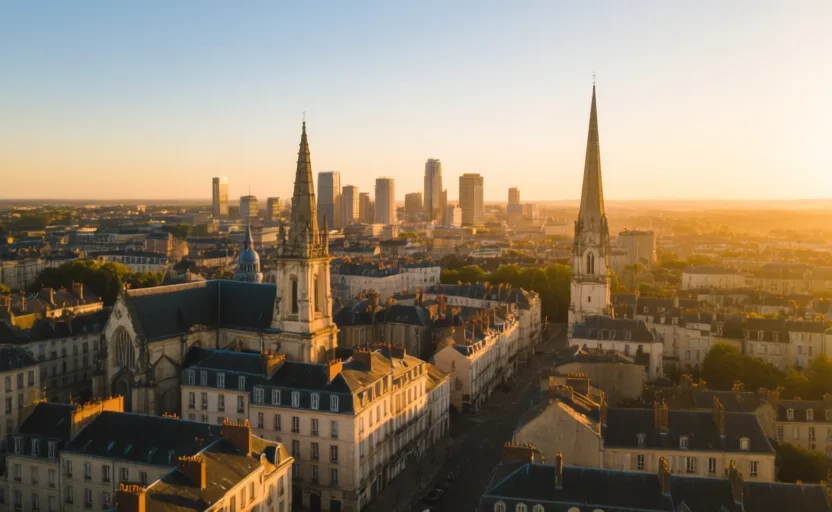 Nantes · AI city illustration · Artistic impression
City · Europe
Nantes
Saved in this browser — no account needed. Sign in later and it comes with you.
Where it is
Where the Loire starts to widen into its estuary, 50 kilometres from the Atlantic, the river once split into a dozen channels around sandy islands. Those islands made the river easy to cross and fixed the site of Nantes. The city also sits at a junction of regions: Brittany to the north, the Vendée and Bordeaux road to the south, the Atlantic to the west and the heart of France upriver. Beneath it lies the old rock of the Armorican Massif, whose Sillon de Bretagne ridge meets the Loire here in cliffs above the quays. The climate is oceanic, with about 820 millimetres of rain a year spread through all seasons.
The land and water around it
The Loire and its former islandsriver
The Loire here is a river of about 1,000 kilometres, and its estuary, 60 kilometres long, begins at Nantes. The old channels and islands were levelled in the 1920s to 1940s. Feydeau and Gloriette were joined to the north bank, and what remained became the Isle of Nantes.
The Sillon de Bretagnemountains
A ridge of ancient Ordovician and Cadomian rock, part of the Armorican Massif, that ends at the Loire in cliffs. Its last point, the Butte Sainte-Anne, is a landmark 38 metres above sea level.
The Loire estuaryestuary
The estuary joins Nantes with Saint-Nazaire, the seaport at its mouth, and together they form one of the main urban areas of north-western France. The two have been linked since the shipyards and the port moved downstream.
Its history, in short
Nantes takes its name from the Namnetes, a Gaulish tribe, and probably started as a Bronze Age trading place for tin and iron. The Franks took it from the Visigoths around 490, and the Bretons took it from the Franks in 851; for centuries it was a principal residence of the dukes of Brittany, until Brittany joined France in 1532 and Rennes became the provincial capital. The Atlantic gave the city its second life. After France built a colonial empire, Nantes became the country's largest port and took part in nearly half of the French slave trade across the Atlantic in the 1700s, and it was the last French port to carry on the illegal trade, until about 1827. Food processing and shipbuilding came next, until the shipyards closed in 1987. The city then reinvented itself around services and green policy, and in 2013 it won the European Green Capital Award. The river looks different from what it did: between 1926 and 1946 most of its channels were filled in to make room for streets.
Timeline
Dates are shown on a timeline rather than as changing shapes on the map. The globe draws modern boundaries only, and tinting a modern outline to stand for a historical one would state something we cannot source.
First cities & states
c. 900 BC
Early metalworking
After roughly a thousand years of trade, local smithies appear. Remains of forges from the 8th and 7th centuries BC have been found in the city, and the region exports tin as far as Ireland.
Approximate dateWikipedia
Classical world
c. 490
Taken by the Franks
Clovis captures Nantes from the Visigoths after a sixty-day siege and uses it as a stronghold against the Bretons.
Approximate dateWikipedia
Post-classical world
851
Captured by the Bretons
The city passes to the Bretons, with help from Lambert II of Nantes. In Charlemagne's time it had been capital of the Breton March, a buffer zone for the Carolingian Empire.
Well attestedWikipedia
Early modern & oceanic
1491–1532
Brittany joins France
Anne of Brittany weds the French king Charles VIII in 1491, which starts the merging of the duchy with the crown. It is ratified in 1532. Rennes receives the main courts and administration, while Nantes keeps the Chamber of Accounts.
Well attestedWikipedia29 June 1793
Battle of Nantes
About 30,000 Royalist troops from the Vendée attack a Republican garrison of 12,000, hoping to reach Normandy. They fail, and their leader Jacques Cathelineau is killed.
Well attestedWikipedia
Industrial & imperial
until about 1827
The last slaving port
Having flourished in the 18th century, the slave trade is outlawed by the Revolution but revives in Nantes, the last French port to conduct it illegally. Around 400,000 people may have been deported in the 19th century.
Approximate dateWikipedia1926–1946
The channels are filled in
Silt, collapsing quays and crowded embankments lead the city to fill most of the Loire's side channels and divert the water. Large avenues replace them.
Well attestedWikipedia
Contemporary
1987
The shipyards close
Deindustrialisation ends shipbuilding, and the city turns to services under the mayor Jean-Marc Ayrault, in office from 1989 to 2012.
Well attestedWikipedia
Places that carry meaning
Castle of the Dukes of BrittanyFrom 1207; mostly 15th century
A fortress with granite towers on the outside and delicate tuffeau stone ornament in Flamboyant style on its inner facades, which also served as the residence of the ducal court.
Nantes Cathedral1434–1891
A Gothic cathedral that took 457 years to build. Inside is the monument to Duke Francis II and his wife, an example of French Renaissance sculpture.
Feydeau Island18th century
Houses built on damp soil from the former river island lean visibly, a trace of the days when the Loire still ran on both sides. The island is now attached to the north bank.
Languages here
Places are usually multilingual. This lists what is actually spoken, not one language per border.
FrenchRomance family
The language of daily life; the city is a stronghold of standard French.
Nantes lies in the territory of the langues d'oïl. People born abroad were 8.5 per cent of the population in 2013, mostly from Algeria, Morocco and Tunisia.
GalloRomance family
The traditional Romance dialect of Upper Brittany.
Gallo is spoken by some people in the region around Nantes, but the city's own 'parler nantais' is of dubious existence.
BretonCeltic family
A Celtic language, visible in schools and signs.
Lower Breton immigration in the 19th century made Breton widely spoken in parts of Nantes. The city joined the Breton-language public office in 2013, and since then it has supported six bilingual schools and introduced bilingual signage. Its Breton name is Naoned.
Learn the language here
- 1Understand which languages are spoken hereNantes is multilingual. Start with which languages are used, by whom, and for what — the phrase list only covers one of them.Written by Globe Quest
- 2Learn 11 phrasesCurated everyday phrases for Nantes, with audio and a written form.Written by Globe Quest
- 3Say them out loudSpeaking practice with pronunciation feedback, one phrase at a time.Globe Quest material, your own additions
- 4Come back to themSpaced review, so what you learned this week is still there next month.Written by Globe Quest
Check yourself
After Brittany joined France in 1532, which city became its provincial capital?
Rennes
Nantes had been the main residence of the dukes, but Rennes, where dukes were crowned, received most of the legal and administrative institutions. Nantes kept the Chamber of Accounts.
What happened to the Loire's channels in Nantes between 1926 and 1946?
Most were filled in and replaced by avenues
Silting needed constant dredging, which undermined the quays, and one quay collapsed in 1924. The city responded by filling in most channels, joining islands to the bank and leaving only two branches.
Worth arguing about
- Nantes belongs to Brittany by history and culture but not by the modern administrative region. Who should decide where such a city belongs?
- The city that grew rich from the Atlantic slave trade later reinvented itself as a green capital. How should a city tell both stories?
Sources
- Wikipedia · NantesWikipedia · encyclopedia · checked 2026-11-24
Reviewed by Globe Quest editorial on 2026-11-24. Drafted with AI assistance and checked against the sources above before publication.