 Globe Quest
 Human Quest · LearningSign in
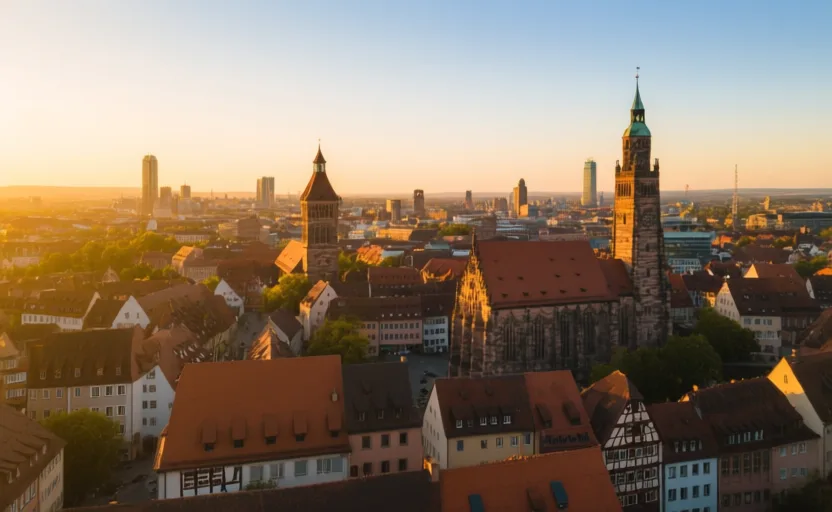 Nuremberg · AI city illustration · Artistic impression
City · Europe
Nuremberg
Also known as Nürnberg
Saved in this browser — no account needed. Sign in later and it comes with you.
Where it is
A castle on a rock above the Pegnitz started the city, and trade routes made it large. It is the principal city of Franconia, in northern Bavaria, and it has grown into a continuous built-up area with its neighbours Fürth, Erlangen and Schwabach, about 1.4 million people in all. Old villages such as Kraftshof, Thon and Katzwang were absorbed along its edges. Its position inland and at some altitude gives it a climate that is oceanic but with continental touches: variable winters between about minus 3 and 4 degrees, and warm summers rising to around 25 degrees in the afternoon, with rain through the year.
The land and water around it
The Pegnitzriver
The river runs through the old city, below the castle ridge. Nuremberg lies on it at a point where several trade routes met.
The Franconian uplandplain
The city is the largest in the cultural region of Franconia, and the surrounding metropolitan region has about 3.6 million people. Its inland setting and higher ground give it a more continental climate than the north-west of Germany.
Its history, in short
The first document, in 1050, mentions an imperial castle between eastern Franconia and the Bavarian Nordgau. The city grew around it on the strength of its position on major trade routes. Under Conrad III a burgraviate was established, passing to the Hohenzollern in 1193, and the burgraves’ power gradually gave way to an imperial mayor and a castellan, and then to the city itself, which became a Free Imperial City in the 13th century. The Imperial Regalia were kept here from 1424 until the end of the empire. In the 15th and 16th centuries it was the centre of the German Renaissance, home to Albrecht Dürer and to astronomers, printers and instrument makers. It accepted the Reformation in 1525, and the Religious Peace of 1532 signed here kept Lutherans and Catholics from war for fifteen years. Trade families such as the Tucher, Imhoff and Haller traded across Europe, then business declined. After Napoleon the city joined Bavaria, and in 1835 the Ludwigsbahn to Fürth became the first German railway. The Nazi Party chose Nuremberg for its rallies, held in 1927, 1929 and every year from 1933 to 1938, and for the 1935 laws that stripped Jews of citizenship. After the war the city hosted the international trials of 1945 and 1946.
Timeline
Dates are shown on a timeline rather than as changing shapes on the map. The globe draws modern boundaries only, and tinting a modern outline to stand for a historical one would state something we cannot source.
Post-classical world
1050
First mention
A document names the imperial castle, set between eastern Franconia and the Nordgau of Bavaria.
Well attestedWikipedia1424
The Imperial Regalia
The crown jewels of the empire are placed in the city’s keeping, where they remain until the end of the Holy Roman Empire.
Well attestedWikipedia
Early modern & oceanic
1471
Regiomontanus’s observatory
Johannes Mueller of Königsberg builds an astronomical observatory and publishes important star charts. In 1515 Dürer produces the first printed star maps of both hemispheres.
Well attestedWikipedia1525
Protestant Reformation
The city accepts the Reformation. The Religious Peace of Nuremberg in 1532 then prevents war between Lutherans and Catholics for fifteen years.
Well attestedWikipedia
Industrial & imperial
1835
The first German railway
The Bavarian Ludwigsbahn opens between Nuremberg and nearby Fürth.
Well attestedWikipedia1935
The Nuremberg Laws
At the party rally, Hitler orders the Reichstag to meet in the city, where it passes laws that strip Jews and other non-Aryans of German citizenship.
Well attestedWikipedia
Contemporary
1945–1946
The Nuremberg trials
German officials accused of war crimes and crimes against humanity are tried before an international tribunal. The Soviet Union had wanted Berlin as the site, and as a compromise Berlin became the tribunal’s permanent seat while the first trial was held here. Prominent defendants were executed in October 1946.
Well attestedWikipedia
Places that carry meaning
Nuremberg Castle11th century onward
A group of three castles that tower over the old town, on the site of the imperial castle from which the city grew.
The old town and city wallsMiddle Ages
Among the best-preserved medieval centres in Germany. The Nazi mayor Willy Liebel tried to strip the late 19th-century styling from the centre to restore its medieval look, and slated the Grand Synagogue for demolition.
Palace of Justice1945–1946
Chosen for the trials because it was spacious, largely undamaged by bombing and had a large prison attached. The courtroom was enlarged by removing a wall.
Nazi Party Rally Grounds1930s
Buildings and assembly grounds designed by Albert Speer, built only for the party conventions, some of them unfinished.
Languages here
Places are usually multilingual. This lists what is actually spoken, not one language per border.
GermanGermanic family
The official language of the city.
Nuremberg is the cultural centre of Franconia and has long been a place of printing and publishing, from the Renaissance humanists to its present-day publishers. In Bavaria, dialects are holding up better than elsewhere in Germany.
Turkish and Arabic
The two largest home languages after German in the country as a whole.
A 2020 survey found German in 90 per cent of German households, Turkish in 2 per cent and Arabic in 1 per cent. In Nuremberg, 19.2 percent of residents had an immigrant background in 2022, but this does not say which language they use.
Minority languages and other immigrant languages
Recognised regional languages, plus Kurdish, Polish, Italian, Greek and others.
Romani, Danish, Frisian and Sorbian have minority status in Germany, mostly in their own regions. Common immigrant languages nationally include Kurdish, Polish, Italian, Greek, Spanish and Russian.
Learn the language here
- 1Understand which languages are spoken hereNuremberg is multilingual. Start with which languages are used, by whom, and for what — the phrase list only covers one of them.Written by Globe Quest
- 2Learn 11 phrasesCurated everyday phrases for Nuremberg, with audio and a written form.Written by Globe Quest
- 3Say them out loudSpeaking practice with pronunciation feedback, one phrase at a time.Globe Quest material, your own additions
- 4Come back to themSpaced review, so what you learned this week is still there next month.Written by Globe Quest
Check yourself
Why was Nuremberg chosen for the postwar trials?
It was the site of the rallies and the Nuremberg Laws, and its Palace of Justice survived largely intact
The symbolism of holding the trials where the party had staged its rallies mattered, and the courthouse and its prison were usable. Berlin became the tribunal’s permanent seat as a compromise.
What opened between Nuremberg and Fürth in 1835?
The first German railway, the Ludwigsbahn
The Bavarian Ludwigsbahn was the first railway in Germany. The Zollverein customs union and more railways then opened the way for greater prosperity.
Worth arguing about
- The city’s medieval look was preserved, then promoted and exploited by the Nazi regime. How should a city treat the buildings and grounds that were used for propaganda?
- Nuremberg held the imperial crown jewels, the rallies and the trials. What makes a place the natural stage for such events?
What we have not established
These are open questions, listed rather than filled in. We would rather show a gap than a plausible guess.
Which languages do Nuremberg’s residents speak at home?
About one in five residents had an immigrant background in 2022, but German statistics count origin, not language, and no recent survey of home languages is known, so the shares of minority languages cannot be given.
Sources
- Wikipedia · NurembergWikipedia · encyclopedia · checked 2026-11-24
- Wikipedia · Languages of GermanyWikipedia · encyclopedia · checked 2026-11-24
Reviewed by Globe Quest editorial on 2026-11-24. Drafted with AI assistance and checked against the sources above before publication.