 Globe Quest
 Human Quest · LearningSign in
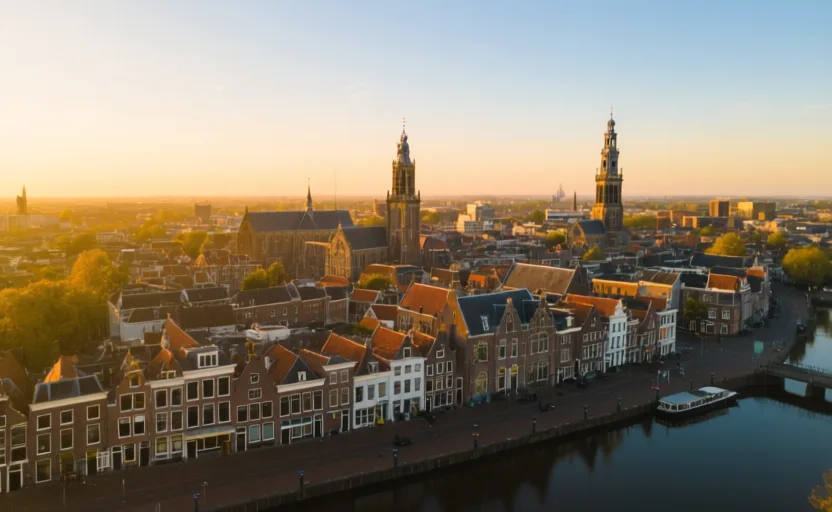 Groningen · AI city illustration · Artistic impression
City · Europe
Groningen
Saved in this browser — no account needed. Sign in later and it comes with you.
Where it is
Far from the Randstad, Groningen is the main city of the Dutch north, built at the northern tip of the Hondsrug, a sandy ridge that gave early settlers dry ground above wet country. Streams cross the old centre, and canals run out from it, the Van Starkenborgh Canal, the Eems Canal and the Winschoterdiep, once the arteries of trade. The north-east position makes the city a little colder in winter than other large Dutch cities, with frosts common, nights of minus ten not unusual, and prevailing north-westerly winds and gales off the North Sea. Rainfall is about 800 millimetres a year and cloud cover is heavy.
The land and water around it
The Hondsrugplain
A sandy ridge whose northern end is where the city was founded. Settlement evidence in the region goes back to around 3950–3650 BCE, and Saxons occupied the area before the first document.
The canalsriver
Waterways surround the city and are called diep locally. No longer used to move goods, they were once the arteries of trade, and warehouses at Noorderhaven stored colonial produce brought back from the Dutch colonies.
The northern climateclimate
An oceanic climate pushed colder by the north-eastern position. The record low is minus 26.8 degrees, on 16 February 1956, and snow often falls but seldom lasts.
Its history, in short
The oldest document naming Groningen dates from 1040, though people had lived in the region for millennia. The city gained de facto city rights in 1245, with no formal grant surviving. Distance from the successive centres of power in Utrecht, The Hague and Brussels forced it to rely on itself and the nearby region. It traded as a Hanseatic city, built walls in the thirteenth century, and in the late fifteenth century governed Friesland as well, acting almost as an independent city-state, which is when the Martinitoren was raised. Autonomy ended in 1536 when it accepted Charles V, and the Dutch and English took it in the siege of 1594, bringing it into the Dutch Republic. In the seventeenth century it was a base of the West India Company, whose ships carried enslaved Africans to the colonies. The university was founded in 1614. Bernhard von Galen’s siege failed in 1672 and is still celebrated every 28 August. In April 1945 the Battle of Groningen destroyed much of the main square.
Timeline
Dates are shown on a timeline rather than as changing shapes on the map. The globe draws modern boundaries only, and tinting a modern outline to stand for a historical one would state something we cannot source.
Post-classical world
1040
First document
The oldest written reference to Groningen. It had no formal city charter, though it counts as a city from 1245.
Well attestedWikipedia1245
De facto city rights
The city gains city rights in practice, though no written record of a formal grant survives. It is among the oldest cities in the Netherlands.
Approximate dateWikipedia
Early modern & oceanic
Late 15th century
Height of power
Groningen governs neighbouring Friesland, and the Martinitoren, still the city’s main landmark, is built.
Approximate dateWikipedia1536
Under Charles V
The city accepts Charles V as ruler, ending its autonomy. After the Siege of Groningen in 1594 the city and its province join the Dutch Republic.
Well attestedWikipedia1614
The university
The University of Groningen is founded with courses in law, medicine, theology and philosophy. It is the second oldest in the Netherlands.
Well attestedWikipedia28 August 1672
Gronings Ontzet
The city’s walls withstand a siege led by the bishop of Münster, Bernhard von Galen. The relief is celebrated annually with music and fireworks as “Bommen Berend”.
Well attestedWikipedia
Contemporary
April 1945
The Battle of Groningen
The main square and the Grote Markt are largely destroyed. The Martinitoren, the Goudkantoor and the city hall survive undamaged.
Well attestedWikipedia2019
Merger with Haren and Ten Boer
The municipality merges with its two neighbours, after an earlier merger with Hoogkerk and Noorddijk in 1968.
Well attestedWikipedia
Places that carry meaning
The MartinitorenLate 15th century
The tower named for the city’s patron, Saint Martin of Tours, which gives the city the nickname Martinistad. It is the city’s most significant landmark.
The Groninger Museum1994
A futuristic, colourful building by Alessandro Mendini that echoes Italian post-modern ideas.
Camp Nuis1951–1961
A former labour camp near the city that housed 250 of the 3,500 Moluccan soldiers and their families who came to the Netherlands in 1951, after they were unwelcome in Indonesia. It closed in 1961.
Languages here
Places are usually multilingual. This lists what is actually spoken, not one language per border.
DutchGermanic family
The standard language of the city and its two universities.
Students make up an estimated 25 per cent of the population, which gives the city a large body of residents from elsewhere in the country and abroad.
GroningsGermanic family
The regional dialect, which spread from the city into the surrounding land.
Its influence grew in the thirteenth century as the city asserted its authority over the countryside. In Frisian the city is called Grins and in the province dialect Groot Loug.
Learn the language here
- 1Understand which languages are spoken hereGroningen is multilingual. Start with which languages are used, by whom, and for what — the phrase list only covers one of them.Written by Globe Quest
- 2Learn 12 phrasesCurated everyday phrases for Groningen, with audio and a written form.Written by Globe Quest
- 3Say them out loudSpeaking practice with pronunciation feedback, one phrase at a time.Globe Quest material, your own additions
- 4Come back to themSpaced review, so what you learned this week is still there next month.Written by Globe Quest
Check yourself
Why did Groningen historically rely on itself and its region?
It was far from the successive Dutch centres of power in Utrecht, The Hague and Brussels
The city’s relative isolation from those centres pushed it towards self-reliance. At the height of its power in the fifteenth century it could be seen as an independent city-state.
Roughly what share of Groningen’s population are students?
About a quarter
An estimated 25 per cent of residents are students, which makes it the country’s demographically youngest city, though Urk is the youngest municipality overall.
Worth arguing about
- Groningen’s distance from the centres of power made it self-reliant for centuries. Is that independence still visible in how the north sees the Randstad?
- The city’s warehouses and shipyards served the slave trade of the West India Company. How does a university town that prides itself on openness address that?
What we have not established
These are open questions, listed rather than filled in. We would rather show a gap than a plausible guess.
How many people live in Groningen?
The municipality had 244,807 people in January 2025, but it absorbed Haren and Ten Boer in 2019, and older figures such as 232,874 for 2020 or the historical series use the original city limits. The Groningen metro area has about 557,000.
Sources
- Wikipedia · GroningenWikipedia · encyclopedia · checked 2026-11-24
Reviewed by Globe Quest editorial on 2026-11-24. Drafted with AI assistance and checked against the sources above before publication.