 Globe Quest
 Human Quest · LearningSign in
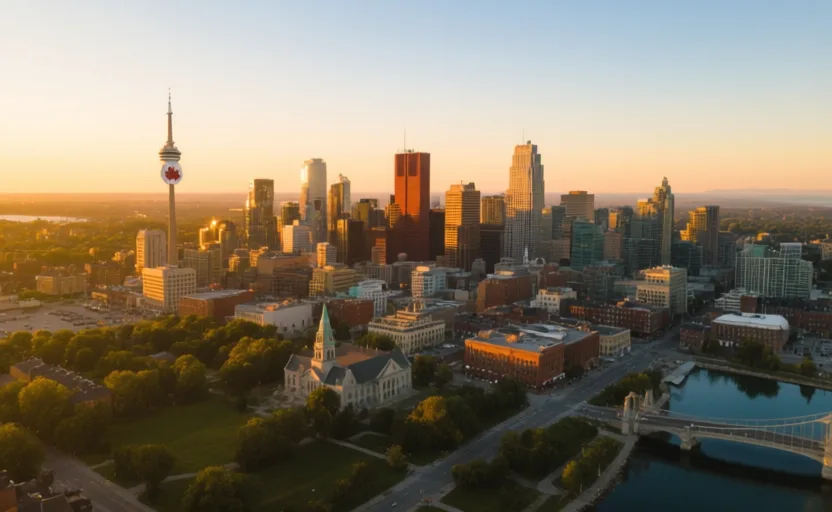 Hamilton · AI city illustration · Artistic impression
City · North America
Hamilton
Saved in this browser — no account needed. Sign in later and it comes with you.
Where it is
Hamilton is cut in two by a cliff. The Niagara Escarpment runs the full width of the city, so the “lower” city, including downtown, lies along the south shore of the harbour at the western tip of Lake Ontario, while the “upper” city sits on the plateau above it, up to about 250 metres higher than the lake. The harbour is closed off from the open lake by a long sandbar, laid down when lake levels stood higher at the end of the last ice age. The climate is humid continental and mild by Canadian standards, though the higher, more open ground near the airport runs colder, windier and snowier than the built-up lowlands.
The land and water around it
The Niagara Escarpmentplateau
A rock cliff that crosses the whole city and divides it into the lower city by the harbour and the upper city on the plateau.
Hamilton Harbour and the Beachstripharbour
A natural harbour at the head of Lake Ontario, sealed from the lake by a sandbar that stretches southeast toward the escarpment. Ships enter through a canal cut across the bar, which two bridges span: the high Skyway carrying the QEW and the lower lift bridge.
Cootes Paradisemarsh
A large wetland at the western end of the harbour, once rich in fish and birds. Settlement and industry degraded it, but legal protection that began in the 1880s and later civic efforts have kept it ecologically important.
Its history, in short
Before European settlement the land around the western end of the lake belonged to the Neutral nation, whom the French called the Attiwandaronk. Haudenosaunee nations pushed them out, and the Crown bought the ground from the Mississaugas in 1792. After the War of 1812 a landowner named George Hamilton laid out a town on a farm bought from James Durand, and in 1816 it was picked as the administrative centre of the new Gore District in preference to Ancaster. The real turning point came in 1832, when a canal was cut through the sandbar and the harbour became a working port. Heavy industry followed: Stelco and Dofasco were founded in 1910 and 1912, and by the late twentieth century the city produced most of Canada’s steel. From the 1970s many of the big plants closed or moved away, the last Stelco mills shutting in 2013, and manufacturing’s share of local jobs fell from 22 to 12 per cent in ten years. In 2001 the old city merged with Ancaster, Dundas, Flamborough, Glanbrook and Stoney Creek to form today’s much larger Hamilton.
Timeline
Dates are shown on a timeline rather than as changing shapes on the map. The globe draws modern boundaries only, and tinting a modern outline to stand for a historical one would state something we cannot source.
Early modern & oceanic
September 1699
French visit Tinawatawa
French travellers reach a Seneca Haudenosaunee village on ground later occupied by the hamlet of Westover, the first recorded European visit in the area.
Well attestedWikipedia1792
The Between the Lakes Purchase
Under Treaty 3 the Crown buys from the Mississaugas the ground that Hamilton would later occupy, then grants parcels to Loyalists to encourage settlement.
Well attestedWikipedia
Industrial & imperial
1816
Chosen as the district seat
The new town on George Hamilton’s land is made the administrative centre of the Gore District, ahead of Ancaster.
Well attestedWikipedia1832
The canal through the sandbar
A cut through the outer sandbar gives ships access to the harbour and makes Hamilton a major port. A permanent stone jail is finished the same year.
Well attestedWikipedia9 June 1846
City status
An act of the Parliament of the Province of Canada makes Hamilton a city. Its population had been 6,475 the year before.
Well attestedWikipedia1910 and 1912
Stelco and Dofasco founded
Two steelmakers are formed within two years of each other. Between them they would later account for most of the country’s steel.
Well attestedWikipedia
Contemporary
1 January 2001
Amalgamation
Hamilton merges with Ancaster, Dundas, Flamborough, Glanbrook and Stoney Creek into one single-tier city. The old city had 331,121 residents; the new one began at 519,949.
Well attestedWikipedia2013
The Stelco mills close for good
Idle since 2010, the mills are permanently shut, capping a decade in which manufacturing’s share of employment fell from 22 to 12 per cent.
Well attestedWikipedia
Places that carry meaning
Dundurn Castle19th century
The residence of Allan MacNab, eighth premier of Canada West, and now a National Historic Site. It records the political class that ran the Gore District from its new port town.
Stoney Creek BattlefieldWar of 1812
British regulars and local militia defeated an invading American force here, on ground that is now a park in the east of the city.
James Street North2000s onward
A downtown strip where galleries, a media-arts centre and the September Supercrawl festival (over 220,000 visitors by 2018) grew up in a district left behind by the retreat of heavy industry.
Languages here
Places are usually multilingual. This lists what is actually spoken, not one language per border.
EnglishGermanic family
The everyday language of work, school and government.
Ancestry in Hamilton is mostly English, Scottish, Irish, Italian and German, and the city’s newer arrivals have come from many more countries, but English is the common language between all of them.
FrenchRomance family
A minority language with provincial services and its own schools.
Hamilton is one of the Ontario centres designated for provincial services in French. The 2016 census counted 6,760 Francophones, and 30,530 residents (5.8 per cent) knew both official languages. Two French-language boards run five schools.
Immigrant languages
Spoken in households with roots in Europe, South Asia, East Asia and the Middle East.
A quarter of residents were born abroad in 2016, and newcomers of the 1990s came chiefly from the former Yugoslavia, Poland, India, China, the Philippines and Iraq. Italian is the largest of the European ancestries after the British Isles, so Italian-speaking households are long established.
Iroquoian languagesIroquoian family
The historic languages of the Neutral and Haudenosaunee peoples.
The Neutral spoke an Iroquoian language, and the Haudenosaunee nations who displaced them, and who were later settled on reserves west of Lake Ontario, speak related ones. The district’s old name, Attiwandaronia, comes from this heritage.
Learn the language here
- 1Understand which languages are spoken hereHamilton is multilingual. Start with which languages are used, by whom, and for what — the phrase list only covers one of them.Written by Globe Quest
- 2Learn 14 phrasesCurated everyday phrases for Hamilton, with audio and a written form.Written by Globe Quest
- 3Say them out loudSpeaking practice with pronunciation feedback, one phrase at a time.Globe Quest material, your own additions
- 4Come back to themSpaced review, so what you learned this week is still there next month.Written by Globe Quest
Check yourself
What turned Hamilton into a major port in 1832?
A canal cut through the sandbar that closes off the harbour
The harbour is a natural one, but a long sandbar shut it off from Lake Ontario. Cutting a ship canal through that bar in 1832 opened it to lake traffic.
Why do people in Hamilton speak of the “upper” and “lower” city?
The Niagara Escarpment runs through the city and splits it
The escarpment crosses the city from side to side, so the harbour-side lowlands and the plateau above are distinct districts joined by steep roads.
Worth arguing about
- Hamilton made much of Canada’s steel for a century and then lost most of it. What does a city owe the neighbourhoods built around a single industry?
- A cliff divides the city into two halves with different weather, histories and reputations. Does a physical barrier like that shape politics as well as travel?
What we have not established
These are open questions, listed rather than filled in. We would rather show a gap than a plausible guess.
Which languages do Hamiltonians speak at home?
Ancestry and place-of-birth counts are available, but they do not say which languages are used in households, and mother tongue differs from home language, so no shares are given for languages other than French.
Sources
- Wikipedia · Hamilton, OntarioWikipedia · encyclopedia · checked 2026-11-24
- Wikipedia · History of Hamilton, OntarioWikipedia · encyclopedia · checked 2026-11-24
- Wikipedia · CanadaWikipedia · encyclopedia · checked 2026-11-24
Reviewed by Globe Quest editorial on 2026-11-24. Drafted with AI assistance and checked against the sources above before publication.