 Globe Quest
 Human Quest · LearningSign in
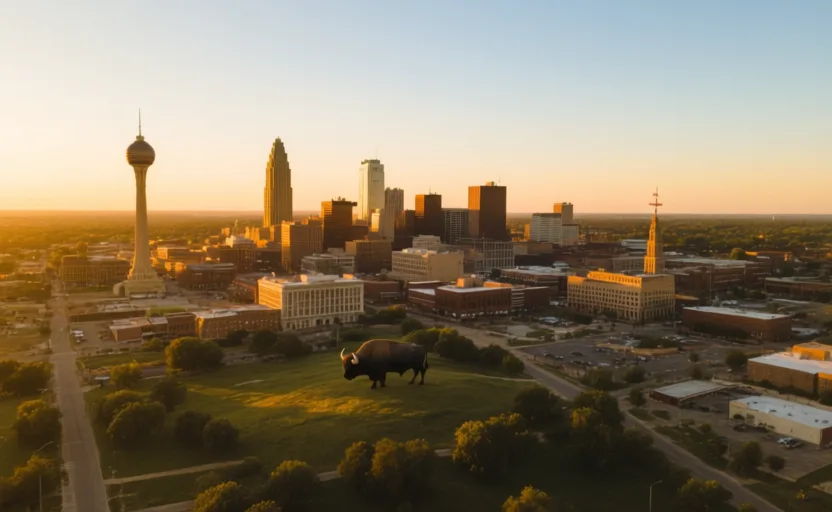 Buffalo · AI city illustration · Artistic impression
City · North America
Buffalo
Saved in this browser — no account needed. Sign in later and it comes with you.
Where it is
The city stands where Lake Erie narrows into the Niagara River, on the lake's far eastern shore and directly across the water from Fort Erie in Ontario. The river leaves here heading north, over Niagara Falls, towards Lake Ontario. The ground is a narrow lake plain that runs east as far as Utica, and Buffalo itself is mostly flat, with the land rising into the hills of the Appalachian Upland to the south. Winter is the defining feature of the climate: wind blowing across the open lake feeds snow bands, and the city averages about 95 inches of snow a year. About 278,000 people lived in the city in 2020, and more than 1.23 million in the wider metropolitan area.
The land and water around it
Lake Erie and the head of the Niagara Riverlake
Buffalo sits where the lake empties into the river that runs over Niagara Falls. Grain from the Midwest was transferred here for the trip east, which is what the canal and the grain trade were built around.
The Erie–Ontario lake plainplain
A narrow, level strip between the lakes and the Appalachian Upland. The flat ground made it easy to lay out canals, rail yards and streets, and the hills of the Southtowns begin where the plain ends.
Lake-effect snowclimate
The humid continental climate here is shaped by Lake Erie. Snow bands form depending on wind direction off the lake, and the worst storms in the record, the Blizzard of 1977 and the storm of November 2014 that dropped more than five feet, came from that combination of wind, lake and cold.
Its history, in short
Before Europeans arrived, the lower Great Lakes were held by Iroquoian-speaking peoples, and the Seneca, one of the Haudenosaunee nations, came to dominate the area after the mid-seventeenth century wars. They settled permanently on Buffalo Creek only in 1780, when displaced Senecas were moved there from Fort Niagara, and the Seneca name for the place, Došowëh, is still used. A small village grew up after the Revolutionary War, was burned by British forces in 1813 and quickly rebuilt. The decisive choice came in 1825, when Buffalo, not rival Black Rock, was picked as the western end of the Erie Canal. Grain from the Midwest was transferred here onto canal boats, and the invention of the grain elevator made the city the world's leading grain port. Railways, flour milling, Niagara hydroelectricity and then steel followed, and in 1950 the city peaked at 580,132 people. The St. Lawrence Seaway, opened in 1959, made the port and canal largely irrelevant, and deindustrialisation and suburbanisation cut the population by more than half by 2010. The 2020 census was the first in seventy years to show the city and Erie County both gaining people.
Timeline
Dates are shown on a timeline rather than as changing shapes on the map. The globe draws modern boundaries only, and tinting a modern outline to stand for a historical one would state something we cannot source.
Early modern & oceanic
1780
Seneca settlement on Buffalo Creek
Seneca people displaced from Fort Niagara are relocated to Buffalo Creek, the first permanent Native American settlement there. The Seneca town of Došowëh, “between the basswoods”, gives the city its Seneca name.
Well attestedWikipedia
Industrial & imperial
1813
Buffalo burned in the War of 1812
British forces burn Buffalo and Black Rock in response to the destruction of Newark by American forces. Rebuilding is complete by 1815.
Well attestedWikipedia1825
Terminus of the Erie Canal
The canal opens with Buffalo as its western end, after the harbour was expanded and the village was chosen over Black Rock. The city is incorporated in 1832 and doubles in size between 1845 and 1855, with Irish and German Catholic immigrants making up much of the growth.
Well attestedWikipedia1843
The grain elevator
Joseph Dart and Robert Dunbar adapt the steam-powered elevator to unload lake freighters. Unloading by hand had been slow, hard work, and mechanising it helped make Buffalo the largest grain port in the world.
Well attestedWikipedia1901
Pan-American Exposition
The exposition, lit by Niagara hydroelectricity, is the city's showcase. President William McKinley is shot there by an anarchist and dies, and Theodore Roosevelt is sworn in at a house in Buffalo.
Well attestedWikipedia
Contemporary
1950
Population peak
Buffalo reaches 580,132 people, the fifteenth largest city in the country, with about eighty per cent of local jobs in manufacturing. It had been eighth largest in 1900.
Well attestedWikipedia1959
St. Lawrence Seaway opens
The seaway, combined with an expanded Welland Canal, lets ships bypass Buffalo's port and barge canal. Together with suburbanisation and the loss of heavy industry, it begins the long decline that cut the population by more than half by 2010.
2020
First population gain in seventy years
The census shows Buffalo growing by 6.5 per cent, and Erie County gaining too, ending a decades-long trend of loss. Health care, education and logistics now carry more of the economy than steel.
Places that carry meaning
Guaranty BuildingSkyscraper era
Louis Sullivan's early skyscraper in the downtown, part of a collection of nineteenth- and twentieth-century downtown buildings.
Buffalo Central Terminal1929
A railway station on the East Side, built when Buffalo had more than a dozen railway terminals and was the second-largest rail hub in the country after Chicago. Its scale is a measure of how much freight and travel passed through the city.
Darwin D. Martin House20th century
A Prairie School house in the Parkside neighbourhood designed by Frank Lloyd Wright.
Languages here
Places are usually multilingual. This lists what is actually spoken, not one language per border.
EnglishGermanic family
The everyday language of the city.
Western New York has long been a destination for people from elsewhere, from New England settlers after the Revolution to Black Americans arriving from the South in the two Great Migrations, and English is what they share. Across the United States, 77 per cent of residents speak only English at home.
SpanishRomance family
The largest language of recent migration.
Puerto Rican migrants arrived in large numbers in the 1940s and 1950s looking for industrial work, and Latino residents now make up a large share of a city where Black and Latino residents together are the largest group. Spanish is the second most spoken language in the country as a whole.
Polish, German, Italian and Irish heritage
The languages of earlier immigrant neighbourhoods.
German and Irish immigrants filled the south and east sides from the 1830s to the 1850s, Poles replaced the Germans on the East Side around 1900, and Italian families settled mainly on the lower West Side. Such immigrant languages tend to fade within two or three generations, but they left behind churches, clubs and street names.
SenecaIroquoian family
The language of the first permanent settlement.
The Seneca name for the city, Došowëh, goes back to the town on Buffalo Creek, and the Seneca tradition of winter storytelling by trained tellers is described in local accounts.
Learn the language here
- 1Understand which languages are spoken hereBuffalo is multilingual. Start with which languages are used, by whom, and for what — the phrase list only covers one of them.Written by Globe Quest
- 2Learn 12 phrasesCurated everyday phrases for Buffalo, with audio and a written form.Written by Globe Quest
- 3Say them out loudSpeaking practice with pronunciation feedback, one phrase at a time.Globe Quest material, your own additions
- 4Come back to themSpaced review, so what you learned this week is still there next month.Written by Globe Quest
Check yourself
Why did Buffalo grow so quickly after 1825?
It was chosen as the western end of the Erie Canal
Grain and other goods from the Midwest were transferred at Buffalo between lake ships and canal boats, which turned a remote village into the largest grain port in the world.
What made Buffalo's port largely irrelevant after 1959?
The St. Lawrence Seaway let ships bypass it
The seaway and the enlarged Welland Canal gave ships a direct route to the Atlantic, so cargo no longer had to be unloaded at the head of the Niagara River.
Worth arguing about
- Buffalo's fortunes rose with a canal and fell with a seaway. How much of a city's future is decided by a route someone else builds?
- The city is described as one of the most segregated in the country, with Main Street dividing the East and West sides. How do the shape of a place and its history of housing policy reinforce one another?
What we have not established
These are open questions, listed rather than filled in. We would rather show a gap than a plausible guess.
Which people held the Buffalo Creek area when the French first explored it?
Accounts name the Erie, the Neutral and the small Wenro (Wenrohronon) as living around the eastern end of Lake Erie in the early seventeenth century, and the relationships between these peoples are themselves uncertain. Nobody can say precisely who lived on the creek itself.
Sources
- Wikipedia · Buffalo, New YorkWikipedia · encyclopedia · checked 2026-11-24
- Wikipedia · History of Buffalo, New YorkWikipedia · encyclopedia · checked 2026-11-24
- Wikipedia · United StatesWikipedia · encyclopedia · checked 2026-11-24
Reviewed by Globe Quest editorial on 2026-11-24. Drafted with AI assistance and checked against the sources above before publication.