 Globe Quest
 Human Quest · LearningSign in
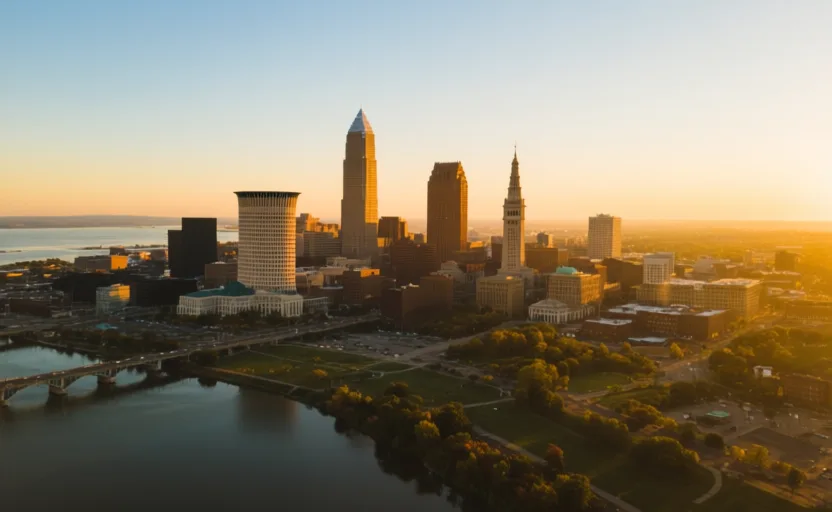 Cleveland · AI city illustration · Artistic impression
City · North America
Cleveland
Saved in this browser — no account needed. Sign in later and it comes with you.
Where it is
Lake Erie gives Cleveland its shoreline at 569 feet above sea level, and the land climbs quickly from there: Public Square, less than a mile inland, is at 650 feet, and the airport five miles back is at 791. The city stands on a series of irregular bluffs parallel to the water, cut mainly by the Cuyahoga and two smaller streams, Big Creek and Euclid Creek. The lake keeps summers cooler and winters warmer than the rest of Ohio, and because the land rises east of the river mouth, winds off the water drop heavy lake-effect snow on the East Side from mid-November until the lake freezes.
The land and water around it
Lake Erielake
The city is the most populous on the lake. The waterfront gave access to Great Lakes trade, and from there, canals and later the St. Lawrence Seaway linked it to the Atlantic.
The Cuyahoga Riverriver
The river cuts through the bluffs to the lake and sits at the centre of the city’s industrial history. Its polluted surface caught fire thirteen times from 1868, and the fire of June 1969 helped lead to the Clean Water Act of 1972.
The lakeshore bluffsplateau
Rising in a series of irregular steps from the shore, the bluffs put the business centre on higher ground than the water and shape the lake-effect snow belt east of the river.
Its history, in short
At the end of the last Ice Age this was a tundra shore, and human traces go back more than 12,000 years, through Archaic, Woodland and fortified-village cultures. The region appears to have been empty from about 1640 to 1740. The modern city began on 22 July 1796, when surveyors of the Connecticut Land Company laid out a New England-style town around a public square at the mouth of the Cuyahoga, named for their leader Moses Cleaveland. Growth was slow until the Ohio and Erie Canal linked the Great Lakes to the Ohio River in 1832, and railways added to it. Cleveland absorbed its rival Ohio City in 1854, and by 1910 it was the sixth-largest city in the country, with steel, oil and car makers, a stretch of mansions on Euclid Avenue and newcomers from Ireland, Italy and several empires of central and eastern Europe. The population reached 914,808 in 1950, then fell to 372,624 by 2020 as industry shrank and people moved to the suburbs. The burning of the Cuyahoga in 1969 became a symbol of industrial pollution.
Timeline
Dates are shown on a timeline rather than as changing shapes on the map. The globe draws modern boundaries only, and tinting a modern outline to stand for a historical one would state something we cannot source.
Early modern & oceanic
22 July 1796
Surveyors lay out Cleaveland
The Connecticut Land Company, led by General Moses Cleaveland, lays out townships and a capital in the Western Reserve. The plan centres on Public Square. The spelling of the name later loses its extra letter.
Well attestedWikipedia
Industrial & imperial
1832
The Ohio and Erie Canal
The canal joins the Ohio River and the Great Lakes, and through the Erie Canal and the Hudson, the Atlantic. Cleveland grows rapidly as the lake end of the route.
Well attestedWikipedia1854
Ohio City annexed
The city absorbs Ohio City, its long-standing rival on the west bank of the Cuyahoga. Cleveland, incorporated as a city in 1836, had at first lain only on the eastern bank.
Well attestedWikipedia1870
Standard Oil
John D. Rockefeller founds Standard Oil in Cleveland. He moves its headquarters to New York in 1885.
Well attestedWikipedia1920
The fifth-largest city
The population reaches 796,841, with 30% foreign-born, after waves of immigration and the Great Migration of Black southerners.
Contemporary
1967
An early Black mayor
Carl B. Stokes wins the mayoralty, making Cleveland the first large American city with a Black mayor. He works to restore the Cuyahoga.
Well attestedWikipediaJune 1969
The river burns
A fire on the polluted Cuyahoga draws national attention to industrial pollution and is seen as a catalyst of the environmental movement.
Well attestedWikipediaDecember 1978
A default on federal loans
Cleveland defaults on federal loans, the first large American city to do so since the Great Depression, while steel and car-making jobs vanish.
Well attestedWikipedia
Places that carry meaning
Public Square1796
The centre of the downtown plan that Cleaveland drew in a New England style. The square still anchors the business district.
The Group Plan and Terminal Tower1903–1930
City Hall, the county courthouse, the public library and Public Auditorium cluster around the open Cleveland Mall in matching neoclassical style, one of the most complete City Beautiful projects. The Terminal Tower, finished in 1927, stood taller than any other building on the continent outside New York until 1964.
Playhouse Square1920s
A cluster of theatres that is the second-largest performing arts centre in the country, behind New York’s Lincoln Center.
Euclid AvenueLate 19th century
Known as Millionaires’ Row for its prestige and elegance. An early film studio operated in one of its mansions before Hollywood became the centre of American cinema.
Languages here
Places are usually multilingual. This lists what is actually spoken, not one language per border.
EnglishGermanic family
The common language of the city.
About 77% of Americans speak only English at home.
SpanishRomance family
The main minority language today.
Hispanic and Latino residents were 13.1% of the city in 2020. Recent immigration has also brought Ethiopians, South Asians, Albanians and others from the former Soviet Union and the Middle East.
HungarianUralic family
The language of one of the city’s great historic immigrant communities.
Hungarians were once so numerous that the city had the highest concentration of them outside Budapest. They arrived alongside Czechs, Slovaks, Poles, Slovenes, Croats and others from central and eastern Europe.
Learn the language here
- 1Understand which languages are spoken hereCleveland is multilingual. Start with which languages are used, by whom, and for what — the phrase list only covers one of them.Written by Globe Quest
- 2Learn 12 phrasesCurated everyday phrases for Cleveland, with audio and a written form.Written by Globe Quest
- 3Say them out loudSpeaking practice with pronunciation feedback, one phrase at a time.Globe Quest material, your own additions
- 4Come back to themSpaced review, so what you learned this week is still there next month.Written by Globe Quest
Check yourself
What did the 1969 Cuyahoga River fire help bring about?
Passage of the Clean Water Act and a push for environmental protection
The river had burned thirteen times since 1868, but the 1969 fire drew national attention, and the Clean Water Act followed in 1972.
Why was Cleveland known as the Sixth City in 1910?
It was the sixth-largest city in the United States
Canal, rail and lake trade and heavy industry made it one of the country’s largest cities, though its population peaked in 1950 and has since fallen sharply.
Worth arguing about
- A river that caught fire thirteen times became a symbol of recovery. Is that a story about a city cleaning up, or about a country deciding what pollution it would accept?
- Cleveland went from 914,808 residents to 372,624 in seven decades. What should a city of that new size do with the grand civic buildings of its larger past?
What we have not established
These are open questions, listed rather than filled in. We would rather show a gap than a plausible guess.
Was the Cleveland area empty from about 1640 to 1740?
Archaeology suggests the population declined from the 16th century, through cold, warfare and disease, and that the region may have been uninhabited for roughly a century. The evidence is indirect, so which peoples lived here, and when they left, remains open.
Sources
- Wikipedia · ClevelandWikipedia · encyclopedia · checked 2026-11-24
- Wikipedia · History of ClevelandWikipedia · encyclopedia · checked 2026-11-24
- Wikipedia · Languages of the United StatesWikipedia · encyclopedia · checked 2026-11-24
Reviewed by Globe Quest editorial on 2026-11-24. Drafted with AI assistance and checked against the sources above before publication.