 Globe Quest
 Human Quest · LearningSign in
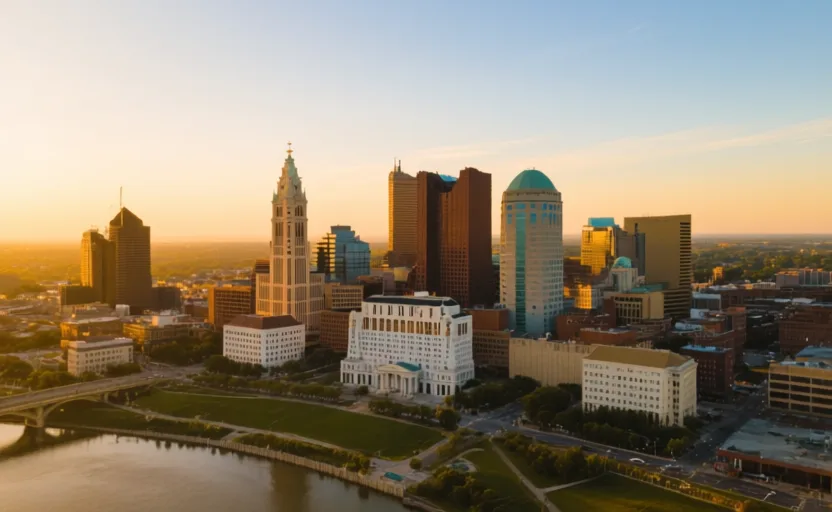 Columbus · AI city illustration · Artistic impression
City · North America
Columbus
Saved in this browser — no account needed. Sign in later and it comes with you.
Where it is
Columbus was put where the map said the middle of Ohio was. The Scioto River and the Olentangy River meet just northwest of downtown, and the city spreads across a flat plain left by the glacier that covered most of the state in the Wisconsin ice age. Across the surrounding county the ground varies by about 140 metres between its lowest and highest points, and shale and limestone are cut into small ravines along the creeks. Winters are cold and dry with light snow, since the city is too far from Lake Erie for lake-effect storms, and summers are warm and muggy. The low ground beside the rivers floods, and the worst flood on record, in 1913, struck the west-side neighbourhood of Franklinton.
The land and water around it
The Scioto and Olentangy confluenceriver
The forks lie just northwest of downtown. Indigenous villages stood here, the first settlement was placed beside them, and the decision to site the capital nearby was based on access to rivers.
The glaciated plainplain
A relatively flat landscape left by the ice sheet of the Wisconsin glaciation. Open, level ground made suburban expansion easy.
River ravinesvalley
Tributaries of Alum Creek and the Olentangy cut through shale, while those of the Scioto cut through limestone, creating small ravines that add variety to the plain.
Its history, in short
Before any town, people of the Adena, Hopewell and Fort Ancient cultures raised burial mounds here; a Mingo village stood at the river forks until colonial militia burned it in 1774. The Treaty of Greenville in 1795 opened the land to settlers, and Lucas Sullivant founded Franklinton in 1797 on the west bank of the forks. Columbus itself is a decision, not an accident. Ohio’s legislature had shuttled its capital between Chillicothe and Zanesville, and in 1812 it chose to build a new city in the state’s centre, on the east bank across from Franklinton, near the main rivers. The name honours Christopher Columbus, although no reliable record says why. The capital moved in 1816, and the National Road, the Ohio and Erie Canal and railways kept the city growing. Suburban expansion from the 1950s, and a mayor who annexed neighbouring land, made Columbus the largest city in Ohio by the early 1990s. Its economy rests on government, a large state university, insurance and technology.
Timeline
Dates are shown on a timeline rather than as changing shapes on the map. The globe draws modern boundaries only, and tinting a modern outline to stand for a historical one would state something we cannot source.
First cities & states
1000 BC to AD 1700
Mound-building cultures
The Adena, Hopewell and Fort Ancient peoples live in the Columbus area. Their burial mounds survive in parks, and clay from one mound was used for bricks in the early city.
Approximate dateWikipedia
Early modern & oceanic
1797
Franklinton
Lucas Sullivant founds a village on the west bank of the forks, naming it for Benjamin Franklin. A flood wipes it out in 1798, and it is rebuilt a little further inland.
Well attestedWikipedia
Industrial & imperial
14 February 1812
A capital planned in the forest
After the legislature compromises on a central site, the new city of Columbus is founded on dense forest on the high banks opposite Franklinton.
Well attestedWikipedia1816
State capital
Columbus becomes the capital in 1816 and is incorporated as a borough on 10 February of that year.
Well attestedWikipedia1908
The Columbus Experiment
The brothers Clarence and Charles Hoover design the world’s first water plant to filter and soften together, which drastically reduces typhoid deaths. The basic design is still used.
Well attestedWikipedia25 March 1913
The Great Flood
Floodwater devastates Franklinton, leaving more than 90 dead and thousands of west-side residents homeless. A flood wall is not completed there until 2004.
Well attestedWikipedia
Contemporary
1999
First Black mayor
Michael Coleman is elected the city’s first African American mayor and serves 16 years, the longest term of any mayor. His time sees the Arena District rise on the former penitentiary site.
Well attestedWikipedia
Places that carry meaning
Ohio Statehouse and Capitol Square1839 onward
Construction began in 1839 on a plot donated by four local landowners. The square was not part of the city’s original layout.
German Village19th century
One of four historic districts, with Italian Village, Victorian Village and the Brewery District, that the city protects outside its main register.
Franklinton1797 onward
The first settlement, now a neighbourhood on the west bank, long exposed to flooding and protected by a flood wall since 2004.
Languages here
Places are usually multilingual. This lists what is actually spoken, not one language per border.
EnglishGermanic family
The everyday language of the city.
Spoken at home by most residents, as in the rest of Ohio.
SpanishRomance family
The language of the largest Hispanic community, mainly of Mexican origin.
Mexican Americans are the biggest part of the Hispanic population, alongside a notable Puerto Rican community.
SomaliAfroasiatic family
A major community language of recent African immigration.
Immigration from Somalia has grown, along with that from Mexico, India, Nepal, Bhutan and China.
NepaliIndo-Aryan family
The language of immigrants from Nepal and Bhutan.
The city’s Asian population is diverse, and the arrival of people from Nepal and Bhutan is one reason.
Learn the language here
- 1Understand which languages are spoken hereColumbus is multilingual. Start with which languages are used, by whom, and for what — the phrase list only covers one of them.Written by Globe Quest
- 2Learn 14 phrasesCurated everyday phrases for Columbus, with audio and a written form.Written by Globe Quest
- 3Say them out loudSpeaking practice with pronunciation feedback, one phrase at a time.Globe Quest material, your own additions
- 4Come back to themSpaced review, so what you learned this week is still there next month.Written by Globe Quest
Check yourself
Why was Columbus built where it is?
The legislature chose a central site near the rivers to end the capital dispute
After the capital shuttled between Chillicothe and Zanesville, lawmakers settled on a new city in the middle of the state near major rivers rather than any existing town.
What was the Columbus Experiment of 1908?
A water plant that filtered and softened water together, cutting typhoid
The design by the Hoover brothers was the first of its kind in the world, and the same basic approach is still used.
Worth arguing about
- The city is named for Christopher Columbus, whose statue was removed from City Hall in 2021 and whose name some have asked to change. What should a place do with a name that has outgrown its reason?
- Columbus was planned as a capital in the forest and annexed its suburbs for decades. What kind of city does that process make?
What we have not established
These are open questions, listed rather than filled in. We would rather show a gap than a plausible guess.
Why was the city named Columbus?
No reliable record explains the choice. One local history says a state lawmaker and resident who admired the explorer persuaded his colleagues, but the explorer had no link to Ohio.
Sources
- Wikipedia · Columbus, OhioWikipedia · encyclopedia · checked 2026-11-24
- Wikipedia · Languages of the United StatesWikipedia · encyclopedia · checked 2026-11-24
Reviewed by Globe Quest editorial on 2026-11-24. Drafted with AI assistance and checked against the sources above before publication.