 Globe Quest
 Human Quest · LearningSign in
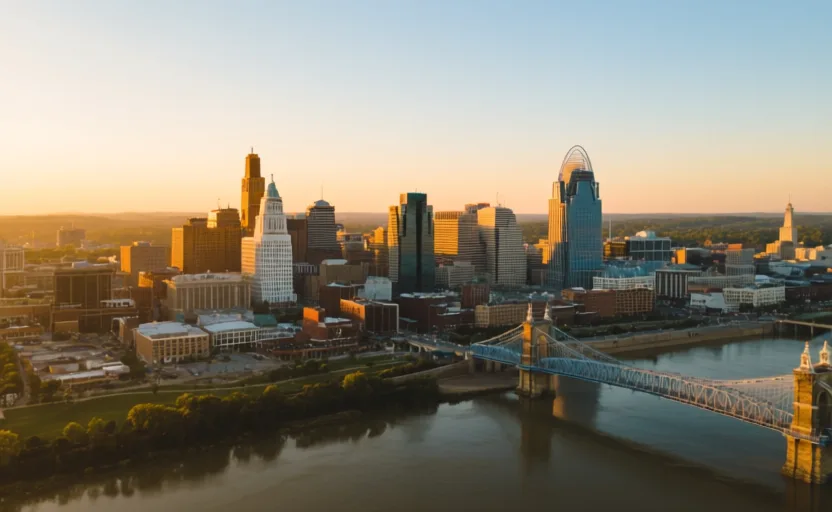 Cincinnati · AI city illustration · Artistic impression
City · North America
Cincinnati
Saved in this browser — no account needed. Sign in later and it comes with you.
Where it is
Cincinnati occupies a basin on the north bank of the Ohio River and the hills and bluffs that rise behind it, with the Licking River entering from the Kentucky side directly opposite downtown. By river it lies roughly midway between Pittsburgh and Cairo, Illinois. The city is built across a number of hills and low ridges on the edge of the Bluegrass region, and the tri-state urban area it anchors spills into Kentucky and Indiana. The climate is on the boundary between humid continental and humid subtropical, so winters are milder and the frost-free season longer than in the northern Midwest. The Ohio is both its asset and its hazard, and the 1937 flood reached about 80 feet. About 309,000 people lived in the city in 2020 and more than 2.3 million in the metropolitan area.
The land and water around it
The Ohio Riverriver
The river carried the steamboats that made the city and the floods that periodically drowned its lower streets. The flood of 1937 was among the worst in the country, and afterwards the city built protective flood walls. The pumping station at Mill Creek's mouth starts working when the gauge at the Roebling Suspension Bridge reaches 52 feet.
The hills and bluffsmountains
Cincinnati's old nickname, the City of Seven Hills, refers to the ridges that overlook the river. The flat ground between the river and the first hill is occupied by downtown, while neighbourhoods such as Mount Auburn climbed the slopes and were once reached by an inclined plane.
A climate on the borderclimate
Hot, humid summers, with highs of 90 °F or above on about 27 days a year, give way to cool winters with sharp swings between cold snaps and thaws. Because of the river valley and the heat of the built-up core, the urban centre is warmer than the airport suburbs.
Its history, in short
The first settlers landed on the north bank in late 1788, in three small settlements, Columbia, North Bend and the central one, Losantiville, whose invented name meant “town opposite the mouth of the Licking”. Fort Washington, built in 1789, held the settlers and troops of the Northwest Territory, and in January 1790 the governor renamed the town for the Society of the Cincinnati, a veterans' association. Steamboats arrived in 1811, and pork processing earned the city the nickname “Porkopolis”. Its position facing slave-state Kentucky made it a prominent stop on the Underground Railroad. By 1850 only five American cities were bigger. German-speaking immigrants built most of what is now Over-the-Rhine and created numerous cultural institutions in the city's first decades. In the 1880s the city built its own railway to Chattanooga, which it owned until 2024. Population peaked in the 1950s at about half a million and then fell for sixty years, though the 2020 census showed the first rise since 1950. Race riots in 2001 and the later redevelopment of Over-the-Rhine are the city's recent turning points.
Timeline
Dates are shown on a timeline rather than as changing shapes on the map. The globe draws modern boundaries only, and tinting a modern outline to stand for a historical one would state something we cannot source.
Post-classical world
c. 900–1600
Fort Ancient peoples
Archaeologists give the name Fort Ancient to the farming culture found across southwest Ohio, whose makers likely included the Shawnee and other peoples. They lived in large agricultural towns and hunted in winter along the Ohio.
Approximate dateWikipedia
Early modern & oceanic
1788
Three settlements on the north bank
Columbia, Losantiville and North Bend are founded in the Northwest Territory, on land from the Symmes Purchase. Israel Ludlow lays Losantiville out on a grid from a public landing on the river.
1790
Renamed Cincinnati
Governor Arthur St. Clair gives the settlement the name of the Society of the Cincinnati, which is named for the Roman citizen-farmer Cincinnatus. By then about 700 people live in the town, many of them soldiers at Fort Washington.
Industrial & imperial
1811
Steamboats on the Ohio
Steam power opens the city to faster trade with St. Louis and New Orleans downriver. The city is incorporated in 1819 and becomes a pork-processing centre.
Well attestedWikipedia1850
Sixth-largest city in the United States
With 115,435 people the city has grown nearly fourfold since 1830. It serves as a supply point for westbound pioneers and is an important stop on the Underground Railroad.
1880
The Cincinnati Southern Railway
The city completes a railway to Chattanooga, Tennessee. No other American city owned a railway across state lines, and Cincinnati kept this one until selling it in March 2024.
Well attestedWikipedia1937
The great Ohio flood
The river reaches about 80 feet, 55 feet above its normal level, and destroys many areas along the valley. Afterwards Cincinnati builds protective flood walls.
Contemporary
April 2001
Over-the-Rhine unrest
Riots follow the fatal police shooting of an unarmed young Black man, Timothy Thomas. A later settlement among the city, the police union, the American Civil Liberties Union and Black community organisations introduces a community policing strategy that has been used as a model elsewhere.
Well attestedWikipedia
Places that carry meaning
Over-the-Rhine1865 to the 1880s
A large, mostly intact historic district of ornate brick buildings put up by German immigrants. The neighbourhood has been heavily redeveloped in the twenty-first century, with a focus on small businesses.
Cincinnati Union Terminal1930s
The railway station built during the downtown rebuilding of the 1920s and 1930s, now the home of the Cincinnati Museum Center. It belongs to the same wave of civic construction as Carew Tower, the tallest building in the city when it opened.
National Underground Railroad Freedom Center2004
Opened on the riverfront to commemorate the city's role as a crossing point for people escaping slavery from Kentucky, on the border between a free state and a slave state.
Languages here
Places are usually multilingual. This lists what is actually spoken, not one language per border.
EnglishGermanic family
The everyday language, in a distinctive local accent.
Residents speak a General American dialect, but southwest Ohio shares some vowel patterns with the English of northern New Jersey, unlike the rest of the Midwest.
GermanGermanic family
The language of the largest historic immigrant community.
German speakers built Over-the-Rhine, founded a German Protestant hospital in 1888, and left the dishes goetta and mock turtle soup. Anti-German feeling in World War I led to rumours about German-American businesses and the internment of the Cincinnati Symphony's conductor, and the language declined across the country after the war.
SpanishRomance family
The largest language of recent migration.
About 4 per cent of the city's residents identified as Hispanic or Latino in 2020. Spanish is the second most spoken language in the country as a whole.
ShawneeAlgonquian family
A language of the region's earlier peoples.
The Shawnee were among the peoples likely responsible for the Fort Ancient culture. They were driven out of Ohio from the 1640s by the Haudenosaunee and could return after the Treaty of Grande Paix in 1701.
Learn the language here
- 1Understand which languages are spoken hereCincinnati is multilingual. Start with which languages are used, by whom, and for what — the phrase list only covers one of them.Written by Globe Quest
- 2Learn 14 phrasesCurated everyday phrases for Cincinnati, with audio and a written form.Written by Globe Quest
- 3Say them out loudSpeaking practice with pronunciation feedback, one phrase at a time.Globe Quest material, your own additions
- 4Come back to themSpaced review, so what you learned this week is still there next month.Written by Globe Quest
Check yourself
What was Cincinnati's first name, and what did it mean?
Losantiville, meaning the town opposite the mouth of the Licking
The surveyor John Filson built the name from words in several languages, and the governor replaced it in 1790 with a name honouring the Society of the Cincinnati.
What was unusual about the Cincinnati Southern Railway?
It was owned by the city and ran across state lines
The city built it to Chattanooga in 1880 and held it until the 2024 sale, the last such line in the country.
Worth arguing about
- Cincinnati faced slave-state Kentucky across a river, a boundary that was crossed by people seeking freedom and by trade. What does that kind of border do to a city?
- German speakers once shaped the city's cultural institutions, then faced hostility in wartime. What does a place lose when a language is pushed out of public life?
What we have not established
These are open questions, listed rather than filled in. We would rather show a gap than a plausible guess.
What was Cincinnati's peak population?
The 1950 figure is given as both 503,998 and 509,998 in different passages, and neither the census year nor the exact peak could be reconciled. Either way, it was just over half a million.
Sources
- Wikipedia · CincinnatiWikipedia · encyclopedia · checked 2026-11-24
- Wikipedia · History of CincinnatiWikipedia · encyclopedia · checked 2026-11-24
- Wikipedia · United StatesWikipedia · encyclopedia · checked 2026-11-24
Reviewed by Globe Quest editorial on 2026-11-24. Drafted with AI assistance and checked against the sources above before publication.