 Globe Quest
 Human Quest · LearningSign in
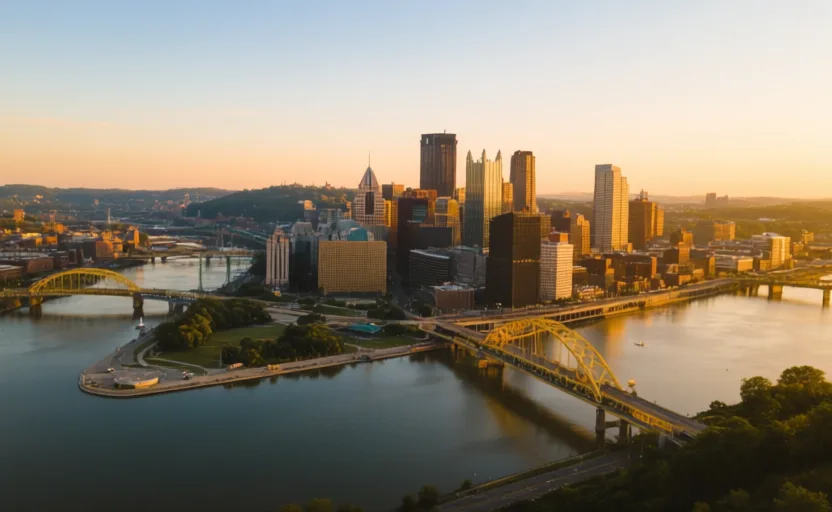 Pittsburgh · AI city illustration · Artistic impression
City · North America
Pittsburgh
Saved in this browser — no account needed. Sign in later and it comes with you.
Where it is
Two rivers, the Allegheny from the northeast and the Monongahela from the southeast, run into each other in south-western Pennsylvania and become the Ohio. The downtown triangle fills the wedge between them, and the rest of the city climbs the steep, cut-up hills of the Allegheny Plateau on every side. The terrain explains the bridges (the city counts 446), the way neighbourhoods are divided among separate hillsides and valleys, and why the rivers mattered so much: they carried goods out of the Appalachian interior long before roads did. Winters are cold and snowy, summers warm, and the climate shifts with the temperature threshold used to classify it.
The land and water around it
The Point and the Ohio headwatersriver
The Allegheny and Monongahela meet at the tip of the downtown triangle and form the Ohio, which leads on to the Mississippi. That single junction is why the French and British both wanted the site, and why Meriwether Lewis bought a keelboat here in 1803 for the Missouri expedition.
The Allegheny Plateauplateau
The city is cut into a dissected plateau, so ground rises sharply from the river banks. Ninety neighbourhoods sit on separate hillsides and in hollows, and the same slopes are where densely built immigrant districts such as Polish Hill and the South Side grew up.
Appalachian coal countrymountains
The mineral-rich Allegheny Mountains behind the city supplied the coal and iron that made it a manufacturing centre by the 1850s, and it is counted as the largest city in the Appalachian region.
Its history, in short
The forks of the Ohio were a gateway before they were a city. Seneca, Lenape, Shawnee and others lived and hunted in the valley, and in the 1750s France and Britain fought over the junction because whoever held it controlled a water route into the continent. The British took it in 1758 and named the fort and settlement for William Pitt. Coal and river transport did the rest: iron, brass, tin and glass by 1815, steel production from 1875, and by 1911 roughly half the nation’s steel. Workers came from Wales, Ireland and Germany, then from southern and eastern Europe, and Black migrants arrived from the South in the Great Migration. Ethnic neighbourhoods grew on the densely built hillsides and in the valleys. The mills also produced the smoke and river pollution that made the place notorious, and after the Second World War a clean-air and redevelopment programme began to change it. The programme also displaced thousands of people, many of them Black residents of the Lower Hill. Steel declined late in the twentieth century, and the economy turned towards health care, universities and technology.
Timeline
Dates are shown on a timeline rather than as changing shapes on the map. The globe draws modern boundaries only, and tinting a modern outline to stand for a historical one would state something we cannot source.
Early human world
Perhaps 19,000 years ago
First people in the valley
Evidence from the Meadowcroft Rockshelter, west of the city, suggests that people were living in this region as far back as 19,000 years ago, though the date is tentative.
Approximate dateWikipedia
Early modern & oceanic
1749–1758
France and Britain at the forks
French soldiers arrive to link Canada with Louisiana by river, and Fort Duquesne is built. The French and Indian War begins around the junction, and General John Forbes takes it in 1758 and starts Fort Pitt.
Well attestedWikipedia1763
Siege of Fort Pitt
During Pontiac’s War a confederation of Native nations besieges the fort. The siege is lifted after Colonel Henry Bouquet defeats part of the force at Bushy Run.
Well attestedWikipedia
Industrial & imperial
1816
Incorporated as a city
The borough created in 1794 becomes a city. The War of 1812 had cut off British goods, and by 1815 local workshops were producing iron, brass, tin and glass.
Well attestedWikipedia1845
The Great Fire
More than a thousand buildings burn. The rebuilding draws on Irish labour, as people fleeing the Famine arrive, and the coal and iron trades keep pulling in German and other European workers.
Well attestedWikipedia1901
U.S. Steel is formed
Carnegie Steel and other companies are merged into U.S. Steel. By 1910 the city accounts for between a third and a half of national steel output.
Well attestedWikipediaMarch 1936
The worst flood
Heavy rain and melting snow push the rivers to a peak of 46 feet, and at least 62 people die. It is the city’s worst flood on record.
Well attestedWikipedia
Contemporary
1950s to 1961
Renaissance and its costs
A clean-air and civic revitalisation project cleans up the air and rivers. Redevelopment also clears the Lower Hill District: 1,551 mostly Black residents and 413 businesses are displaced for the Civic Arena, which opens in 1961.
Well attestedWikipedia
Places that carry meaning
Point State Park1750s onward
The park sits at the meeting of the three rivers, the ground the French and British fought to control in the 1750s and where Fort Pitt was built.
The Lower Hill District20th century
A neighbourhood whose mostly Black population was cleared in the 1950s to make way for the Civic Arena. The wider neighbourhood now holds an estimated 12,000 people, and some residents argue the clearances were meant to disperse Black and low-income communities.
Oakland and the Cathedral of LearningEarly 20th century
Oakland became the city’s educational and cultural centre, with three universities, museums, a library and a music hall. The University of Pittsburgh’s 42-storey Cathedral of Learning rises over it.
Languages here
Places are usually multilingual. This lists what is actually spoken, not one language per border.
EnglishGermanic family
The everyday language of the city, with a local dialect.
Pittsburghese, whose speakers are sometimes called Yinzers after the local word “yinz”, took its vowels, vocabulary and rhythm from several streams: Scots-Irish, German and Eastern European newcomers, and African Americans.
The languages of the mill neighbourhoods
Brought by the waves of arrivals after 1870.
Immigrants from Italy, the Balkans and the Austro-Hungarian and Russian empires took jobs in mills, mines and construction and brought their languages with them. The area still has one of the largest Slavic populations in the country, along with large Italian, Croatian and Ukrainian communities.
Learn the language here
- 1Understand which languages are spoken herePittsburgh is multilingual. Start with which languages are used, by whom, and for what — the phrase list only covers one of them.Written by Globe Quest
- 2Learn 14 phrasesCurated everyday phrases for Pittsburgh, with audio and a written form.Written by Globe Quest
- 3Say them out loudSpeaking practice with pronunciation feedback, one phrase at a time.Globe Quest material, your own additions
- 4Come back to themSpaced review, so what you learned this week is still there next month.Written by Globe Quest
Check yourself
Who is Pittsburgh named after?
William Pitt, the British statesman, named by General John Forbes in 1758
Forbes, a Scotsman, named the settlement for William Pitt after taking the forks from the French in 1758, and the final h was dropped federally between 1891 and 1911 before being restored.
What forms where the Allegheny and Monongahela meet?
The Ohio River
The Ohio begins at that junction and runs on toward the Mississippi, which made the forks a strategic gateway for French, British and then American traders and armies.
Worth arguing about
- The post-war clean-air programme made the city healthier and also cleared Black neighbourhoods such as the Lower Hill. How should a city weigh a public benefit against who pays for it?
- Steel declined but the hospitals and universities that industrial fortunes helped build stayed. Is that resilience planned or lucky?
Sources
- Wikipedia · PittsburghWikipedia · encyclopedia · checked 2026-11-24
- Wikipedia · History of PittsburghWikipedia · encyclopedia · checked 2026-11-24
Reviewed by Globe Quest editorial on 2026-11-24. Drafted with AI assistance and checked against the sources above before publication.