 Globe Quest
 Human Quest · LearningSign in
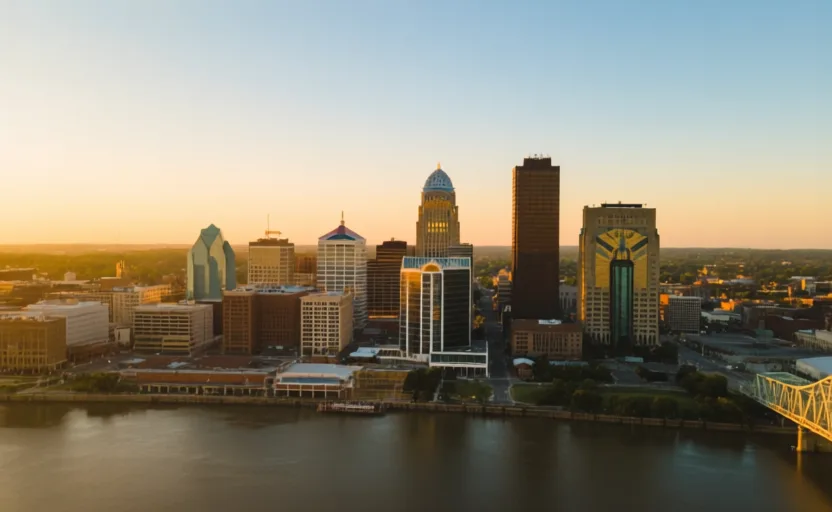 Louisville · AI city illustration · Artistic impression
City · North America
Louisville
Saved in this browser — no account needed. Sign in later and it comes with you.
Where it is
The only rapids on the long run of the Ohio River sit at Louisville, where the water drops over limestone ledges known as the Falls. Boats had to be unloaded or hauled around them, and a town grew at that forced stop. The city lies on the Kentucky side of the river facing Indiana, at the edge of the Bluegrass region, on a wide, flat floodplain ringed by hills. Much of that ground was swamp and had to be drained, and in the 1840s the creeks were rerouted or put in canals to stop floods and disease. South of the city the land rises into the wooded hills called the Knobs. Summers are hot and humid and winters mix rain, sleet and snow.
The land and water around it
The Falls of the Ohioriver
A single series of rapids in the middle of the Ohio’s long course. It forced travellers to stop and portage, and it is the reason a trading town, and later a canal and railway junction, was built here.
The floodplainplain
Most of the city sits on a very wide, flat floodplain that was swampland before it was drained. Areas generally east of Interstate 65 are above the flood plain, in gently rolling hills.
The Knobsmountains
A scenic, largely undeveloped hill region in the south of Jefferson County, home to Jefferson Memorial Forest.
Its history, in short
Before Europeans, the area was a hunting ground, because wars in the seventeenth century had emptied it of permanent villages. The first American settlers arrived in 1778, led by George Rogers Clark, who settled them on Corn Island in the river and then on the mainland. The town was chartered in 1780 and named for Louis XVI of France, whose troops were helping the Americans against Britain. Its early growth rested on the Falls: cargo and passengers had to be moved around them, so Louisville became a major river port and later a rail hub. Enslaved African Americans worked in the shipping trades, and the city was also a crossing point towards the free state of Indiana. In the Civil War it was a Union base, though after the war returning Confederate veterans took political control. The twentieth century brought a residential segregation ordinance that the Supreme Court struck down in 1917, a huge army camp in the First World War, mid-century decline, and, from the 1990s, a revival downtown. In 2003 the city and Jefferson County merged.
Timeline
Dates are shown on a timeline rather than as changing shapes on the map. The globe draws modern boundaries only, and tinting a modern outline to stand for a historical one would state something we cannot source.
Early modern & oceanic
about 1650
The valley is depopulated
Native occupation of the area had been continuous from about 1000 BCE. The Beaver Wars of the seventeenth century then emptied much of the Ohio River region, and the Iroquois kept it as a hunting ground by conquest.
Approximate dateWikipedia1778
Settlement on Corn Island
George Rogers Clark leads soldiers and about 80 civilians to the Falls and settles them on an island in the river. Clark is recognised as the founder of Louisville.
1780
Town charter
Virginia’s assembly approves the charter on 1 May. The town is named for King Louis XVI, whose soldiers were aiding the Americans.
Industrial & imperial
1828
Incorporated city
By this date the population has reached 7,000, driven by the work of unloading and reloading river boats around the Falls.
Well attestedWikipedia6 August 1855
Bloody Monday
On election day Protestant mobs attack German and Irish Catholic neighbourhoods. Twenty-two people die and property damage is widespread.
Well attestedWikipedia17 May 1875
The first Kentucky Derby
The race is run at the Louisville Jockey Club’s track, which later took the name Churchill Downs.
Well attestedWikipedia1917
Buchanan v. Warley
The Supreme Court strikes down Louisville’s 1914 residential segregation ordinance, holding that it breached the Fourteenth Amendment’s due process protection. The case was a deliberate test brought by the local NAACP. The same year the city is chosen for Camp Zachary Taylor, one of the country’s largest First World War training camps.
Well attestedWikipedia
Contemporary
2003
City and county merge
Louisville and Jefferson County share the same boundaries under a consolidated government. The merger raised the recorded population from 256,231 in 2000 to 597,337 in 2010.
Well attestedWikipedia
Places that carry meaning
Old LouisvilleLate 19th century
The largest historic preservation district made up only of Victorian houses and buildings in the United States.
Churchill Downs1875 onward
The racetrack that hosts the Kentucky Derby on the first Saturday of May, preceded by a two-week festival that opens with the Thunder Over Louisville fireworks.
Little AfricaLate 19th–mid 20th century
A neighbourhood where freed people settled after the Civil War. By the 1920s it was thriving; it went into decline across the 1940s and 1950s.
Languages here
Places are usually multilingual. This lists what is actually spoken, not one language per border.
EnglishGermanic family
The everyday language of the city.
The United States has no statutory national language, though English is by far the most spoken. Louisville is described as an Upper South city shaped by both Southern and Midwestern culture.
GermanGermanic family
The language of a major nineteenth-century immigrant community.
German and Irish Catholics had distinct neighbourhoods by the 1850s, which is why they were targeted in the 1855 riot. Present-day language use among their descendants is not recorded here.
Learn the language here
- 1Understand which languages are spoken hereLouisville is multilingual. Start with which languages are used, by whom, and for what — the phrase list only covers one of them.Written by Globe Quest
- 2Learn 14 phrasesCurated everyday phrases for Louisville, with audio and a written form.Written by Globe Quest
- 3Say them out loudSpeaking practice with pronunciation feedback, one phrase at a time.Globe Quest material, your own additions
- 4Come back to themSpaced review, so what you learned this week is still there next month.Written by Globe Quest
Check yourself
Why is the city called Louisville?
After Louis XVI of France, whose soldiers aided the Americans
Settlers named the town for Louis XVI during the Revolutionary War. French troops were then fighting alongside the Americans against Britain.
Why did a city grow at this spot on the Ohio?
Rapids called the Falls forced boats to stop and transfer cargo
The Falls are the only rapids on a long stretch of the Ohio. Unloading, hauling and reloading cargo created the city’s first economy and shaped its canal and railway links.
Worth arguing about
- Louisville is called one of the northernmost Southern cities and one of the southernmost Northern ones. Does a city’s regional identity matter to its politics and its culture?
- The city tested a residential segregation law in the Supreme Court in 1917 and won. Why do patterns of segregation survive after the law is struck down?
Sources
- Wikipedia · Louisville, KentuckyWikipedia · encyclopedia · checked 2026-11-24
- Wikipedia · History of Louisville, KentuckyWikipedia · encyclopedia · checked 2026-11-24
- Wikipedia · United StatesWikipedia · encyclopedia · checked 2026-11-24
Reviewed by Globe Quest editorial on 2026-11-24. Drafted with AI assistance and checked against the sources above before publication.