 Globe Quest
 Human Quest · LearningSign in
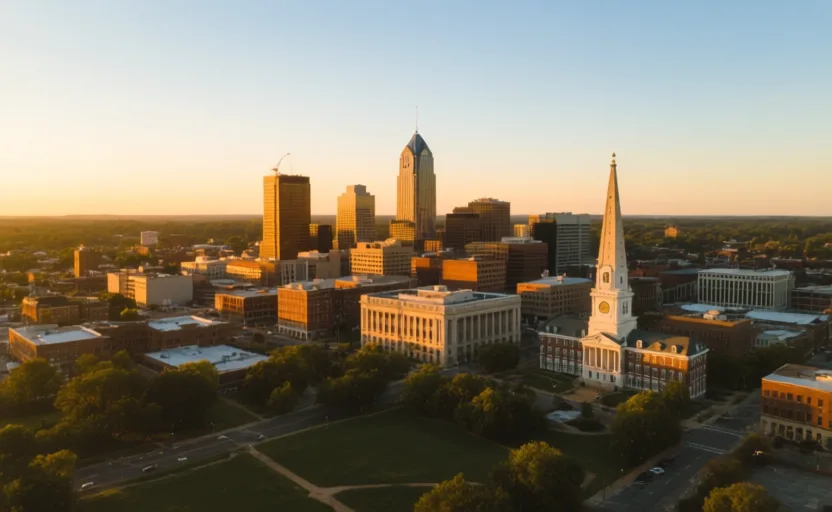 Lexington · AI city illustration · Artistic impression
City · North America
Lexington
Saved in this browser — no account needed. Sign in later and it comes with you.
Where it is
Lexington lies in Kentucky's Bluegrass region, a country of horse farms that gives the city its identity and its nickname, Horse Capital of the World. Since 1974 the city and Fayette County have been a single government, and the 285 square miles inside the boundary are divided between an urban core and a protected rural ring. A small stream, Town Branch, once ran through the centre and now flows under Vine Street. The climate is humid subtropical on its northern margin: four distinct seasons, hot humid summers, cold winters with 14.5 inches of snow in an average year, and a national foundation lists it as a high-allergy area.
The land and water around it
The Bluegrass farmlandplain
The region around Lexington is the Bluegrass, where hundreds of horse farms occupy land that urban planners have deliberately kept open. The farms support the Kentucky Horse Park, Keeneland and the Red Mile race courses, and the sale of thoroughbreds.
Town Branch and McConnell Springsriver
The stream where the founders camped, known at first as the Middle Fork of Elkhorn Creek, was rerouted under Vine Street. McConnell Springs marks the spot where the frontiersmen named the settlement in 1775.
A climate on the northern edgeclimate
The city sits at the northern fringe of the humid subtropical zone. The annual mean is 56.3 °F, with temperatures that have ranged from −21 °F in 1963 to 108 °F in 1936. Annual precipitation is about 50 inches.
Its history, in short
In June 1775 William McConnell and a band of frontiersmen pitched camp beside a spring on what is now Town Branch. News arrived of the first armed clash between Massachusetts militia and British troops, at Lexington on 19 April, and the party named their camp for it, the first of many American places to take that name. In 1780 forty-five settlers signed the Lexington Compact, dividing half-acre house lots inside a fort and five-acre fields outside it. A caravan of about 600 Virginians, called the Travelling Church, arrived in 1781, and Virginia chartered the town in 1782. The First African Baptist Church was founded by Peter Durrett, a preacher held in slavery, about 1790. In the early 19th century Lexington was a rising city beyond the Appalachians; the planter John Wesley Hunt was the first millionaire in the country beyond the Alleghenies, and Henry Clay, a lawyer with marriage ties to wealthy Kentucky families, helped lead the push for war with Britain in 1812. Racial violence marked 1917 and 1920. Since 1958 the city has used a growth boundary to keep farmland intact.
Timeline
Dates are shown on a timeline rather than as changing shapes on the map. The globe draws modern boundaries only, and tinting a modern outline to stand for a historical one would state something we cannot source.
Early modern & oceanic
June 1775
Named for a battle
Frontiersmen camped at McConnell Springs learn of the fighting at Lexington, Massachusetts, and name their site after it, 17 years before Kentucky becomes a state.
Well attestedWikipedia25 January 1780
The Lexington Compact
Forty-five settlers sign articles of agreement dividing lots inside the fort and larger outlots outside it. The settlement is also called Fort Lexington.
Well attestedWikipedia6 May 1782
Chartered by Virginia
The Virginia General Assembly charters the town, a year after the Travelling Church of about 600 pioneers reaches the area.
Well attestedWikipediac. 1790
First African Baptist Church
Peter Durrett, a Baptist preacher held in slavery who had helped guide the Travelling Church, founds what is now the state's oldest Black Baptist congregation and the third oldest in the United States.
Approximate dateWikipedia
Industrial & imperial
9 February 1920
The Lockett trial
A mob gathers outside the courthouse during the trial of Will Lockett. The National Guard fires, killing six and wounding 50, and about 1,200 federal troops from Camp Zachary Taylor arrive. Martial law lasts two weeks.
Well attestedWikipedia
Contemporary
1958
A growth boundary
Lexington enacts what is described as the first urban growth boundary in the nation, limiting development to an urban service area and requiring a minimum of 40 acres in the rural ring.
Well attestedWikipedia1974
City and county merge
Lexington becomes coterminous with Fayette County, a consolidated city with a nonpartisan mayor and council.
Well attestedWikipedia
Places that carry meaning
McConnell Springs1775
The site where William McConnell's party camped and the settlement took its name, now a preserved spring within the city.
Gratz Park Historic Districthistoric district
A historic district around Transylvania University, where a patriotic concert is staged on the Morrison Hall steps on the eve of Independence Day.
The former Woolworth's building1960s
Added to the National Register of Historic Places because of the civil rights sit-ins that demanded integrated lunch service. The owner demolished it in 2004, and the site was paved as a parking lot.
Languages here
Places are usually multilingual. This lists what is actually spoken, not one language per border.
EnglishGermanic family
The native and most common language, in its Southern American form.
Southern American English is the native dialect of the city and region, the language of most residents.
SpanishRomance family
The largest language other than English.
Hispanic or Latino residents were 7.4 percent of the city in 2020, and Spanish is spoken by more residents than any other language besides English.
SwahiliBantu family
The second-largest language other than English.
Swahili is the language spoken by the second-largest non-English group in the city, followed by Arabic and Nepali. Kinyarwanda, Mandarin, Japanese, French, Korean and Portuguese are also common.
Learn the language here
- 1Understand which languages are spoken hereLexington is multilingual. Start with which languages are used, by whom, and for what — the phrase list only covers one of them.Written by Globe Quest
- 2Learn 12 phrasesCurated everyday phrases for Lexington, with audio and a written form.Written by Globe Quest
- 3Say them out loudSpeaking practice with pronunciation feedback, one phrase at a time.Globe Quest material, your own additions
- 4Come back to themSpaced review, so what you learned this week is still there next month.Written by Globe Quest
Check yourself
Why is the city named Lexington?
After the Massachusetts town where fighting began in April 1775
The frontiersmen at McConnell Springs heard of the first clash between militia and British troops at Lexington, Massachusetts, and named their camp for it.
What did Lexington adopt in 1958 to keep the farms around it?
An urban growth boundary
Development was restricted to an urban service area, with a 40-acre minimum in the rural ring, which is how the Bluegrass horse farms still surround the city.
Worth arguing about
- Lexington has had an urban growth boundary since 1958, and expanding it in 1996 split the community. Who gets to decide when a protected landscape should give way to housing?
- About 196 languages are spoken in the city, and an estimated 23 percent of residents speak something other than English at home. How should a city that built its identity on horse farms and old families describe itself now?
What we have not established
These are open questions, listed rather than filled in. We would rather show a gap than a plausible guess.
How many Lexington residents speak a language other than English at home?
The figure of about 23 percent is a local estimate based on enrolment of English language learners in the public schools, not a census count, so it may over- or under-state the true share.
Sources
- Wikipedia · Lexington, KentuckyWikipedia · encyclopedia · checked 2026-11-24
Reviewed by Globe Quest editorial on 2026-11-24. Drafted with AI assistance and checked against the sources above before publication.