 Globe Quest
 Human Quest · LearningSign in
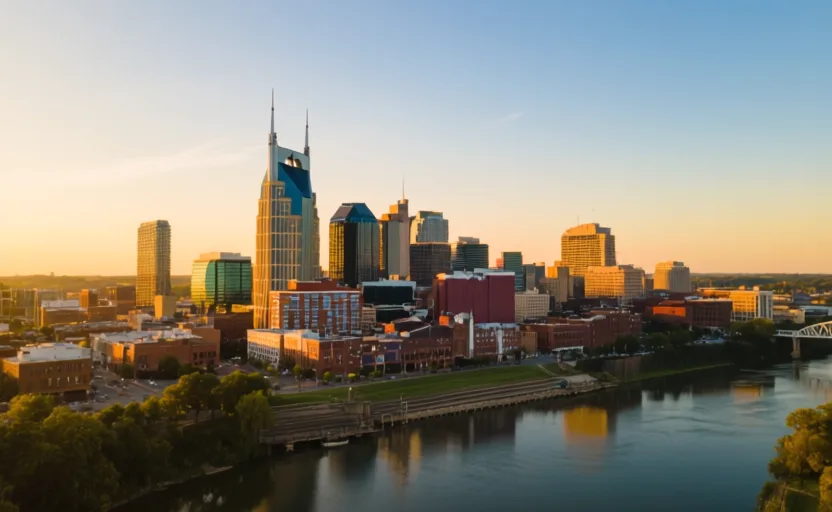 Nashville · AI city illustration · Artistic impression
City · North America
Nashville
Saved in this browser — no account needed. Sign in later and it comes with you.
Where it is
The Cumberland River bends through the northwest corner of the Nashville Basin, a shallow bowl of limestone country in Middle Tennessee, and the city is laid out across its banks. Ground here is hilly rather than flat: the river sits about 117 metres above sea level, the highest point inside the city limits is roughly 354 metres, and isolated hills, including the one under the state capitol, break up the skyline. The Highland Rim, a rougher plateau, begins at the basin’s edge. Summers are hot and humid, winters cool with little snow, and unusually for a city of its size, more than half the ground is under tree canopy.
The land and water around it
The Cumberland Riverriver
A tributary of the Ohio, navigable enough that Nashville began as a port. Floods along it and its tributaries inundated much of the city in May 2010.
The Nashville Basin and Highland Rimplateau
The city sits in a lowland bowl surrounded by a higher, rougher rim, which makes the terrain hilly even though it is a basin. Cedar glades on thin soils, such as those near Lebanon, mark the limestone below.
The urban forestforest
About 56 percent of the ground inside the city limits is under tree canopy, the highest share of any American city, a result of hills and low-density settlement as much as of design.
Its history, in short
Native peoples of the Middle Cumberland Mississippian culture built mounds, villages and stone-box cemeteries here, and then the archaeological record empties between about 1475 and 1500. French fur traders returned in the 1700s to a salt lick they called French Lick, but left. The city proper begins in 1779, when a party led by James Robertson and John Donelson built Fort Nashborough on the river; North Carolina chartered it in 1784 and named it for Francis Nash. A river port, then a railway junction, it became Tennessee’s capital in 1843. In 1862 it was the first Confederate state capital to fall to Union troops, and the Union army held it until the war ended; a Confederate army was beaten outside the city in December 1864. After the war it grew as a trading centre and as a base for Black higher education, including Fisk University. Its modern identity as Music City dates from the 1940s and 1950s, when radio and recording studios gathered around the Grand Ole Opry. In 1963 the city and Davidson County merged into one government.
Timeline
Dates are shown on a timeline rather than as changing shapes on the map. The globe draws modern boundaries only, and tinting a modern outline to stand for a historical one would state something we cannot source.
Post-classical world
c. 1300
Mississippian centre on the Cumberland
The area is a core of Mississippian culture, with platform mounds and villages. Evidence of this culture disappears from the area by about 1475 to 1500, possibly after drought, disease and warfare.
Approximate dateWikipedia
Early modern & oceanic
1714
French Lick
French traders under Charles Charleville set up a trading post at a salt and sulphur spring on the river. The settlement is largely abandoned by the 1740s.
1779
Fort Nashborough
Settlers led by James Robertson and John Donelson, organised by Judge Richard Henderson, build a fort on the site. It is chartered by North Carolina in 1784 and named for Francis Nash.
Well attestedWikipedia
Industrial & imperial
1862
First Confederate capital to fall
After Fort Donelson falls, Nashville is evacuated and taken by Union troops under Don Carlos Buell. Refugees, escaped slaves and Unionists flood in.
Well attestedWikipedia1872
Fisk University
The former Fisk Free Colored School, built on the grounds of a Union fort, is renamed Fisk University and becomes a leading institution of African-American higher education. Jefferson Street grows as the Black business district.
Well attestedWikipedia
Contemporary
1950
Music City
The radio announcer David Cobb ad libs on air that the sounds on WSM are coming from Music City, U.S.A., coining a nickname that now serves as the official tourism brand.
Well attestedWikipedia1963
City and county consolidate
After a failed referendum in 1958 and the annexation of about 42 square miles of suburbs, voters approve a new charter. Nashville and Davidson County are governed by one mayor and council from 1963.
May 2010
A thousand-year flood
Rivers and creeks overrun parts of the city, damaging the Grand Ole Opry House and other landmarks, killing eleven people and causing over $2 billion in damage.
Well attestedWikipedia
Places that carry meaning
Jefferson Street1870s to 1960s
The historic centre of Black Nashville, a corridor of businesses and a stop for jazz and blues players, until the construction of Interstate 40 in the late 1960s split the neighbourhood.
The Parthenon1897
A full-scale replica of the Athenian temple, built for the Tennessee Centennial Exposition and kept as the centrepiece of Centennial Park, which gave the city its nickname “Athens of the South”.
Music Row and the Grand Ole Opry1940s onward
The district where record labels cluster, and the longest-running live radio show in the world. The recording industry arrived in the late 1940s to capture Opry performers, and the city has been the second-largest music production centre in the United States since the 1960s.
Languages here
Places are usually multilingual. This lists what is actually spoken, not one language per border.
EnglishGermanic family
The dominant language of daily life and government.
In January 2009 Nashville’s voters rejected a charter amendment that would have made English the city’s official language.
SpanishRomance family
The language of the city’s growing Latino community.
Guatemalans form a significant part of that community. When Guatemala announced a consulate in 2023, it estimated some 72,000 of its nationals lived in and around Nashville.
Learn the language here
- 1Understand which languages are spoken hereNashville is multilingual. Start with which languages are used, by whom, and for what — the phrase list only covers one of them.Written by Globe Quest
- 2Learn 11 phrasesCurated everyday phrases for Nashville, with audio and a written form.Written by Globe Quest
- 3Say them out loudSpeaking practice with pronunciation feedback, one phrase at a time.Globe Quest material, your own additions
- 4Come back to themSpaced review, so what you learned this week is still there next month.Written by Globe Quest
Check yourself
Who first called Nashville “Music City, U.S.A.”?
A radio announcer on WSM in 1950
David Cobb ad libbed the phrase on air, recording studios had already been arriving to record Opry performers, and the name stuck.
What distinction did Nashville have in the American Civil War?
It was the first Confederate state capital taken by Union forces
Union troops took the city in February 1862, early in the war, which turned its depots and river port into a Union base for the rest of the conflict.
Worth arguing about
- A route built through Jefferson Street in the 1960s split a Black business and music district. Who should answer for damage like that, and how can it be repaired?
- Nashville merged city and county government in 1963 after an earlier vote failed. What does consolidation change about who a city serves?
Sources
- Wikipedia · Nashville, TennesseeWikipedia · encyclopedia · checked 2026-11-24
- Wikipedia · History of Nashville, TennesseeWikipedia · encyclopedia · checked 2026-11-24
- Wikipedia · Languages of the United StatesWikipedia · encyclopedia · checked 2026-11-24
Reviewed by Globe Quest editorial on 2026-11-24. Drafted with AI assistance and checked against the sources above before publication.