 Globe Quest
 Human Quest · LearningSign in
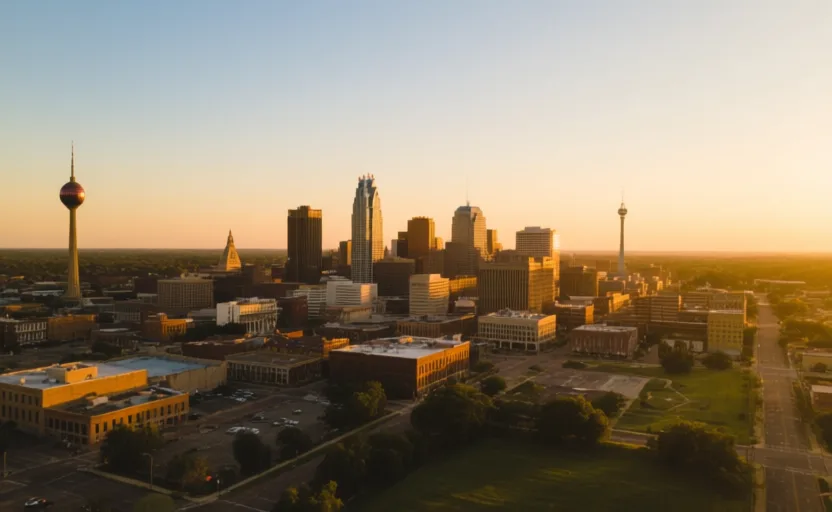 Memphis · AI city illustration · Artistic impression
City · North America
Memphis
Saved in this browser — no account needed. Sign in later and it comes with you.
Where it is
A high bluff above the Mississippi is what made a city here possible. The river elsewhere along this reach floods wide across the delta lowlands, but the Chickasaw Bluffs stand clear of it, and Memphis has never been regularly inundated, unlike the Arkansas side opposite, where backwater from the Mississippi has repeatedly flooded the St. Francis lowlands and limited growth. Downtown rises directly from the bluff, and the city spreads east across southwest Tennessee towards Mississippi and Arkansas. Under it lies a deep, soft artesian aquifer that supplies the city’s drinking water. The climate is humid subtropical, with hot and very humid summers and winters that swing between the Great Plains and the Gulf.
The land and water around it
The Chickasaw Bluffscoast
A string of high bluffs on the east bank of the Mississippi. The fourth bluff holds Memphis and gave the site natural protection from flooding, which is why it was fought over in the colonial era and why it outgrew its rivals, Randolph upriver and Hopefield across the water.
The river carried steamboat trade and now barge traffic past the city’s port, the fifth-busiest inland water port in the country. Memphis is also a crossing point for two interstates and several freight railroads.
The Memphis Sand aquiferclimate
A deep artesian aquifer beneath Shelby County, with soft water and a very large estimated volume. A planned crude-oil pipeline across it, running through the historically Black Boxtown neighbourhood, was cancelled after public and legal opposition over contamination risk.
Its history, in short
People of the Mississippian culture built mounds along this bluff, and the Chickasaw held the country when Europeans arrived. Spanish and French explorers passed through from the 1540s, and the French built forts in the 1680s and 1739, but the area stayed unsettled by Europeans for most of the eighteenth century. The Chickasaw ceded West Tennessee to the United States in 1818, and in 1819 three investors, John Overton, James Winchester and Andrew Jackson, laid out Memphis, naming it for the ancient Egyptian city on the Nile. Steamboats, railways and plantations around it made it a great cotton market, built on the labour of enslaved African Americans, and later the world’s largest spot-cotton and hardwood-lumber market. Yellow fever killed over 5,000 people in 1878 and drove the city to bankruptcy. Racial violence ran through its history, from the 1866 riots to disenfranchisement in the 1890s, and in 1968 the city’s sanitation strike drew Martin Luther King Jr. to Memphis, where he was assassinated. Today it is a freight hub built around FedEx’s air cargo operation.
Timeline
Dates are shown on a timeline rather than as changing shapes on the map. The globe draws modern boundaries only, and tinting a modern outline to stand for a historical one would state something we cannot source.
Post-classical world
800–1600 CE
Mississippian communities
Mound-building Mississippian peoples, including the local Tipton phase, live along this stretch of the river until the time of de Soto. The Chickasaw later hold the land.
Approximate dateWikipedia
Early modern & oceanic
1540s
De Soto’s expedition
The Spanish conquistador Hernando de Soto is believed to have been the first European in the Memphis area, in 1541.
Industrial & imperial
22 May 1819
Founded by Overton, Winchester and Jackson
The founders lay out a grid with four public squares, less than five months after the Chickasaw cession was ratified. It is incorporated as a city in 1826.
6 June 1862
Union capture
Union forces take the city in the First Battle of Memphis and hold it for the rest of the war. It becomes a supply base and a centre of illicit cotton trading.
Well attestedWikipediaMay 1866
The Memphis Riots
Over three days, white mobs of police, firemen and others attack the Black community, killing 46 Black residents and destroying nearly 100 houses.
Well attestedWikipedia1878
Yellow fever
More than 5,000 die in a city of 40,000, and 20,000 flee within days of the outbreak being declared. The city goes bankrupt and gives up its charter until 1893.
1910s–1950
The Crump era
E. H. “Boss” Crump controls local politics for about forty years. From 1900 to 1950 the population grows from 102,350 to about 396,000 on the strength of cotton, lumber and mules.
Approximate dateWikipedia
Places that carry meaning
Beale Street19th–20th century
The street at the centre of the development of Memphis blues, still lined with bars and clubs with live music.
The Lorraine Motel and the National Civil Rights Museum1968 to present
The motel where Martin Luther King Jr. was assassinated. A foundation acquired it in 1982 and converted it into the National Civil Rights Museum.
Mason Temple20th century
The auditorium named for Charles Harrison Mason, founder of the Church of God in Christ, whose international headquarters is in Memphis and which is the biggest Pentecostal body in the country. King gave his “I’ve Been to the Mountaintop” speech here.
Languages here
Places are usually multilingual. This lists what is actually spoken, not one language per border.
EnglishGermanic family
The everyday language of the city.
English is by far the most commonly spoken language in the United States, which has no statutory national language.
SpanishRomance family
Spoken by a small but present Hispanic community.
Hispanic or Latino residents of any race made up 6.49% of the city’s population in 2010.
Learn the language here
- 1Understand which languages are spoken hereMemphis is multilingual. Start with which languages are used, by whom, and for what — the phrase list only covers one of them.Written by Globe Quest
- 2Learn 12 phrasesCurated everyday phrases for Memphis, with audio and a written form.Written by Globe Quest
- 3Say them out loudSpeaking practice with pronunciation feedback, one phrase at a time.Globe Quest material, your own additions
- 4Come back to themSpaced review, so what you learned this week is still there next month.Written by Globe Quest
Check yourself
Where does the name Memphis come from?
The ancient Egyptian capital on the Nile
The founders borrowed the name of the ancient Egyptian capital because both stand on a great river. The Greek name Memphis itself comes from the Egyptian Mennefer.
Why did Memphis survive and grow while rivals nearby faded?
It stood on a high bluff that kept it above the Mississippi’s floods
The bluff gave natural protection from flooding. Hopefield, on the Arkansas side, was repeatedly hit by backwater floods, and Randolph was bypassed by the railway.
Worth arguing about
- A city grown on cotton and river trade now relies on air freight. What makes a place a logistics hub, and who benefits from it?
- Memphis is both a centre of the blues and soul and of the civil rights movement. How do music and politics shape each other in a city?
What we have not established
These are open questions, listed rather than filled in. We would rather show a gap than a plausible guess.
Where did the Chickasaw come from?
Some historians treat the Chickasaw as descendants of the Mississippian mound builders. Others, and Chickasaw oral history, say they migrated into the region from west of the Mississippi with the Choctaw, so the question of continuity is left open.
Sources
- Wikipedia · Memphis, TennesseeWikipedia · encyclopedia · checked 2026-11-24
- Wikipedia · History of Memphis, TennesseeWikipedia · encyclopedia · checked 2026-11-24
- Wikipedia · United StatesWikipedia · encyclopedia · checked 2026-11-24
Reviewed by Globe Quest editorial on 2026-11-24. Drafted with AI assistance and checked against the sources above before publication.