 Globe Quest
 Human Quest · LearningSign in
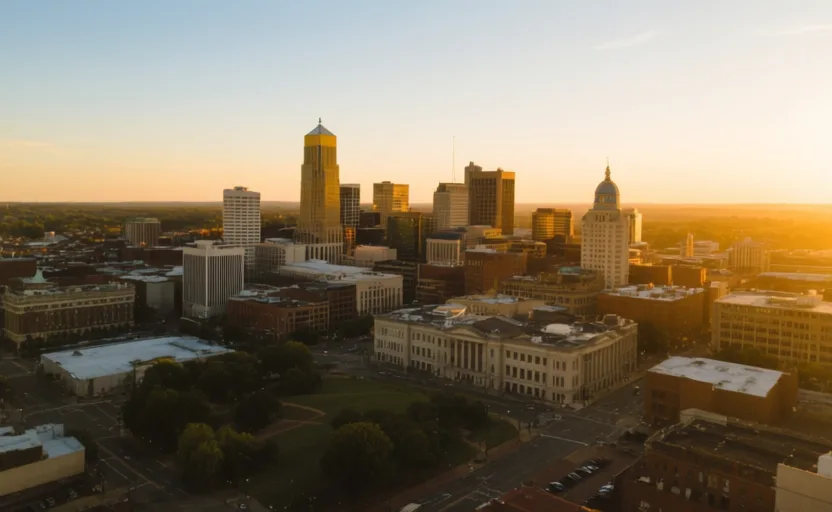 Birmingham · AI city illustration · Artistic impression
City · North America
Birmingham
Saved in this browser — no account needed. Sign in later and it comes with you.
Where it is
Birmingham lies in Jones Valley, a trough in the southern Appalachian foothills walled in by long ridges that run from north-east to south-west. Small creeks, Village Creek and Valley Creek, drain it toward the Black Warrior River, and the main railway corridor splits the valley in two. South of downtown rises Red Mountain, and beyond it the suburbs of Shades Valley were sheltered from the smoke of the industrial city. The reason for the city is underground: iron ore, coal and limestone lie close together here, and the climate is humid subtropical, with hot summers and spring tornadoes.
The land and water around it
Jones Valley and its ridgesvalley
The city sits in a valley between parallel ridges, the tail ends of the Appalachian foothills. The railway corridor along the valley floor decided where the first factories were built.
Red Mountainmountains
A prominent ridge just south of downtown, lined with broadcast towers and topped by Vulcan Park. The “Over the Mountain” suburbs behind it, including Mountain Brook and Vestavia Hills, were sheltered from the industrial smoke and became the affluent edge of the metropolitan area.
The Cahaba River basinriver
South of Shades Valley lies the basin of the Cahaba River, noted for the variety of its aquatic life, among the richest of any river system in the country.
Its history, in short
Birmingham is a planned industrial town. A company of cotton planters, bankers and railroad men, the Elyton Land Company, founded it on 1 June 1871 where two railways were due to cross. Nearby lay ore, coal and limestone, which together make steel. Its founders borrowed the name of the English industrial city to advertise the plan. Cholera and the Wall Street crash of 1873 slowed it, but growth then became explosive, earning it the nicknames Magic City and Pittsburgh of the South. Many of its workers were African Americans from the Alabama countryside, usually without union protection. In 1963 the city became the centre of the American civil rights struggle, when marches led by local activists, together with Martin Luther King Jr., ended segregation in the city's public accommodations. From a peak of 340,887 in 1960 the population fell to about 200,000 in 2020, as residents moved to suburbs that had not existed as towns before 1950. Medicine, led by the University of Alabama at Birmingham, along with banking and engineering, later diversified an economy that had rested on steel.
Timeline
Dates are shown on a timeline rather than as changing shapes on the map. The globe draws modern boundaries only, and tinting a modern outline to stand for a historical one would state something we cannot source.
Industrial & imperial
1 June 1871
Founded by the Elyton Land Company
Investors lay out the city beside the planned crossing of two railroads, close to ore, coal and limestone. They name it for Birmingham, England.
Well attestedWikipedia1911
Elyton and neighbours absorbed
Elyton, the older town the city grew beside, and other neighbouring towns are merged into Birmingham. Between 1902 and 1912 four large office buildings rise at 20th Street and 1st Avenue North.
Well attestedWikipedia1938
Vulcan raised on Red Mountain
The cast iron statue of Vulcan, made for the 1904 St. Louis Exposition, is erected in Vulcan Park. It is described as the largest cast iron statue in the world.
Well attestedWikipedia
Contemporary
April–September 1963
The civil rights campaign
Fred Shuttlesworth asks Martin Luther King Jr. and the organisation they both helped lead, the Southern Christian Leadership Conference, to come and help end segregation. Daily marches in April and May meet fire hoses, dogs and mass arrests, with more than 3,000 people, mostly high-school-age children, jailed. King writes his letter from jail on 16 April. On 15 September a bomb at the 16th Street Baptist Church kills four girls.
Well attestedWikipedia1969
University of Alabama at Birmingham
The university is established and, through urban renewal in the 1970s, grows into a major medical and research centre that helps diversify the city's economy.
Well attestedWikipedia1979
First Black mayor
Richard Arrington Jr. is elected the city's first African-American mayor.
Well attestedWikipedia2020
Overtaken by Huntsville
After the census Birmingham, with 200,733 residents, is passed by Huntsville and stops being the largest city in Alabama, though it remains the heart of the state's largest metropolitan area.
Well attestedWikipedia
Places that carry meaning
Kelly Ingram Park, the 16th Street Baptist Church and the Birmingham Civil Rights Institute1963 onward
The church, the park beside it and the institute that tells the story of the movement stand together. The park and church were at the centre of the 1963 marches and the bombing that autumn.
Vulcan Park1938
On Red Mountain south of downtown, the statue of the Roman god of the forge is a monument to the iron industry that created the city.
Ruffner Mountain Nature Centerpresent
A reserve east of the city centre, among the biggest nature reserves inside any American city.
Languages here
Places are usually multilingual. This lists what is actually spoken, not one language per border.
EnglishGermanic family
The language of daily life and of the city's civic and religious institutions.
About 77 percent of people in the United States speak only English at home, and English is the working language of the city's government, churches and universities.
MuscogeeMuskogean family
The language of the Upper Creek people who held the region before settlement.
The area was part of the Muscogee Confederacy, and the most prominent Indigenous settlement of the 19th century, the Upper Creek community of Tvlwv Haco, a Muscogee name meaning “Crazy Town”, stood in what is now Indian Springs Village.
SpanishRomance family
The language of a small Hispanic population.
The 2000 census counted 1.55 percent of the city's residents as Hispanic or Latino, a small share compared with the national pattern, where Spanish is spoken at home by 14 percent of people.
Learn the language here
- 1Understand which languages are spoken hereBirmingham is multilingual. Start with which languages are used, by whom, and for what — the phrase list only covers one of them.Written by Globe Quest
- 2Learn 12 phrasesCurated everyday phrases for Birmingham, with audio and a written form.Written by Globe Quest
- 3Say them out loudSpeaking practice with pronunciation feedback, one phrase at a time.Globe Quest material, your own additions
- 4Come back to themSpaced review, so what you learned this week is still there next month.Written by Globe Quest
Check yourself
What made the site of Birmingham attractive to its founders?
Iron ore, coal and limestone close to a planned railway crossing
The three raw materials of steel lie close together here, and nowhere else in the world is there a significant quantity of all three so near each other.
What has happened to Birmingham's population since 1960?
It has fallen by about 41 percent as people moved to suburbs
The city peaked at 340,887 in 1960 and counted 200,733 in 2020, while suburbs such as Hoover, Vestavia Hills, Alabaster and Gardendale grew.
Worth arguing about
- Birmingham was planned as a factory town, and its name was chosen to advertise that. How much of a city's later fate is set by the reason it was founded?
- The population inside the city limits fell by about 41 percent while the metropolitan area grew. What is a city, if the people who work in it live under other governments?
Sources
- Wikipedia · Birmingham, AlabamaWikipedia · encyclopedia · checked 2026-11-24
- Wikipedia · Languages of the United StatesWikipedia · encyclopedia · checked 2026-11-24
Reviewed by Globe Quest editorial on 2026-11-24. Drafted with AI assistance and checked against the sources above before publication.