 Globe Quest
 Human Quest · LearningSign in
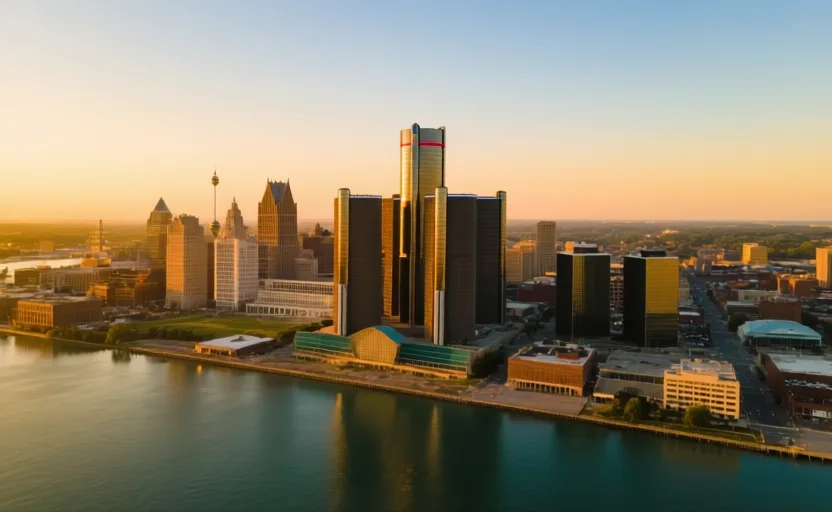 Detroit · AI city illustration · Artistic impression
City · North America
Detroit
Saved in this browser — no account needed. Sign in later and it comes with you.
Where it is
The name is the geography. Détroit is the French word for a strait, and the city grew on the north bank of the river that links Lake St. Clair to Lake Erie, one of the four major straits tying the Great Lakes to the sea. Across the water lies Windsor, Ontario, which makes Detroit the largest American city on the Canadian border. The ground slopes gently from northwest to southeast over a till plain of glacial and lake clay, with no hill to speak of. Winters are cold and the summers warm, in a humid continental climate moderated by the lakes.
The land and water around it
The Detroit Riverriver
A short, deep channel between Lake St. Clair and Lake Erie that gave the city its name. It carries heavy freight and has been described as the busiest commercial waterway in the world, and with the Windsor crossing forms the second-busiest border crossing in North America.
The till plainplain
Low ground of glacial and lake clay slopes gently toward the river from the northwest. With no relief to constrain it, the city could spread freely in every direction.
The river’s islands and marshesisland
Along 48 miles of the river and western Lake Erie, islands, marshes and shoals form the Detroit River International Wildlife Refuge, which sits within a metropolitan area.
Its history, in short
In 1701 the French officer Cadillac and his lieutenant Tonty set up Fort Pontchartrain du Détroit, a fur-trading post that Cadillac hoped would grow into a Paris of New France. Britain took it in 1760, Chief Pontiac failed to seize it in 1763, and the United States gained it after the Revolution. A fire in 1805 destroyed nearly all the colonial town. The city first held Michigan’s capital after statehood in 1837. Its real growth came when the Great Lakes ore and grain trade met the new motor industry. Henry Ford’s moving assembly line of 1913 cut chassis assembly time by nearly 90 percent, and by 1920 Detroit’s makers were producing a million cars a year, about half the world’s output. Black migrants from the South, and Polish, German and Middle Eastern immigrants, filled its factories. Decline set in from the 1950s as plants closed and people moved to the suburbs. Since the 1950 peak of 1.85 million, the population has fallen by about 65 percent. The city filed the largest municipal bankruptcy in American history in 2013 and exited in December 2014.
Timeline
Dates are shown on a timeline rather than as changing shapes on the map. The globe draws modern boundaries only, and tinting a modern outline to stand for a historical one would state something we cannot source.
Early modern & oceanic
1701
Fort Pontchartrain du Détroit
Cadillac and Tonty lead about a hundred Frenchmen to build the post, which grows into the biggest French settlement on the route from Montreal down to New Orleans.
1760
Surrender to the British
The last French commander yields on 29 November. The British shorten the name to Detroit, and the fur trade continues under new management.
Well attestedWikipedia
Industrial & imperial
1805
The Great Fire
A fire destroys nearly all of the town’s colonial buildings. Residents and neighbours from Quebec help rebuild it, and Detroit is first incorporated as a city the following year.
Well attestedWikipedia1837
First capital of Michigan
Michigan enters the Union, and Detroit serves as the state’s first capital and hosts its first state elections.
Well attestedWikipedia1913
The moving assembly line
Henry Ford’s assembly line cuts the time to build a chassis by nearly 90 percent and lets a Model T roll off every 24 seconds at its peak.
Well attestedWikipedia
Contemporary
1950
Population peak
The census records 1.85 million people. Plants close or move out through the 1950s and the city’s tax revenue falls, leading to its first postwar deficit in 1961.
Well attestedWikipedia2013 to 2014
Bankruptcy and exit
Detroit files for bankruptcy as the largest U.S. city to do so and leaves it in December 2014, having cut about $7 billion in debt.
Well attestedWikipedia
Places that carry meaning
Ste. Anne de Détroit1701
A Catholic parish founded with the city, the second oldest continuously operating one in the United States, and the first building erected here.
Art Deco downtown and New Center1920s
The Guardian Building, the Penobscot Building, the Fisher Building and Cadillac Place date from the boom years and form the core of the skyline’s older layer.
Lafayette ParkMid-20th century
A 78-acre residential district on the east side designed by Ludwig Mies van der Rohe.
Languages here
Places are usually multilingual. This lists what is actually spoken, not one language per border.
EnglishGermanic family
The everyday language of the city.
The language of the town since British rule, and of the factories and unions that followed.
FrenchRomance family
The founders’ language, preserved in the place name.
The city’s name and its oldest parish both date from the colonial French era.
OjibweAlgonquian family
The Anishinaabe language of the surrounding region.
In Ojibwe the area is called Waawiiyaataanong, “where the river bends”, a reminder that Anishinaabe and Iroquoian nations lived here when the French arrived.
Learn the language here
- 1Understand which languages are spoken hereDetroit is multilingual. Start with which languages are used, by whom, and for what — the phrase list only covers one of them.Written by Globe Quest
- 2Learn 12 phrasesCurated everyday phrases for Detroit, with audio and a written form.Written by Globe Quest
- 3Say them out loudSpeaking practice with pronunciation feedback, one phrase at a time.Globe Quest material, your own additions
- 4Come back to themSpaced review, so what you learned this week is still there next month.Written by Globe Quest
Check yourself
What does the name Detroit refer to?
A French word for a narrow strait of water
Détroit is French for strait. The post was founded on the narrow north-south passage linking Lake St. Clair and Lake Erie.
Roughly how much of Detroit’s peak population has it lost since 1950?
About 65 percent
From 1.85 million at the 1950 census, the population has fallen by around two thirds, which is why large parts of the city have high vacancy.
Worth arguing about
- Detroit became the world’s car capital within a generation and lost two thirds of its people within another two. Which parts of that rise and fall were avoidable?
- A city can shrink and still be a city. What should a place with a large fraction of its land vacant do with it?
What we have not established
These are open questions, listed rather than filled in. We would rather show a gap than a plausible guess.
When was the United Auto Workers founded in Detroit?
The accounts of the city give 1935 in one place and 1940 in another, so the date of the union’s founding here stays unstated.
Sources
- Wikipedia · DetroitWikipedia · encyclopedia · checked 2026-11-24
- Wikipedia · History of DetroitWikipedia · encyclopedia · checked 2026-11-24
Reviewed by Globe Quest editorial on 2026-11-24. Drafted with AI assistance and checked against the sources above before publication.