 Globe Quest
 Human Quest · LearningSign in
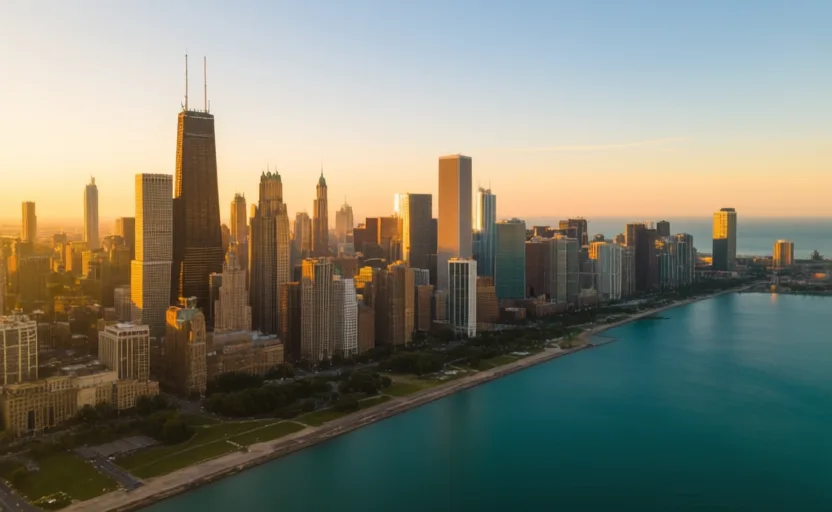 Chicago · AI city illustration · Artistic impression
City · North America
Chicago
Saved in this browser — no account needed. Sign in later and it comes with you.
Where it is
Water drains in two directions from Chicago. The city lies on the southwestern shore of Lake Michigan, on a low continental divide at the Chicago Portage, where the Great Lakes watershed meets the Mississippi’s. A short carry between the two systems is what made a flat, marshy lakeshore a place worth holding. The Chicago River runs through downtown and the Calumet River through the industrial far South Side. Everything is level, so the street grid could be laid out in straight lines to the horizon. Summers are hot and humid and winters cold and snowy, with the lake cooling the shoreline when the wind blows off it.
The land and water around it
Lake Michiganlake
The lake bounds the city on the east and supplies its fresh water. Industrial pollution of the lake in the late nineteenth century forced a search for a new way to dispose of sewage, and in 1885 engineer Lyman Cooley proposed a canal to divert water towards the Illinois River instead.
The Chicago Portageplain
The low divide linking the Great Lakes and Mississippi watersheds, and the reason the site mattered to French traders and later to canal and railroad builders.
The Chicago and Calumet riversriver
Two rivers drain parts of the city. The Chicago River runs through the downtown, and the Calumet serves the industrial far South Side, where most of the Port of Chicago’s facilities stand.
Its history, in short
The Miami–Illinois word šikaakwa, a wild garlic-like plant, gave the place its name in French rendering. The Potawatomi held the area in the eighteenth century, and Jean Baptiste Point du Sable, a trader of African descent, set up the first permanent settlement in the 1780s. Fort Dearborn followed in 1803, and the Potawatomi were forcibly removed after the 1833 treaty, the same year the town was organised. Incorporated in 1837, it prospered because it commanded the route between the Great Lakes, the eastern states and the Mississippi basin, first by lake and then by rail. The fire of 1871 destroyed the business district but not the growth: the city passed a million people by 1890 and had the first steel-framed high-rise in 1885. Migration brought European workers, then Black families from the American South, and factories and stockyards gave way to a finance and services economy after 1950.
Timeline
Dates are shown on a timeline rather than as changing shapes on the map. The globe draws modern boundaries only, and tinting a modern outline to stand for a historical one would state something we cannot source.
Early modern & oceanic
c. 1679
First written name
Robert de La Salle refers to the site as “Checagou” in a memoir, and Henri Joutel notes the wild garlic growing there in the late 1680s.
Approximate dateWikipedia1780s
Du Sable’s trading post
Jean Baptiste Point du Sable, possibly born in Saint-Domingue, becomes the first known permanent settler. He is commonly called the founder of Chicago.
Industrial & imperial
1803
Fort Dearborn
The US Army builds the fort, which the Potawatomi destroy in the War of 1812 before it is rebuilt.
Well attestedWikipedia1833
Treaty and town
The Potawatomi are forcibly removed west of the Mississippi under the Treaty of Chicago, and the Town of Chicago is organised on 12 August with about 200 people.
Well attestedWikipedia1871
The Great Chicago Fire
The fire leaves more than 100,000 people homeless and clears the business district for what becomes the biggest building boom in the country.
1885
The first steel-framed high-rise
The Home Insurance Building opens, usually counted as the start of the skyscraper era.
Well attestedWikipedia27 July–3 August 1919
Race riot
Violence started by white Americans against Black Americans on the South Side kills 38 people and leaves 1,000 to 2,000, mostly Black residents, homeless. It is the worst of the riots of the “Red Summer”.
Well attestedWikipedia2 December 1942
First controlled nuclear reaction
Scientists at the University of Chicago achieve it as part of the Manhattan Project.
Well attestedWikipedia
Places that carry meaning
The Loop1871 onward
The central business district, rebuilt after the fire, now the second-largest in the country. It sits at the centre of a street grid that grew from the original townsite plot.
Hull House1889
Founded by Jane Addams and Ellen Gates Starr to serve the city’s immigrant poor. Its programmes became a model for the new field of social work.
The South Side Black Belt1910s–1950s
The near South Side became the first Black residential district because it had the oldest and cheapest housing. Segregation and later public housing shaped the area for decades; the Black population grew from 44,103 in 1910 to 233,903 in 1930.
Languages here
Places are usually multilingual. This lists what is actually spoken, not one language per border.
EnglishGermanic family
The shared language of the city.
The United States has no statutory official language, but English is the everyday language of public life in Chicago as elsewhere.
SpanishRomance family
The largest language after English in Illinois.
About 1.7 million people in Illinois spoke Spanish at home in 2024. In Illinois in 1910 the second language was German, with Polish, Swedish and Czech behind it.
PolishSlavic family
A language of the city’s older European migration, still large.
Slavs settled the Midwestern industrial cities, and Chicago was a main destination. Polish remains the second-largest language other than Spanish in Illinois, with about 158,000 speakers in 2024.
Chinese and Tagalog
Languages of later Asian migration.
In 2024 Illinois counted about 117,000 speakers of Chinese and 84,000 of Tagalog, following the post-1965 rise in immigration from East and South Asia.
Learn the language here
- 1Understand which languages are spoken hereChicago is multilingual. Start with which languages are used, by whom, and for what — the phrase list only covers one of them.Written by Globe Quest
- 2Learn 12 phrasesCurated everyday phrases for Chicago, with audio and a written form.Written by Globe Quest
- 3Say them out loudSpeaking practice with pronunciation feedback, one phrase at a time.Globe Quest material, your own additions
- 4Come back to themSpaced review, so what you learned this week is still there next month.Written by Globe Quest
Check yourself
Why did Chicago’s site matter before it was a city?
It sat on a portage between the Great Lakes and Mississippi watersheds
The Chicago Portage joined two river systems, so whoever held it controlled access from the lakes and eastern states into the Mississippi basin.
What did the 1871 fire lead to in Chicago?
The largest building boom in the nation’s history, and the first steel-framed high-rise in 1885
The destruction cleared the centre for rebuilding, and the Home Insurance Building of 1885 began the skyscraper era.
Worth arguing about
- A city sited on a continental divide reversed its own river to carry sewage away from the lake. What does engineering on that scale say about how Chicago sees its geography?
- Chicago’s neighbourhoods were sorted by ethnicity and by race, partly by choice and partly by exclusion. How should that history be read in the city’s layout today?
What we have not established
These are open questions, listed rather than filled in. We would rather show a gap than a plausible guess.
Who first settled Chicago, and when?
Du Sable is dated to the 1780s in one account and to 1790 in another, and his birthplace is given only as perhaps Saint-Domingue.
Sources
- Wikipedia · ChicagoWikipedia · encyclopedia · checked 2026-11-24
- Wikipedia · History of ChicagoWikipedia · encyclopedia · checked 2026-11-24
- Wikipedia · Languages of the United StatesWikipedia · encyclopedia · checked 2026-11-24
Reviewed by Globe Quest editorial on 2026-11-24. Drafted with AI assistance and checked against the sources above before publication.