 Globe Quest
 Human Quest · LearningSign in
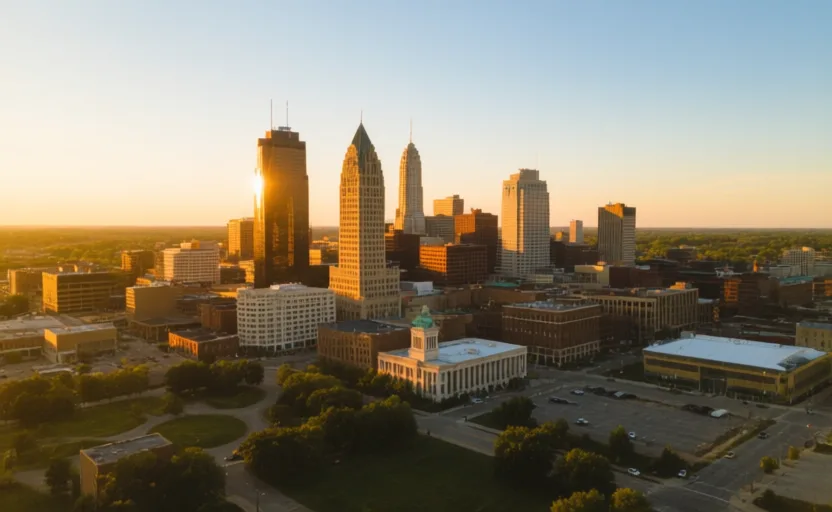 Milwaukee · AI city illustration · Artistic impression
City · North America
Milwaukee
Saved in this browser — no account needed. Sign in later and it comes with you.
Where it is
Three rivers, the Milwaukee, the Menomonee and the Kinnickinnic, reach Lake Michigan within a short distance of each other, and the city grew around that junction on the lake’s western shore. North of downtown the shoreline rises into steep bluffs left by the glaciers, and about 30 miles west lie the Kettle Moraine and the small lakes of the glacial country. The lake shapes the weather: winters are cold and snowy, summers hot and humid, and on light-wind afternoons a lake breeze pushes cooler air inland. The city itself is compact, at roughly 96 square miles.
The land and water around it
Lake Michigan and its bluffslake
The city is built along the shores and bluffs of the lake. Steep bluffs begin about a mile north of downtown, and the lake gave Milwaukee its role as a port for wheat and other produce.
The three riversriver
The Milwaukee, Menomonee and Kinnickinnic meet near downtown. The Root River and Lincoln Creek add smaller waterways, and the river junction decided where the first towns stood.
The Kettle Moraineplain
About 30 miles to the west lies a landscape of glacial ridges and inland lakes. It reminds visitors that the city’s whole terrain, bluffs included, was sculpted by ice.
Its history, in short
Algonquian peoples, among them the Menominee, Potawatomi and Ojibwe, lived along these waterways for thousands of years, with the Ho-Chunk nearby. A trader from Michilimackinac set up a post here in 1785. The big change came in 1833, when the Treaty of Chicago opened the land and Milwaukee developed as a lake port, finally incorporating as a city in 1846. Competing founders laid out separate towns on either side of the river. The arrival of German immigrants from the 1840s gave the city a reputation as the most German in America, with beer brewing and a strong tradition of choral festivals. By 1910 German was the most spoken language in the city, ahead of English, and Polish was third. Milwaukee grew into an industrial city of breweries and factories, and in the first half of the twentieth century it elected three Socialist mayors, the so-called Sewer Socialists. The population has fallen at every census since 1970, and the city is still one of the most racially segregated in the country, a legacy of early twentieth-century redlining.
Timeline
Dates are shown on a timeline rather than as changing shapes on the map. The globe draws modern boundaries only, and tinting a modern outline to stand for a historical one would state something we cannot source.
Early modern & oceanic
1785
A trading post
Alexis Laframboise, from Michilimackinac, sets up a trading post and is counted as the area’s earliest European-descended resident.
Well attestedWikipedia
Industrial & imperial
1818
Juneautown
Solomon Juneau arrives and founds a settlement east of the river. Byron Kilbourn later founds a rival Kilbourntown to the west and lays out its streets so that they do not meet Juneau’s, which is why so many bridges in the city cross at an angle.
Well attestedWikipedia1833
The Treaty of Chicago
The treaty opens the area to settlement, and Milwaukee develops as an inland port.
Well attestedWikipedia1844
A settled spelling
The name had been written many ways, from Melleokii in 1679 to Milwaukie, preferred on the east side of the river. The Milwaukee Sentinel switches to the modern spelling on 30 November 1844.
Well attestedWikipedia1845–1855
The first German wave
Immigrants mainly from south-western Germany come in search of cheap farmland. Later waves in 1865–1873 and 1880–1893 follow, and by 1900 about 34% of the city’s people were of German background.
Approximate dateWikipedia1846
Incorporation
Milwaukee is incorporated as a city, thirteen years after the Treaty of Chicago.
Well attestedWikipedia1910
A Socialist government
Emil Seidel serves as mayor from 1910 and Victor Berger is elected the first Socialist congressman. Two more Socialists serve as mayor between 1916 and 1960.
Well attestedWikipedia
Contemporary
1970 onward
Population decline
The city’s population has fallen at every census since 1970, to 577,222 in 2020.
Well attestedWikipedia
Places that carry meaning
Juneautown and Kilbourntown1830s–1840s
The two rival settlements on either side of the Milwaukee River grew into a single city, but the angled bridges still mark the rivalry between their founders.
Henry Maier Festival ParkModern
The lakefront site of Summerfest, listed in 1999 as the largest music festival in the world. The city calls itself the City of Festivals.
The Milwaukee Art MuseumModern
Santiago Calatrava’s first American commission is a lakefront wing with a movable sunscreen, which unfolds like a bird’s wing.
Languages here
Places are usually multilingual. This lists what is actually spoken, not one language per border.
EnglishGermanic family
The dominant language today.
By 2000 English was spoken at home by about 462,000 residents, far ahead of every other language.
GermanGermanic family
Once the city’s most spoken language, now a heritage language.
In 1910 German was spoken at home by 167,108 people, more than English. By 2000 the figure was 4,430, although about 20.8% of residents still reported German ancestry in the 2006–2008 survey.
SpanishRomance family
The largest minority language.
Spanish was spoken at home by 55,245 people in 2000, and Hispanic or Latino residents were 20.1% of the population in 2020. The largest backgrounds in 2010 were Mexican and Puerto Rican.
HmongHmong–Mien family
The language of a Southeast Asian community.
Hmong was the third most spoken language in the city in 2000, with 7,340 speakers, and Hmong food now forms part of the city’s cuisine.
Learn the language here
- 1Understand which languages are spoken hereMilwaukee is multilingual. Start with which languages are used, by whom, and for what — the phrase list only covers one of them.Written by Globe Quest
- 2Learn 14 phrasesCurated everyday phrases for Milwaukee, with audio and a written form.Written by Globe Quest
- 3Say them out loudSpeaking practice with pronunciation feedback, one phrase at a time.Globe Quest material, your own additions
- 4Come back to themSpaced review, so what you learned this week is still there next month.Written by Globe Quest
Check yourself
Why does Milwaukee have so many bridges that cross the river at an angle?
A founder laid out streets on his side so they would not join with his rival’s
Byron Kilbourn laid out Kilbourntown so that its streets did not meet those of Juneautown, hoping to draw trade to his side. The angled bridges remain.
In 1910, which language was spoken at home by the most people in Milwaukee?
German
German had more speakers than English, with 167,108 against 104,892. By 2000 only 4,430 people reported speaking it at home,.
Worth arguing about
- A city built by two competing towns still lives with the street grid they left. Which choices made in the 1840s are still shaping daily life?
- German was spoken by more people than English in 1910, and was nearly gone a century later. What does a city keep when its language disappears?
What we have not established
These are open questions, listed rather than filled in. We would rather show a gap than a plausible guess.
Where does the name Milwaukee come from?
Three explanations compete: an Ojibwe word for “good land”, a Meskwaki word for a gathering place, and a Potawatomi word for council grounds, which is the one the city itself claims. None has been settled.
Sources
- Wikipedia · MilwaukeeWikipedia · encyclopedia · checked 2026-11-24
Reviewed by Globe Quest editorial on 2026-11-24. Drafted with AI assistance and checked against the sources above before publication.