 Globe Quest
 Human Quest · LearningSign in
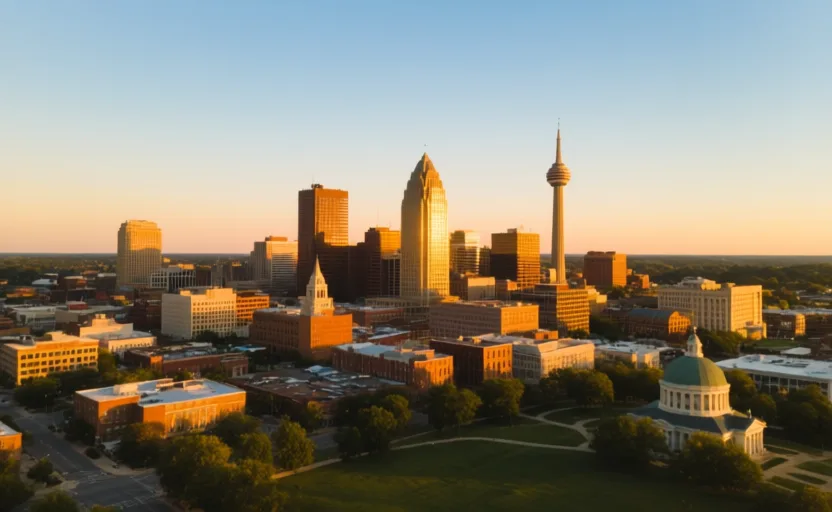 Madison · AI city illustration · Artistic impression
City · North America
Madison
Saved in this browser — no account needed. Sign in later and it comes with you.
Where it is
Madison is a city made by water. Its downtown occupies a narrow isthmus between Lake Mendota and Lake Monona, and Lake Wingra lies inside the city limits too, which is why its trademark is “Lake, City, Lake”. The lakes belong to the Yahara River, which runs south through a chain of four to the Rock River and eventually the Mississippi. Elevation inside the city runs from about 837 feet at the lowest corner on the east side to 1,190 feet on a ridge of glacial debris in the west. The climate is humid continental: winters can be well below freezing, and summers stay mostly in the low 80s °F.
The land and water around it
The isthmuspeninsula
A strip of land between Lakes Mendota and Monona on which the capitol and downtown stand. State Street and Langdon Street connect the university campus on the west to Capitol Square.
The Yahara lakeslake
Four successive lakes on the Yahara River give the region its name: Mendota, Monona, Waubesa and Kegonsa. Only the first two lie within Madison, with Waubesa and Kegonsa just south, and the smaller Lake Wingra is linked to them by Wingra Creek.
The glacial moraineplain
The highest ground in the city, along Pleasant View Road on the west side, is part of a terminal moraine left by the Green Bay Lobe of the Wisconsin glaciation. It marks how far the ice advanced.
Its history, in short
For about 12,000 years people lived around these lakes, and the Ho-Chunk named the region for its four lakes. Effigy mounds built more than a thousand years earlier once dotted the prairies. The modern city began as a speculation. In 1829 the former federal judge James Duane Doty bought 1,261 acres of swamp and forest on the isthmus, and when the Wisconsin Territory was created in 1836 he lobbied its legislature to choose his paper city as the capital, offering buffalo robes to the freezing members and discounted lots to the undecided. He named it for James Madison, who had just died, and its streets for the other signers of the Constitution. The legislature voted for it on 28 November 1836, largely because it lay midway between Milwaukee and the lead-mining country and between Prairie du Chien and Green Bay. The University of Wisconsin was created in 1848, the railway arrived in 1854, and the city was incorporated in 1856. The capitol and the university have shaped it since, including a long record of protest, from the Vietnam War era to the 2011 demonstrations at the capitol.
Timeline
Dates are shown on a timeline rather than as changing shapes on the map. The globe draws modern boundaries only, and tinting a modern outline to stand for a historical one would state something we cannot source.
Industrial & imperial
1829
Doty buys the isthmus
James Duane Doty pays $1,500 for 1,261 acres between the two lakes, intending to build a city in the Four Lakes region.
Well attestedWikipedia28 November 1836
Chosen as capital
The territorial legislature selects Madison, which then exists only on paper, as the capital of Wisconsin Territory. It is named for James Madison, who died on 28 June of that year.
Well attestedWikipedia1848
Statehood and a university
Wisconsin becomes a state with Madison as capital, and the University of Wisconsin is created on 26 July. University Hall, now Bascom Hall, is completed in 1859.
Well attestedWikipedia1856
A city of 6,863
Madison is incorporated as a city two years after the Milwaukee and Mississippi Railroad reaches it.
Well attestedWikipedia1906–1917
The present capitol
The current capitol is built between 1906 and 1917, after its predecessor, the second capitol, burned in 1904.
Well attestedWikipedia
Contemporary
1967–1970
The anti-war years
Thousands march against the Vietnam War, with violent incidents such as the 1967 Dow Chemical protest, in which 74 were injured, and the bombing of Sterling Hall in 1970, which killed a researcher, Robert Fassnacht.
Well attestedWikipedia2011
The Act 10 protests
Between 10,000 and more than 100,000 people crowd the capitol for months over a bill ending almost all collective bargaining for public-sector unions.
Well attestedWikipedia
Places that carry meaning
Wisconsin State Capitol1906–1917
The building on Capitol Square, the third capitol on the site. The square is the centre of the city's public life, with a farmers' market and concerts on it.
Memorial Union Terracepresent
A lakeside gathering place on Lake Mendota whose sunburst-pattern chairs have become a symbol of the city.
Camp RandallCivil War
A west-side site where Union recruits trained during the Civil War. It also served as an army hospital and held Confederate prisoners.
Languages here
Places are usually multilingual. This lists what is actually spoken, not one language per border.
EnglishGermanic family
The language of daily life, the university and the state government.
Madison is the seat of state government and home to the University of Wisconsin, both of which work in English. Nationally about 77 percent of people speak only English at home.
Ho-ChunkSiouan family
The language of the region's first named inhabitants.
The Ho-Chunk had a name for the region meaning the land of four lakes, and effigy mounds around the lakes testify to the people who lived here long before the city.
Hmong
The language of a community of about 2,000 residents.
The five-year American Community Survey estimate for 2022 counts 1,985 Hmong people in the city. Across Wisconsin 36,777 people spoke Hmong at home in 2024, making it the third most common language in the state after English and Spanish.
SpanishRomance family
The most common language after English.
Hispanic or Latino residents were 8.7 percent of the city in 2020, up from 6.8 percent in 2010. Statewide, about 297,000 people speak Spanish at home, second to English.
Learn the language here
- 1Understand which languages are spoken hereMadison is multilingual. Start with which languages are used, by whom, and for what — the phrase list only covers one of them.Written by Globe Quest
- 2Learn 12 phrasesCurated everyday phrases for Madison, with audio and a written form.Written by Globe Quest
- 3Say them out loudSpeaking practice with pronunciation feedback, one phrase at a time.Globe Quest material, your own additions
- 4Come back to themSpaced review, so what you learned this week is still there next month.Written by Globe Quest
Check yourself
Why did the territorial legislature choose Madison as capital in 1836, when it existed only on paper?
Its position was midway between Milwaukee and Prairie du Chien, and between mining and Green Bay
Doty also lobbied aggressively, but the central position between the new eastern cities, the western strategic post, the lead-mining southwest and Green Bay was the main argument.
Which two lakes does the isthmus separate?
Mendota and Monona
Downtown Madison and the capitol stand on the narrow strip between Lake Mendota and Lake Monona, which is the origin of the “Lake, City, Lake” slogan.
Worth arguing about
- Madison was founded as a speculation and won the capital through lobbying, lots and buffalo robes. Does it matter how a city's founding came about once the city has become something else?
- A city with a large university and the state capitol has been a centre of protest for decades. What makes a place a home for dissent, and what does it do to everyday politics?
What we have not established
These are open questions, listed rather than filled in. We would rather show a gap than a plausible guess.
How many people live in Madison?
The 2020 census counted 269,840, while later estimates put the city at 286,233 in 2025 and 300,153 in 2026. The city annexed most of the Town of Madison in 2022, so it is unclear how much of the rise is growth and how much is a change of boundary.
Sources
- Wikipedia · Madison, WisconsinWikipedia · encyclopedia · checked 2026-11-24
- Wikipedia · Languages of the United StatesWikipedia · encyclopedia · checked 2026-11-24
Reviewed by Globe Quest editorial on 2026-11-24. Drafted with AI assistance and checked against the sources above before publication.