 Globe Quest
 Human Quest · LearningSign in
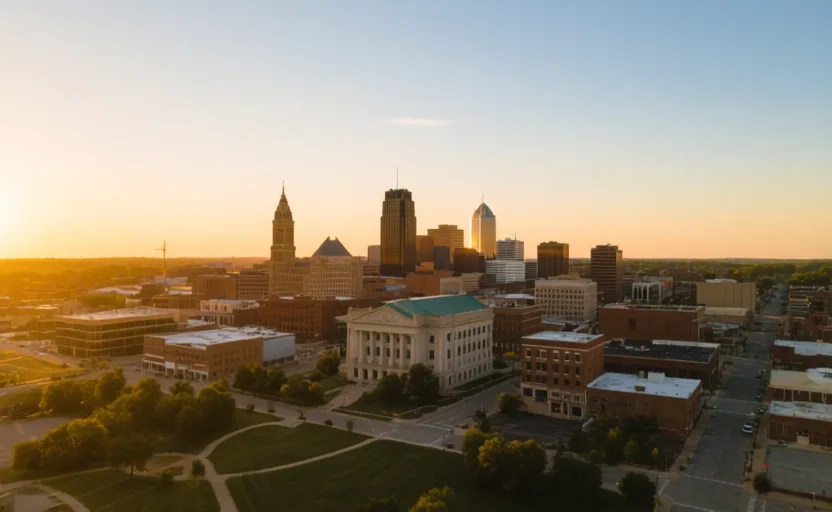 Des Moines · AI city illustration · Artistic impression
City · North America
Des Moines
Saved in this browser — no account needed. Sign in later and it comes with you.
Where it is
In the middle of Iowa the land is mostly level prairie, and the capital stands where the Raccoon River runs into the Des Moines River, at about 260 metres (850 feet) above sea level. Nothing here is near an ocean or a large lake, so the climate is continental: hot, humid summers with afternoon thunderstorms, and winters that often drop below 0 °F. Annual precipitation averages about 36.5 inches, and the average snowfall is of a similar figure. The rivers are the reason for the site, and also the reason it has flooded. The river takes its name from French colonists, most likely from Rivière des Moines.
The land and water around it
The Raccoon and Des Moines confluenceriver
Two rivers join below the downtown, and the point between them drew people long before the fort. Archaeologists have found occupation here going back some seven thousand years, and the fort’s own remains lie beneath streets in the modern centre.
The prairie floodplainplain
A teacher who spent the winter of 1850 to 1851 here described a flat prairie with a few low swells. That openness helped the rivers spread: in May 1851 both rose to an unprecedented level and covered the whole country east of the Des Moines River.
The continental interiorclimate
Far from any sea, the area swings between humid heat in summer and bitter cold in winter. Summer temperatures can reach 100 °F, and the city is slightly colder in winter than Chicago but milder than Minneapolis.
Its history, in short
People have used the meeting of the two rivers for at least 7,000 years, and a village site found in 2010 shows how long. Villages stood in or near the present downtown between about 1300 and 1700, and early settlers still saw mounds, all later levelled. The city itself began in 1843 as a US Army fort meant to keep watch over the Sauk and Meskwaki, who had been moved there from eastern Iowa; they were sent on to Indian Territory and the fort closed in 1846. Settlers took over its buildings, and a great flood in 1851 destroyed much of the town. Incorporation came that year, the name was shortened in 1857, and the same year the town replaced Iowa City as capital. A railway in 1866 and a coal-mining boom made it Iowa’s largest city by 1880. Early in the twentieth century it built a formal civic centre along the river, then declined after the 1950s, before reinventing itself as a centre of insurance and finance.
Timeline
Dates are shown on a timeline rather than as changing shapes on the map. The globe draws modern boundaries only, and tinting a modern outline to stand for a historical one would state something we cannot source.
First cities & states
At least 7,000 years ago
A settlement at the confluence
A site with house deposits and graves, found in 2010 beside the wastewater works, holds over 6,000 artefacts. It shows people living at the river junction for millennia.
Approximate dateWikipedia
Post-classical world
c. 1300–1700
Villages near the downtown
At least three villages stood in or beside what later became downtown. Between fifteen and eighteen mounds were still visible to early settlers.
Approximate dateWikipedia
Industrial & imperial
1843
Fort Des Moines
The fort, built under Captain James Allen at the confluence, was meant to hold in check the Sauk and Meskwaki, whom the government had relocated from eastern Iowa. The War Department chose the river’s name over Allen’s preferred Fort Raccoon.
Well attestedWikipedia1851
Flood and incorporation
In May the rivers inundated much of the town. On 22 September it was incorporated as a city and voters approved the charter that October.
Well attestedWikipedia1857
Capital of Iowa
The name was cut to Des Moines, and the city became the state’s second capital after Iowa City.
Well attestedWikipedia1866
The railroad arrives
Growth had been slow through the Civil War period. After the rail link opened, the city’s size and importance rose sharply, and coal mining expanded from 1864; by 1880 the population of 22,408 made it the largest in Iowa.
Well attestedWikipedia1900–1910
The City Beautiful project
Prompted by the Des Moines Women’s Club civic committee, the city built large Beaux Arts public buildings and fountains along the river. Several survive as the Civic Center Historic District.
Well attestedWikipedia
Contemporary
1950s to the late 1980s
Decline and change of economy
The riverside fountains were buried in the 1950s as the city entered a postindustrial decline. Since then it has shifted from a blue-collar industrial base to professional work, above all insurance and finance.
Approximate dateWikipedia
Places that carry meaning
The fort site1843–1846
Digs have found fort features still buried beneath two modern downtown streets, Martin Luther King Jr. Parkway and First Street. The place marks the city’s start as an instrument of removal as much as settlement.
Civic Center Historic District1900–1910
The former public library (today the World Food Prize hall), the old central post office and City Hall belong to the City Beautiful era. They face the river, a reminder that the rivers were treated as the city’s front door.
Iowa State CapitolSeat of state government
A 275-foot dome covered in 23-karat gold leaf rises over the city from the east bank, flanked by four smaller domes. It houses the governor’s offices and the legislature.
Languages here
Places are usually multilingual. This lists what is actually spoken, not one language per border.
EnglishGermanic family
The everyday language of government, school and work.
Across the United States English dominates speech and writing, though Congress has never made it official for all three federal branches, and states differ in their own laws.
SpanishRomance family
The language of the city’s Hispanic and Latino community.
People of Hispanic or Latino origin made up 12.0% of the city in 2010, and most were of Mexican origin (9.4% of residents). Smaller groups traced their roots to El Salvador, Guatemala and Puerto Rico.
Vietnamese and Lao
Spoken in the largest Asian communities.
In 2010 Vietnamese Americans were 1.2% of residents and Laotians 0.9%, followed by Burmese at 0.4%. The city also has the largest African American population in Iowa.
Learn the language here
- 1Understand which languages are spoken hereDes Moines is multilingual. Start with which languages are used, by whom, and for what — the phrase list only covers one of them.Written by Globe Quest
- 2Learn 12 phrasesCurated everyday phrases for Des Moines, with audio and a written form.Written by Globe Quest
- 3Say them out loudSpeaking practice with pronunciation feedback, one phrase at a time.Globe Quest material, your own additions
- 4Come back to themSpaced review, so what you learned this week is still there next month.Written by Globe Quest
Check yourself
Why was Fort Des Moines built in 1843?
To control the Sauk and Meskwaki, who had been moved to the area
The army built the fort at the river junction to watch over peoples the government had relocated from eastern Iowa; once they were sent to Indian Territory, the fort was abandoned in 1846.
What helped the city grow quickly after the Civil War period?
A railroad link completed in 1866
Growth had been slow until the 1866 rail connection, and coal mining soon followed, making it the largest city in Iowa by 1880.
Worth arguing about
- The fort that began the city existed to control and then remove the Sauk and Meskwaki. How should a city’s official history treat a beginning like that?
- A low insurance premium tax helped attract insurers, and the nickname “Hartford of the West” followed. How much of a city’s fortune can be set by one tax decision?
What we have not established
These are open questions, listed rather than filled in. We would rather show a gap than a plausible guess.
How large is the Des Moines area?
The city counted 214,133 people in 2020, but the six-county metropolitan area is given as about 750,000 in one account and 779,048 in 2024 in another. The difference comes from the year and method used, and the counties included, so no single figure is given.
Sources
- Wikipedia · Des Moines, IowaWikipedia · encyclopedia · checked 2026-11-24
- Wikipedia · United StatesWikipedia · encyclopedia · checked 2026-11-24
Reviewed by Globe Quest editorial on 2026-11-24. Drafted with AI assistance and checked against the sources above before publication.