 Globe Quest
 Human Quest · LearningSign in
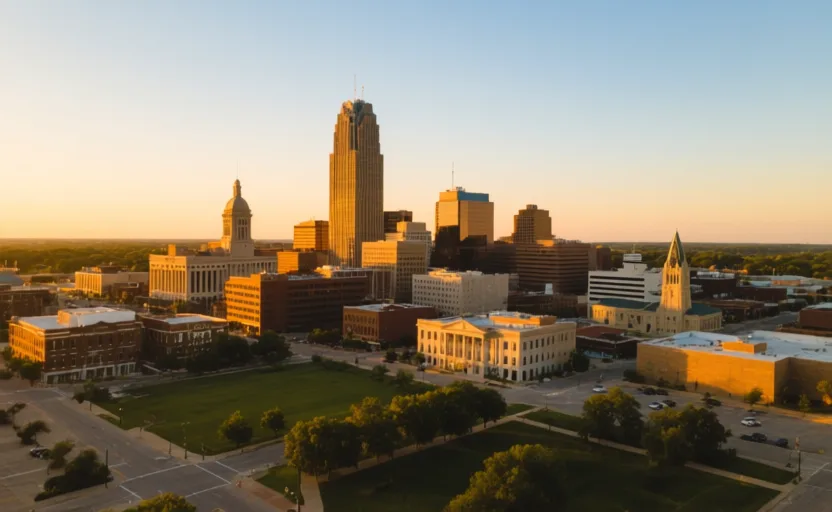 Omaha · AI city illustration · Artistic impression
City · North America
Omaha
Saved in this browser — no account needed. Sign in later and it comes with you.
Where it is
Eastern Nebraska ends at the Missouri River, and Omaha is built on its west bank, a short way north of where the Platte River joins it. Much of the city climbs out of the river valley, and a great deal of the ground downtown has been cut and graded to make it buildable. East of the main channel the land is flood plain, and an old bend of the river survives there as Carter Lake. The climate is hot-summer continental, far from any sea or mountain range to soften it, with a recorded range from minus 32 °F in 1884 to 114 °F in 1936. About 486,000 people lived in the city in 2020, and the metropolitan area, which crosses into Iowa, holds roughly a million.
The land and water around it
The Missouri River valleyriver
The river is why the city is here: a crossing point for ferries, then steamboats, then railways bound for the West. Omaha's nickname, the “Gateway to the West”, comes from the Lone Tree Ferry, which carried settlers across from Iowa.
Carter Lakelake
An oxbow lake on the floodplain east of the river, left behind where the Missouri once flowed. It sits on the Iowa side of the water while belonging to the same urban area, a reminder that the river moves and boundaries do not.
The continental climateclimate
Summers are humid enough to produce frequent thunderstorms, and winters are cold, with seasonal snowfall averaging 28.7 inches. A tornado in 1913 and another in 1975, which arrived together with a blizzard, are the worst episodes in the record.
Its history, in short
The Omaha people, who speak a Siouan language and gave the city its name, were among the groups living along this stretch of the river by the seventeenth century, alongside the Ponca, Pawnee, Otoe, Missouria and Iowa. After the Lewis and Clark expedition passed in 1804, American fur traders built posts nearby. The city itself began in 1854, when speculators from Council Bluffs across the river staked claims and a ferry carried settlers over, and a treaty with the Omaha opened the way to the Nebraska Territory. Omaha was the territorial capital but lost that role to Lincoln when Nebraska became a state in 1867. What kept it growing was transport and trade: the Union Pacific began building west from here in 1866, wholesale houses outfitted farmers across the plains, and the Union Stockyards, opened in 1883, made it a leading meatpacking centre. Irish, Polish, Czech, Italian, Greek and Mexican newcomers filled neighbourhoods around the packing plants, and conflict over labour and race scarred the early twentieth century. Since the 1970s the city has spread west, while insurance, finance and construction have replaced the stockyards.
Timeline
Dates are shown on a timeline rather than as changing shapes on the map. The globe draws modern boundaries only, and tinting a modern outline to stand for a historical one would state something we cannot source.
Industrial & imperial
1804
Lewis and Clark pass the site
The expedition travels along the riverbank where Omaha will stand and meets Otoe and Missouria leaders at a council about twenty miles to the north. American fur-trading posts follow in the next two decades, among them Fort Lisa in 1812 and Fort Atkinson in 1819.
1854
The city is founded
Speculators from Council Bluffs stake claims and the city is informally established at a picnic on 4 July, the same year the Kansas–Nebraska Act is passed. A vigilante claim club protects the founders' land until the Supreme Court rules against it in Baker v. Morton.
January 1866
The Union Pacific starts west
Construction of the first transcontinental railroad begins out of Omaha, after Congress allowed the Union Pacific to start building in 1862. Omaha becomes a transport hub for the whole interior of the country.
Well attestedWikipedia1867
The capital moves to Lincoln
When Nebraska becomes a state the capital is relocated to Lincoln, 53 miles to the southwest. Business leaders respond by building up the wholesale trade, including the warehouse district known as Jobbers Canyon.
1883
Union Stockyards open in South Omaha
Twenty years on, four of the country’s five major packing firms operate in the city, and the yards become the biggest in the world. The plants recruit immigrants who settle around them.
Well attestedWikipedia1898
Trans-Mississippi Exposition
A world's fair presents the new West to the rest of the country and confirms the city's place as its main gateway.
Well attestedWikipedia1913
The Easter Sunday tornado
The storm destroys much of Midtown and the African-American community. The year before, the city had founded the first chapter of the NAACP west of the Mississippi.
Well attestedWikipedia
Contemporary
1989
Jobbers Canyon demolished
The old wholesale district is cleared and the campus of a food company takes its place. The stockyards have also gone, and the Livestock Exchange Building is the only part left.
Well attestedWikipedia
Places that carry meaning
Old Market1880s onward; converted in the 1980s
A historic district of former fruit warehouses in downtown Omaha, converted into shops, restaurants and galleries in the 1980s. It survives from the wholesale economy that supplied the farm country to the west.
Livestock Exchange Building1883 onward
The only building left of the Union Stockyards in South Omaha, now put to new uses and entered on the National Register of Historic Places. The yards once made the area an international centre of meatpacking.
South OmahaAnnexed around 1900
The packing-house district, absorbed into the city around the start of the twentieth century, where immigrants recruited for the plants formed enclaves. It is still a place where newer immigrants arrive.
Languages here
Places are usually multilingual. This lists what is actually spoken, not one language per border.
EnglishGermanic family
The common language of the city.
Spoken by almost everyone, and the language of the settlers from the Mid-Atlantic states who founded the city. Nationally, three-quarters of residents speak only English at home.
SpanishRomance family
The main immigrant language today.
About 14 per cent of the city's residents identified as Hispanic or Latino in the 2020 census, with South Omaha one of the main places where new arrivals settle. The area once held an enclave known as Little Mexico.
Omaha (Umaⁿhaⁿ)Siouan family
The language of the people the city is named for.
The name means “Upstream People” or “Against the Current”. The Omaha and Ponca speak closely related Dhegihan Siouan languages, and the Omaha were among the earliest known residents of the area.
Immigrant heritage languages
Languages of the neighbourhoods the stockyards built.
Irish, Polish, Czech, Italian and Greek communities each gave a district its name, such as Little Italy, Little Bohemia and Greek Town. As elsewhere in the country, these languages mostly faded within two or three generations.
Learn the language here
- 1Understand which languages are spoken hereOmaha is multilingual. Start with which languages are used, by whom, and for what — the phrase list only covers one of them.Written by Globe Quest
- 2Learn 14 phrasesCurated everyday phrases for Omaha, with audio and a written form.Written by Globe Quest
- 3Say them out loudSpeaking practice with pronunciation feedback, one phrase at a time.Globe Quest material, your own additions
- 4Come back to themSpaced review, so what you learned this week is still there next month.Written by Globe Quest
Check yourself
What does the name Omaha mean in the language of the Omaha people?
Upstream People or Against the Current
The name is the Omaha people's own, and the “Gateway to the West” nickname is a separate, later one that came from the ferry crossing.
What happened to Omaha's role as capital in 1867?
It moved to Lincoln when Nebraska became a state
Omaha was the territorial capital but lost the state capital to Lincoln, after which its business leaders concentrated on wholesale trade and transport.
Worth arguing about
- Omaha grew as a place that goods and people passed through on their way west. What does that kind of city owe to the places it served?
- The stockyards drew successive waves of immigrants and also became sites of riots and strikes. How do industries that depend on cheap labour shape the neighbourhoods around them?
What we have not established
These are open questions, listed rather than filled in. We would rather show a gap than a plausible guess.
How big is greater Omaha?
The figure depends on which counties are counted. The metropolitan area has been redefined from five counties to eight, with three in Iowa, and a larger combined statistical area is counted separately, so no single regional population is fixed.
Sources
- Wikipedia · Omaha, NebraskaWikipedia · encyclopedia · checked 2026-11-24
- Wikipedia · History of Omaha, NebraskaWikipedia · encyclopedia · checked 2026-11-24
- Wikipedia · United StatesWikipedia · encyclopedia · checked 2026-11-24
Reviewed by Globe Quest editorial on 2026-11-24. Drafted with AI assistance and checked against the sources above before publication.