 Globe Quest
 Human Quest · LearningSign in
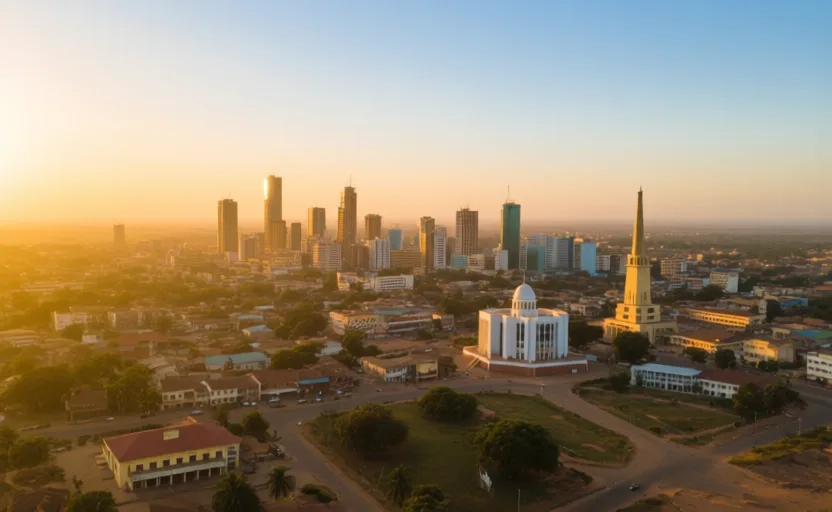 Huambo · AI city illustration · Artistic impression
City · Africa
Huambo
Saved in this browser — no account needed. Sign in later and it comes with you.
Where it is
Huambo stands at 1,721 metres on the central plateau, near the headwaters of the Cunene river. Altitude gives it mild, spring-like temperatures all year despite the tropical latitude: the mean runs from about 16 °C in June to 21 °C in September. Rain averages nearly 1,400 millimetres, mostly from October to April, with a dry winter in which June and July see none at all. The climate and the plentiful water made it a natural site for a railway hub, about 220 kilometres east of Benguela.
The land and water around it
The central plateauplateau
A high, rolling surface where the Ovimbundu kingdoms developed. Its altitude cools the tropical heat, and the highlands became the agricultural heart of colonial Angola.
The Cunene headwatersriver
The city lies near the source of the Cunene river. Abundant water in and around Huambo was one of the reasons the railway engineers chose it as a hub.
Its history, in short
Huambo takes its name from Wambu, one of the older Ovimbundu kingdoms of the central plateau, itself under the larger kingdom of Bailundu. It was the railway that made the town. The Benguela Railway began at Lobito in 1902, the kings of Bailundu and Wambu were eventually subdued by the Portuguese army after ambushing workers, and Governor-General Norton de Matos formally founded Huambo on 8 August 1912. The line reached the Congo border in 1929, and Huambo became the site of the most important railway workshop in Africa. It was renamed Nova Lisboa in 1928 and regained its old name after independence. In 1975 UNITA declared it the capital of its rival republic, and the MPLA retook it in 1976. The city then endured sieges, the 55 Day War and mass displacement until the war ended in 2002.
Timeline
Dates are shown on a timeline rather than as changing shapes on the map. The globe draws modern boundaries only, and tinting a modern outline to stand for a historical one would state something we cannot source.
Early modern & oceanic
15th century onward
The Ovimbundu kingdoms
Bailundu is established as a central kingdom by the 15th century, with Wambu among the smaller kingdoms beneath it.
Approximate dateWikipedia
Industrial & imperial
1902
The railway starts at Lobito
Work begins on the Benguela Railway, devised as the cheapest way to carry Katanga copper to the sea. It advances slowly through rugged terrain and malaria.
Well attestedWikipedia8 August 1912
Huambo founded
Governor-General Norton de Matos officially founds the town after the Portuguese army subdues the Bailundu and Wambu rulers who had opposed the railway.
Well attestedWikipedia1929
The link to the Congo border
The line reaches the border with the Belgian Congo. By now Huambo has the largest railway workshop in Africa, and is a centre of food processing and agricultural research.
Well attestedWikipedia
Contemporary
1975–1976
UNITA's capital
Jonas Savimbi declares Huambo the capital of a rival republic at independence. The MPLA takes the city back on 8 February 1976 with Cuban help.
1992–2002
Siege and displacement
After the 1992 elections UNITA concentrates its leaders and troops in Huambo, and foreign aid agencies withdraw by the end of the year. Violence peaks in 2000, with tens of thousands of displaced people in and around the city.
Well attestedWikipediaFebruary 2002
Peace
The death of Jonas Savimbi and a new ceasefire bring calm and the start of reconstruction.
Well attestedWikipedia
Places that carry meaning
The railway workshops1920s
The most important rail workshop in Africa at the time, and the reason Huambo rose from an Ovimbundu district to an industrial town.
The Agricultural Research Institute1920s onward
An educational and research centre that is now part of the College of Agricultural Science, a sign of the plateau's farming importance.
Languages here
Places are usually multilingual. This lists what is actually spoken, not one language per border.
UmbunduBantu family
The language of the Ovimbundu and of the central highlands.
The most widely spoken African language in Angola, with about 17 per cent of Angolans speaking it natively. Huambo lies at the centre of the Ovimbundu homeland.
PortugueseRomance family
The official language.
Used in administration, schools and as a shared language between ethnic groups. The city was renamed Nova Lisboa under Portuguese rule.
Learn the language here
- 1Understand which languages are spoken hereHuambo is multilingual. Start with which languages are used, by whom, and for what — the phrase list only covers one of them.Written by Globe Quest
- 2Learn 15 phrasesCurated everyday phrases for Huambo, with audio and a written form.Written by Globe Quest
- 3Say them out loudSpeaking practice with pronunciation feedback, one phrase at a time.Globe Quest material, your own additions
- 4Come back to themSpaced review, so what you learned this week is still there next month.Written by Globe Quest
Check yourself
Why was Huambo chosen as a railway hub?
Its high-altitude climate and water supply suited a hub
The altitude gives a benign climate and there is abundant water nearby, so works progressed faster once the railway reached it.
Where does the name Huambo come from?
Wambu, an Ovimbundu kingdom
Wambu was one of the older Ovimbundu kingdoms of the central plateau, under the larger kingdom of Bailundu.
Worth arguing about
- The city was named Nova Lisboa in the 1920s and renamed after independence. What does a place gain or lose by restoring its older name?
- A railway town became the symbolic capital of a rebel movement. Why do war parties choose places that mean something to their own supporters?
Sources
- Wikipedia · HuamboWikipedia · encyclopedia · checked 2026-11-24
- Wikipedia · AngolaWikipedia · encyclopedia · checked 2026-11-24
- Wikipedia · History of AngolaWikipedia · encyclopedia · checked 2026-11-24
- Wikipedia · Geography of AngolaWikipedia · encyclopedia · checked 2026-11-24
Reviewed by Globe Quest editorial on 2026-11-24. Drafted with AI assistance and checked against the sources above before publication.