 Globe Quest
 Human Quest · LearningSign in
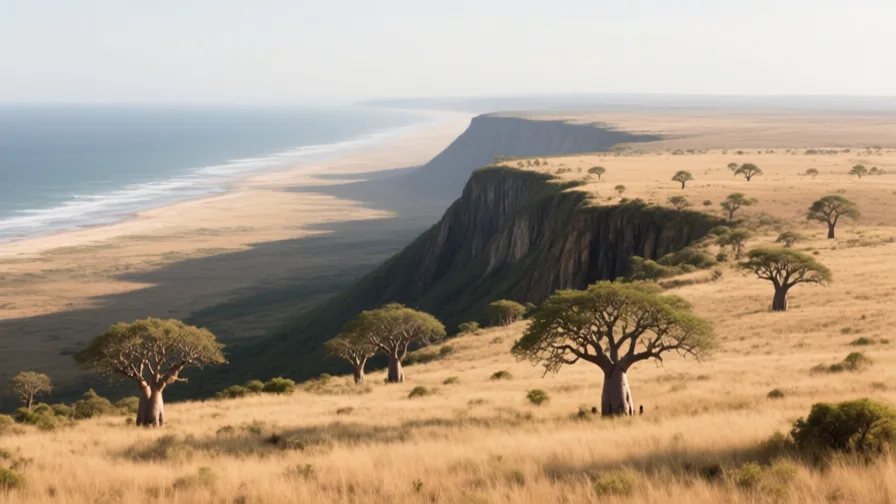 Angola · AI landscape illustration · Artistic impression
Country · Africa
Angola
Saved in this browser — no account needed. Sign in later and it comes with you.
Where it is
Angola fills a large block of the Atlantic side of southern Africa, about 1.25 million square kilometres, with Namibia to the south, Zambia to the east and the Congo to the north. Three belts run parallel to the sea: a dry coastal lowland, a broken line of hills and escarpments, and then a high plateau of savanna. Rain rises with altitude and is heavier in the north, so the interior is wetter and cooler than the coast. The north-western province of Cabinda is cut off from the rest of the country by Congolese territory.
The land and water around it
The coastal lowlandplain
A dry strip of low plains and terraces running from the Namibian border up to Luanda, mostly flat with occasional red sandstone bluffs. Unlike much of the African coast, it has several natural harbours, among them Luanda, Lobito, Moçâmedes and Tômbua, which is why the Portuguese could anchor their colony here.
The escarpment and the high plateauplateau
Behind the coast a belt of hills and cuestas climbs to the interior plateau, which begins around 1,200 metres and reaches 2,500 metres or more in parts of the south. The highest point, Morro de Môco, is 2,620 metres. The plateau is where the Ovimbundu kingdoms formed and where cooler air later drew settlers and railways.
The northern rain forestforest
In the far north and in Cabinda the savanna gives way to rain forest, and the rainy season can last seven months, from September to April. Around 53 per cent of the country is under forest cover, though that share has fallen since 1990.
Its history, in short
Before the Portuguese arrived, the Kingdom of Kongo dominated the north-west, with Ndongo and Matamba to the south of it and Ovimbundu kingdoms further south again. Portugal made contact with Kongo in the 1480s and founded Luanda in the 1570s. For roughly three centuries the coast was organised around supplying enslaved people to Brazil, and Portuguese authority reached the interior slowly; the present borders were only completed in the early twentieth century, against strong local resistance. Armed nationalism began in 1961 and ended Portuguese rule in 1975, but the three liberation movements immediately turned on one another, and with Soviet, Cuban, American and South African involvement the war lasted until 2002. Peace brought oil-funded reconstruction and fast, very uneven growth, concentrated in Luanda and the coast.
Timeline
Dates are shown on a timeline rather than as changing shapes on the map. The globe draws modern boundaries only, and tinting a modern outline to stand for a historical one would state something we cannot source.
Post-classical world
13th century
The Kingdom of Kongo
A large state forms between the Atlantic and the Cuango river, reaching from what is now Gabon down to the Kwanza. It is ruled from Mbanza Congo and divided into provinces under officials answerable to the king.
Early modern & oceanic
1483–1484
Portuguese contact
Portuguese ships under Diogo Cão reach the Kongo coast, and relations with the king follow. The sources place the first voyage in 1482, 1483 or 1484, but agree that the Kongo ruler soon adopted Christianity and corresponded with Europe.
1575–1576
Luanda founded
Paulo Dias de Novais settles a hundred families and four hundred soldiers on the coast. Luanda becomes the base from which the Portuguese trade, and later fight, along the Kwanza.
Approximate dateWikipedia1641–1648
Dutch Luanda
The Dutch occupy Luanda while Portugal is under Spanish rule, and Queen Jinga of Ndongo allies with them. A force sent from Brazil retakes the city in 1648, and Jinga's coalition collapses.
Well attestedWikipedia
Contemporary
1961
Armed struggle begins
The Baixa de Cassanje revolt opens a twelve-year war against Portuguese rule. Three nationalist movements, the MPLA, the FNLA and UNITA, grow out of it, each with a different base and foreign backer.
Well attestedWikipedia11 November 1975
Independence and civil war
The Alvor Agreement fails, and the MPLA holds Luanda as the Portuguese leave and declares independence. Cuban troops back the MPLA, while South Africa and Zaire support its rivals. The fighting continues for more than a quarter of a century.
2002
Peace
Government troops kill the UNITA leader Jonas Savimbi in February, and the Luena memorandum in April ends the war. Around four million displaced people are resettled in the following years.
Well attestedWikipedia
Places that carry meaning
Luanda1576 onward
The capital and main port, and the place where about a third of all Angolans now live. It grew through the slave trade, then through nineteenth-century commerce, then through wartime migration.
Huambofounded 1912
A highland railway town and, in 1975, the seat of a rival UNITA-led government. It was besieged and badly damaged in the civil war.
Cabinda20th century onward
The exclave in the north-west. A separatist movement, the Front for the Liberation of the Enclave of Cabinda, seeks its independence, and the conflict there has continued in sporadic actions.
Languages here
Places are usually multilingual. This lists what is actually spoken, not one language per border.
PortugueseRomance family
The official language and the language of most urban life.
The 2024 census records Portuguese as the native language of 45.5 per cent of Angolans, while a 2014 census found about 71 per cent using it at home. The two figures measure different things, and Portuguese is clearly the shared language between ethnic groups, especially in cities.
UmbunduBantu family
The most widely spoken Angolan language, centred on the central highlands.
The language of the Ovimbundu, spoken natively by about 17 per cent of Angolans in the 2024 census. It is strongest on the plateau and the coast to its west.
KimbunduBantu family
The language of the Ambundu, in and around Luanda and the strip to Malanje.
About 11 per cent of Angolans speak it natively. African rhythms and vocabulary are shaping the Portuguese spoken in the cities.
KikongoBantu family
The language of the Bakongo in the north-west.
Kikongo and Chokwe each account for about 7 per cent of native speakers. Kikongo is also spoken across the border in the Congo.
Learn the language here
Check yourself
How is Angola's terrain arranged from the coast inland?
A dry coastal lowland, a belt of hills and escarpments, then a high plateau
Three parallel belts run along the coast. Rainfall increases with altitude and temperatures fall, which is why the interior is wetter and cooler than the coast.
Why did Angola's civil war follow so quickly after independence?
Three rival liberation movements, each with foreign backers, fell out over who would rule
The MPLA, FNLA and UNITA had competed through the independence war and never united. After the Alvor Agreement collapsed, Soviet, Cuban, American, South African and Zairean involvement turned the dispute into a long proxy war.
Worth arguing about
- About a third of Angola's economic activity sits in Luanda and neighbouring Bengo, while parts of the interior stagnate. What would it take to change that?
- More than half of the country's exports go to one trading partner, and oil and diamonds dominate them. How does a state move from a war economy to a resource economy and then beyond it?
What we have not established
These are open questions, listed rather than filled in. We would rather show a gap than a plausible guess.
When exactly was Luanda founded, and how many Angolans speak Portuguese?
Accounts date the founding to 1575 or to January 1576. Language figures also depend on the question asked: the 2014 and 2024 censuses report Portuguese as a home language and as a native language, which are not directly comparable.
Sources
- Wikipedia · AngolaWikipedia · encyclopedia · checked 2026-11-24
- Wikipedia · History of AngolaWikipedia · encyclopedia · checked 2026-11-24
- Wikipedia · Geography of AngolaWikipedia · encyclopedia · checked 2026-11-24
Reviewed by Globe Quest editorial on 2026-11-24. Drafted with AI assistance and checked against the sources above before publication.