 Globe Quest
 Human Quest · LearningSign in
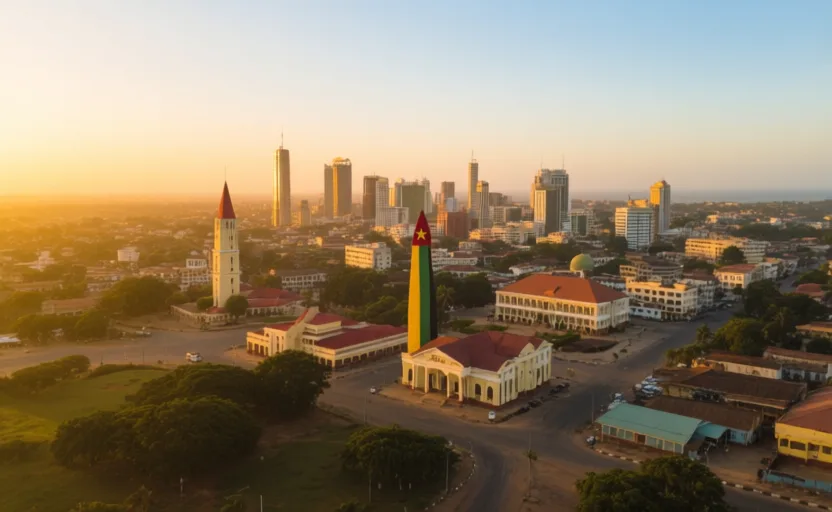 Cabinda · AI city illustration · Artistic impression
City · Africa
Cabinda
Saved in this browser — no account needed. Sign in later and it comes with you.
Where it is
Cabinda is on the Atlantic coast, on the right bank of the Bele river, in a province that Angola holds as an exclave to the north of the Congo river mouth. Its bay covers almost the whole coastline of the city. The land behind is tropical savanna and woodland, with equatorial forest in the east, and the city stands about 24 metres above the sea. Pointe-Noire in the Republic of the Congo is 137 kilometres to the north, and the Congo estuary about 70 kilometres south, so the city looks toward its neighbours on the river mouth as much as toward Luanda.
The land and water around it
Cabinda Baybay
A calm bay close to the mouth of the Congo, which allowed a busy port to form here from the sixteenth century on. Its position near the river mouth made it a navigation point on the whole coast.
The coastal savanna and forestforest
The municipality is dominated by savanna and woodland, with portions of equatorial forest in the east. Until the end of the nineteenth century the inland area was poor and unhealthy, which kept people on the coastal strip.
Its history, in short
Cabinda began as a settlement of fishermen and hunters and, from about 1530, became the sea outlet of the Kingdom of Cacongo, one of the states federated under the Kongo kings. Portuguese traders had a post here from 1620, dealing in enslaved people, cloth, salt and timber, and the trade was valuable enough for a Luso-Brazilian force to attack British positions in 1723. A fort built in 1783 was destroyed the following year. The city proper dates from the 1880s: the Treaty of Simulambuco, signed in 1885, made the region a Portuguese protectorate, and Cabinda became its capital. It was raised to city status in 1956. In 1975 it was the scene of fighting between the MPLA and the FNLA with Zairean troops, and it later served as the main Angolan army base in the Cabinda conflict. Offshore oil gives it its present importance.
Timeline
Dates are shown on a timeline rather than as changing shapes on the map. The globe draws modern boundaries only, and tinting a modern outline to stand for a historical one would state something we cannot source.
Early modern & oceanic
from c. 1530
Outlet of Cacongo
A small settlement turns into the main seaport of Cacongo, a state in the Kongo confederation.
Approximate dateWikipedia1620
A Portuguese trading post
Traders set up a post for enslaved people, cloth, salt and timber. The trade is important enough that a Luso-Brazilian expedition attacks British positions in 1723.
Well attestedWikipedia1783
Fort of Santa Maria de Cabinda
The Portuguese agree with Cacongo's rulers to build a fort. It is destroyed the next year in a joint attack by the Angoio, Cacongo and France.
Well attestedWikipedia
Industrial & imperial
1 February 1885
Treaty of Simulambuco
Signed seven kilometres north of the centre, it recognises the Cabinda region as a Portuguese protectorate. Cabinda becomes capital of the Portuguese Congo Protectorate in 1887.
Well attestedWikipedia
Contemporary
28 May 1956
City status
Cabinda is formally raised to the rank of city, matching its role as a provincial capital.
Well attestedWikipedia1975–1976
Battles for Cabinda
MPLA forces take the city after the Portuguese revolution, then fight FNLA and Zairean units on the border and at Morro do Chizo. The city becomes a heavily fortified base of the Angolan army.
Well attestedWikipedia2010
The Africa Cup of Nations
Cabinda hosts matches at the new Estádio Nacional do Chiazi. The separatist FLEC attacks the bus carrying the Togo team, killing three people.
Well attestedWikipedia
Places that carry meaning
Simulambuco Monument1885
Stands where the 1885 treaty was signed. The secessionist Republic of Cabinda disputes Angolan sovereignty over the province, which makes the treaty's site a political landmark as much as a historical one.
Fort of Santa Maria de Cabinda1783
The ruins of the Portuguese fort are evidence of the long struggle to control this stretch of coast.
Cabinda Museum20th century
A centre for collecting Cabindan oral tradition, with displays of the handicrafts, customs and cultural practices of the province.
Languages here
Places are usually multilingual. This lists what is actually spoken, not one language per border.
Ibinda (Fiote)Bantu family
The main language of the city and province.
Spoken as the first language by most residents. Because Portugal colonised Cabinda later than the rest of Angola, Portuguese has spread more slowly here.
PortugueseRomance family
The official language, used mainly in administration and increasingly in daily life.
The number of Portuguese speakers is growing quickly. Migrants from elsewhere in Angola and from both Congos have added to the mix of languages in the city.
Learn the language here
- 1Understand which languages are spoken hereCabinda is multilingual. Start with which languages are used, by whom, and for what — the phrase list only covers one of them.Written by Globe Quest
- 2Learn 15 phrasesCurated everyday phrases for Cabinda, with audio and a written form.Written by Globe Quest
- 3Say them out loudSpeaking practice with pronunciation feedback, one phrase at a time.Globe Quest material, your own additions
- 4Come back to themSpaced review, so what you learned this week is still there next month.Written by Globe Quest
Check yourself
Why is Portuguese less established in Cabinda than in the rest of Angola?
Portugal colonised Cabinda later, so Ibinda stayed the main language
Portuguese colonisation came later here than elsewhere in Angola, which left Ibinda as the primary language of the city and province.
What did the Treaty of Simulambuco do?
Recognised the Cabinda region as a Portuguese protectorate
Signed in 1885, it made the region a Portuguese protectorate, and the status of Cabinda has been contested ever since the end of Portuguese rule.
Worth arguing about
- A province that the rest of the country can reach only by sea, by air or through foreign territory. What does a place like that need in order to feel part of the state?
- Angola holds Cabinda, and a secessionist movement disputes that. How should outsiders describe a place whose status is contested?
What we have not established
These are open questions, listed rather than filled in. We would rather show a gap than a plausible guess.
What is Cabinda's current population?
The 2014 census gave about 550,000 for the city and 624,646 for the municipality, while a later figure of 699,053 is for the municipality. Boundaries changed in September 2024 when parts were split into new municipalities, so recent figures are not like-for-like.
Sources
- Wikipedia · Cabinda (city)Wikipedia · encyclopedia · checked 2026-11-24
Reviewed by Globe Quest editorial on 2026-11-24. Drafted with AI assistance and checked against the sources above before publication.