 Globe Quest
 Human Quest · LearningSign in
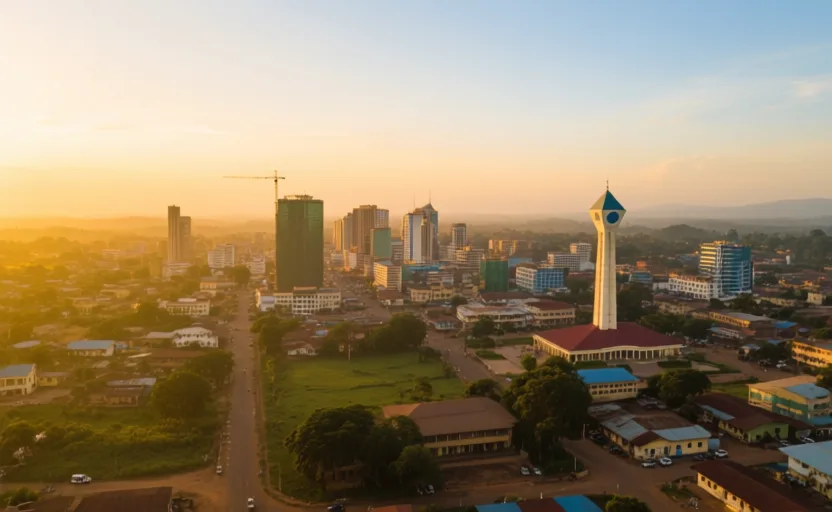 Mbuji-Mayi · AI city illustration · Artistic impression
City · Africa
Mbuji-Mayi
Saved in this browser — no account needed. Sign in later and it comes with you.
Where it is
Mbuji-Mayi stands on the river of the same name in the south-central part of the Democratic Republic of Congo, in Luba country. The climate is tropical with a distinct dry season. Few places of this size are so cut off: the city has little connection to the surrounding provinces, to Kinshasa or to Lubumbashi. Almost everything about its shape follows from what lies underfoot, because the town was laid out on top of one of the largest diamond deposits known, and its streams still carry stones.
The land and water around it
The Mbuji-Mayi River and its tributariesriver
The city lies on the river that gives it its name, and the streams around it are part of the reason the diamond trade escapes control. In the early years stones could be picked out of the waterways by anyone, which left a permit regime as the only way a company could try to police the area. The same rivers are a problem for drinking water: in 2019 some residents were taking water straight from them, and cholera followed.
The diamond-bearing grounddiamond field
In the 1950s the area was thought to hold the world's most important industrial diamond deposits, at least 300 million carats. The city was built over them, and houses, including those of senior company staff, were sometimes demolished to reach the stones beneath. The ground decides who has reason to be here and why the town grew the way it did.
A tropical wet-and-dry climateclimate
The city has a tropical wet-and-dry climate, with a marked dry season. Distance, rather than weather, is the main constraint on this place: it is cut off from the neighbouring provinces and from the country's two largest cities.
Its history, in short
Before the diamonds, the site was a scatter of villages on land held by the Bakwanga clan. Stones were found around 1907 and their worth was understood by 1913, after which a mining company built a camp for its workers and officials. Under that company the settlement, called Bakwanga, grew by plan rather than by choice. Residents needed permits, a command post tracked arrivals, and building and farming were discouraged to protect the diamonds from theft, so the population was only about 39,830 by the late 1950s. Independence in 1960 broke the lock. Luba migrants arrived from other parts of the country, and in August 1960 the Luba chief Albert Kalonji proclaimed the secessionist Mining State of South Kasai with Bakwanga as its capital. Government troops had taken the town by December 1961, and after a brief revival of the secessionist government they retook it in October 1962, and the name Mbuji-Mayi replaced Bakwanga at the end of that year. In the decades of neglect that followed, the mining company ran the town's power and water. How many people live here today is a matter of wide dispute, because nobody has counted them reliably.
Timeline
Dates are shown on a timeline rather than as changing shapes on the map. The globe draws modern boundaries only, and tinting a modern outline to stand for a historical one would state something we cannot source.
Industrial & imperial
1907 and 1913
Diamonds found, then understood
Diamonds are first found in the area in 1907. Their true value is not recognised until 1913, and a mining camp for the Société minière de Bakwanga follows.
Well attestedWikipedia
Contemporary
Late 1950s
A permit town of about 40,000
Residence is controlled by permit and registration, and the company discourages building and farming. The population stands at about 39,830.
Approximate dateWikipedia8 August 1960
South Kasai secedes
Soon after Congolese independence, Albert Kalonji declares the Mining State of South Kasai and makes Bakwanga its capital. He is proclaimed emperor in a traditional ceremony in April 1961.
Well attestedWikipediaOctober 1962
Retaken by government troops
Government troops first take the town and arrest Kalonji by December 1961. After he escapes and briefly revives his government, a second assault ends in his capture on 4 October 1962. The town is known as Mbuji-Mayi from the end of that year.
Well attestedWikipedia1980s and 1990s
The company fills the state's place
With almost no national money for roads, schools or hospitals, the mining company repairs roads, pays soldiers, supplies power and water from its own station, and funds a university. Its chief executive, appointed in 1986, becomes the town's de facto governor.
Well attestedWikipedia4 April 1997
The city falls to Kabila's rebels
As Laurent-Désiré Kabila's forces approach, the company's chief changes sides. Looting by both sides damages the mining operations, and the company then makes payments toward Kabila's war.
Well attestedWikipedia2020
A drinking-water project
The national government launches a project, expected to cost at least 26.2 million dollars, to repair the pumping station and extend the water network. It is expected to help without ending the city's water crisis.
Approximate dateWikipedia
Places that carry meaning
Avenue Inga20th century onward
The main business street, where diamond and mineral buyers have set up shop. One journalist described a city with no real centre and a layout driven by commerce rather than design.
The company mining concession1913 onward
A large mine on the outskirts supplied most of the early output, and the concession remains the source of the city's identity and of its conflicts. Amnesty International reported in 2002 that dozens of suspected illegal miners had been shot dead in the diamond fields.
The Central Prison2015
An outbreak of tuberculosis, including drug-resistant cases, was found in the town's prison in January 2015. It was filled to six times its capacity, which shows how thin public services are in the city.
Languages here
Places are usually multilingual. This lists what is actually spoken, not one language per border.
TshilubaBantu family
The local language of Luba country, and the source of the city's name.
The name Mbuji-Mayi is Tshiluba and means goat-water, after the many goats once kept in the region. The Luba population swelled after independence, when Luba people came from other parts of the country.
FrenchRomance family
The official language and the national lingua franca.
French is the country's official language and, in a 2021 survey, 74 percent of Congolese said they could speak it. It is the language shared between speakers of the country's more than 200 indigenous languages.
LingalaBantu family
The most widely spoken indigenous language nationally.
Lingala is the most widely spoken of the country's indigenous languages, though the language of everyday life in Luba country is Tshiluba.
Learn the language here
- 1Understand which languages are spoken hereMbuji-Mayi is multilingual. Start with which languages are used, by whom, and for what — the phrase list only covers one of them.Written by Globe Quest
- 2Learn 12 phrasesCurated everyday phrases for Mbuji-Mayi, with audio and a written form.Written by Globe Quest
- 3Say them out loudSpeaking practice with pronunciation feedback, one phrase at a time.Globe Quest material, your own additions
- 4Come back to themSpaced review, so what you learned this week is still there next month.Written by Globe Quest
Check yourself
What does the name Mbuji-Mayi mean in Tshiluba?
Goat-water
The name comes from Tshiluba and means goat-water, after the large number of goats in the region. The town was known as Bakwanga until the end of 1962.
Why did the mining company restrict building and movement in its early decades?
To protect the diamonds from theft
Fearing theft, the company required permits and registration and discouraged building, which is why the town stayed small until independence.
Worth arguing about
- A town laid out around a company, then left to that company by the state. What does a city owe the people who live on top of its only resource?
- Diamonds could once be picked from the streams by anyone. Is a resource that cannot be fenced a blessing or a trap for the place that has it?
What we have not established
These are open questions, listed rather than filled in. We would rather show a gap than a plausible guess.
How many people live in Mbuji-Mayi?
Estimates range from about 1.5 million to as many as 3.5 million, depending on who counted and when. No reliable recent census exists, so we give the range rather than a figure.
Sources
- Wikipedia · Mbuji-MayiWikipedia · encyclopedia · checked 2026-11-24
- Wikipedia · Democratic Republic of the CongoWikipedia · encyclopedia · checked 2026-11-24
Reviewed by Globe Quest editorial on 2026-11-24. Drafted with AI assistance and checked against the sources above before publication.