 Globe Quest
 Human Quest · LearningSign in
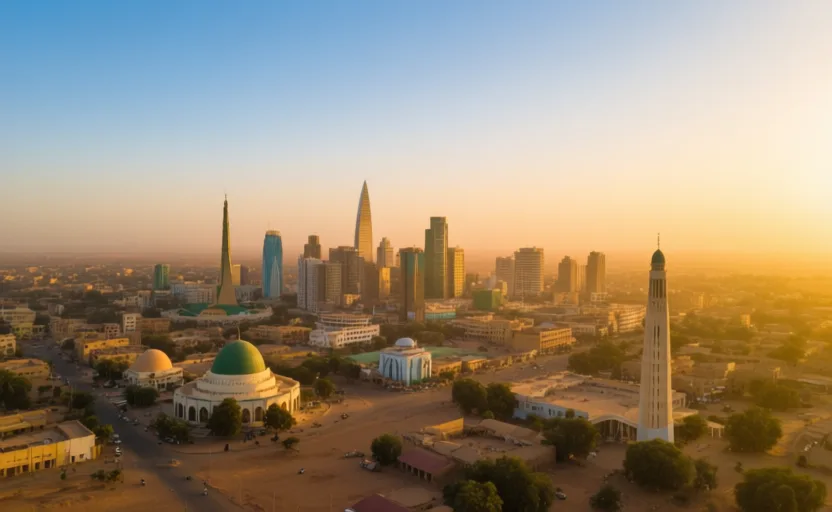 N'Djamena · AI city illustration · Artistic impression
City · Africa
N'Djamena
Saved in this browser — no account needed. Sign in later and it comes with you.
Where it is
The capital stands on the east bank of the Chari at the point where the Logone joins it, in a flat, dry landscape in the far southwest of Chad. Across the two rivers lies Kousséri, in Cameroon, and the pair form one built-up area split by a border. The climate is hot semi-arid: about 510 mm of rain falls in a year, nearly all of it between June and September, and only in August does the average daily high stay under 32 °C. The hottest weeks come in March to May, before the rains. Farming and herding trade still shape the city’s economy, so a poor rainy season is felt in the markets.
The land and water around it
The Chari and Logone confluenceriver
The city is a river port at the meeting of the two rivers that feed Lake Chad. Their west bank belongs to Cameroon, so one stretch of water carries a national frontier through the middle of a single urban area. The Chari also carries heavy-metal contamination that increases downstream of the city, especially in the dry season.
The Sahelian plainplain
The land around the city is largely flat and arid, with the dry season occupying about eight months of the year. High evaporation means that even 510 mm of annual rain leaves the climate classed as semi-arid, and the Harmattan and dust season do the rest.
Lake Chad nearbylake
The lake lies close enough to influence the city’s climate and ecology, and the trade in meat, fish, cotton, livestock, salt, dates and grain that passes through the city’s markets draws on its basin.
Its history, in short
N’Djamena began as a military post. Émile Gentil founded Fort-Lamy on 29 May 1900, a month after the French commander it was named for died at Kousséri, and until the 1920s it was run by the army. It was a minor place for decades: fewer than 10,000 people lived there in 1937. In the Second World War its airfield served as a relay for French troops and supplies. Under Tombalbaye the city was renamed in 1973, taking the name of a nearby Arabic-named village meaning “place of rest”. Its worst years were the civil war. Fighting between northern factions wrecked parts of the city in 1979 and 1980, almost everyone crossed the river to Cameroon, and Libyan forces held it briefly before Hissène Habré took it in 1982 without much resistance. Services were rationed until 1984. Since then the city has grown on the back of people seeking safety from conflict elsewhere, passing a million inhabitants in the early 2010s, and rebels reached it again in 2006 and 2008.
Timeline
Dates are shown on a timeline rather than as changing shapes on the map. The globe draws modern boundaries only, and tinting a modern outline to stand for a historical one would state something we cannot source.
Industrial & imperial
29 May 1900
Fort-Lamy founded
Émile Gentil establishes a French outpost on the Chari and names it for Amédée-François Lamy, killed at the Battle of Kousséri about a month before.
Well attestedWikipedia21 January 1942
Airfield bombed
The French use the city’s airport to move troops and supplies in the Second World War, and a single German Heinkel bomber destroys oil stocks and ten aircraft on the ground.
Well attestedWikipedia
Contemporary
18 November 1956
First municipal elections
The city is divided into five electoral sections. The first, the European district, has four seats on the 33-seat council; the first council has 25 Africans and 8 Europeans. The European district remains a separate quarter into the 1960s.
Well attestedWikipedia6 April 1973
Renamed N’Djamena
President Tombalbaye replaces the colonial name as part of his programme of Africanisation, taking Niǧāmīnā from a nearby village.
Well attestedWikipedia1979–1982
War and flight
Fighting between Habré’s forces and rival northern leaders destroys part of the city. Residents flee to Kousséri, and Libyan tanks help drive Habré out in 1980. They return in 1981–82, when Habré enters the city and takes the presidency.
Well attestedWikipedia2006 and 2008
Rebel assaults
An attack by the United Front for Democratic Change is defeated on 13 April 2006. Rebel groups attack again in early February 2008 and reach the presidential palace before government forces fight them off.
Places that carry meaning
The old colonial corefrom 1900
The area along the Chari where ministries and other government institutions sit, laid out as a European district. To its north and east is newer building, called the “African city” by some residents, where much of the trade happens, and beyond that is the fastest-growing zone with limited formal services.
Chad National Museumpresent
The museum shows a partial skull of Sahelanthropus, known locally as Toumaï, found in the north of the country and regarded as one of the earliest human relatives.
Avenue Charles de Gaulle20th century
The city’s main commercial street, running through the area of the Nassara strip. Its name is one of many reminders of the French period that the 1973 renaming of the city did not remove.
Koussérifrom 1900
The Cameroonian town on the opposite bank, whose battle in April 1900 gave the city its first name and whose streets sheltered N’Djamena’s population during the fighting of 1979–1981.
Languages here
Places are usually multilingual. This lists what is actually spoken, not one language per border.
FrenchRomance family
Language of government, administration and education.
French is the country’s lingua franca and, as the home of every ministry, the courts and the foreign embassies, the capital is where that role is most visible. Its former name, Fort-Lamy, was French.
ArabicSemitic family
Co-official language, and the source of the city’s present name.
The name N’Djamena comes from the Arabic name of a nearby village, and the city was named capital of Islamic culture for 2009. Arabs are the second-largest ethnic group of the country.
Regional languages
The home languages of the country’s many ethnic communities.
Over 100 languages are spoken in Chad, among them Chadic languages and others from the Central Sudanic, Maban and Niger-Congo groups. The capital draws people from the whole country, including many who came as refugees from conflict.
Learn the language here
- 1Understand which languages are spoken hereN'Djamena is multilingual. Start with which languages are used, by whom, and for what — the phrase list only covers one of them.Written by Globe Quest
- 2Learn 14 phrasesCurated everyday phrases for N'Djamena, with audio and a written form.Written by Globe Quest
- 3Say them out loudSpeaking practice with pronunciation feedback, one phrase at a time.Globe Quest material, your own additions
- 4Come back to themSpaced review, so what you learned this week is still there next month.Written by Globe Quest
- 5Practise with people: Arabic practice · DohaAn in-person practice circle. It is a prepared plan and needs a host before it runs.Run by members
Check yourself
Where does the name N’Djamena come from?
The Arabic name of a nearby village, meaning “place of rest”
The city was Fort-Lamy, after Amédée-François Lamy, until 1973, when it took the name of a village, Niǧāmīnā. The Kanuri word for lake gave the country its name, not the capital.
What lies across the river from N’Djamena?
Kousséri, in Cameroon
Kousséri sits on the west bank of the Chari and Logone, and the two towns form one cross-border agglomeration. Residents fled there during the fighting of 1979 and 1980.
Worth arguing about
- A capital whose population multiplied from under 10,000 to over a million in under a century, largely through people escaping conflict. What does a city like that owe to its newcomers?
- The colonial name was replaced in 1973, but the main avenue and the old district still follow the French layout. How much does a rename change a city?
What we have not established
These are open questions, listed rather than filled in. We would rather show a gap than a plausible guess.
How many people live in N’Djamena?
Published estimates differ widely: a figure of about 1.6 million is given for the capital in recent descriptions of the country, while an earlier account puts it above 700,000 and a count for 2012 gives roughly 1.09 million. Rapid growth and unclear boundaries between city and suburbs leave the true total open.
Sources
- Wikipedia · N'DjamenaWikipedia · encyclopedia · checked 2026-11-24
- Wikipedia · ChadWikipedia · encyclopedia · checked 2026-11-24
- Wikipedia · History of ChadWikipedia · encyclopedia · checked 2026-11-24
Reviewed by Globe Quest editorial on 2026-11-24. Drafted with AI assistance and checked against the sources above before publication.