 Globe Quest
 Human Quest · LearningSign in
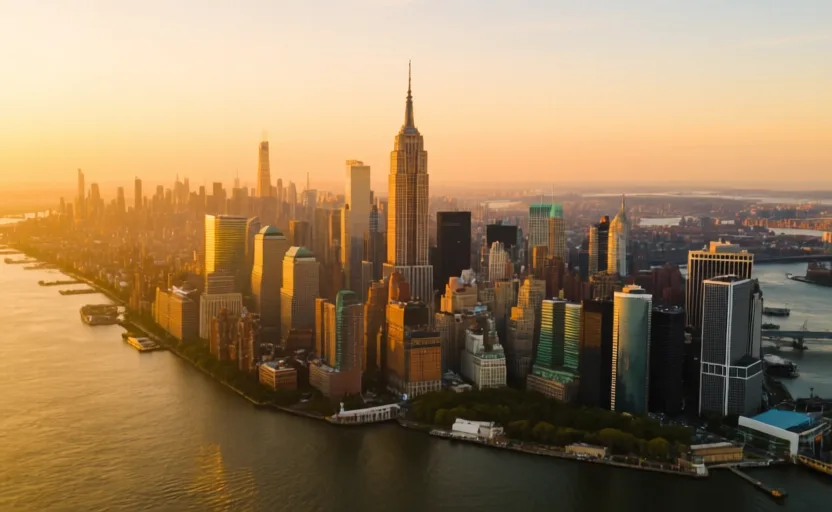 New York City · AI city illustration · Artistic impression
City · North America
New York City
Also known as New York, New Amsterdam, New York City
Saved in this browser — no account needed. Sign in later and it comes with you.
Where it is
Few big cities owe as much to their water. New York stands where the Hudson River reaches a naturally sheltered harbour and then the Atlantic, about halfway between Washington and Boston, and most of the city is built on three islands: Manhattan, Staten Island and the western end of Long Island. The ice sheet of the last glaciation ended near here, and its advance and retreat helped separate Long Island from Staten Island. The climate is humid subtropical, the northernmost of any major city on the continent, with about 1,260 millimetres of rain spread evenly through the year, chilly damp winters, and more than 2,500 hours of sun.
The land and water around it
New York Harbor and the Hudson mouthharbour
One of the world’s largest natural harbours. The Hudson empties into it, and the shelter it gives is the reason a trading port grew here at the southern tip of Manhattan.
Manhattan, Long Island and Staten Islandisland
The three islands under the city. Manhattan’s Lenape name, Manahatta, is usually translated “island of many hills”. Before settlement the island was marshy and cut by streams, and Broadway still follows an old Lenape path.
Jamaica Baymarsh
A salt marsh and island complex across Brooklyn and Queens, part of the Gateway National Recreation Area, which holds more than 9,000 acres of marsh, wetland and water inside the city.
Its history, in short
The harbour was the homeland of the Munsee-speaking Lenape, who called their territory Lenapehoking and were estimated at around 15,000 people in 80 settlements before colonisation. Italian navigator Giovanni da Verrazzano was the first documented European visitor, in 1524. The Dutch founded a permanent settlement on Governors Island in 1624 and built Fort Amsterdam on Manhattan the next year; in 1626 Peter Minuit bought the island from the Canarsie, a small Lenape band, for goods worth 60 guilders. The English took the colony without a fight in 1664 and renamed it for the Duke of York. The city was a centre of resistance to the Crown in the 1760s, the site of the largest battle of the Revolutionary War in 1776, and briefly the national capital, where Washington took office and the Bill of Rights was drafted. It became the country’s largest city in 1790. In the late nineteenth and early twentieth centuries it was the main entrance for immigrants arriving through Ellis Island. In 1898 Brooklyn and several counties merged into the five-borough city, which the subway, opened in 1904, helped bind together.
Timeline
Dates are shown on a timeline rather than as changing shapes on the map. The globe draws modern boundaries only, and tinting a modern outline to stand for a historical one would state something we cannot source.
Early modern & oceanic
1524
Verrazzano enters the harbour
The Italian explorer, sailing for France, is the first European documented in New York Harbor. He names the area New Angoulême.
1624
Dutch settlement
A Dutch fur-trading settlement on Governors Island is the first permanent European presence, and construction of Fort Amsterdam on Manhattan begins in 1625.
Well attestedWikipedia1664
The English take New Amsterdam
Peter Stuyvesant surrenders to English troops without bloodshed, on terms that let Dutch residents stay. In 1667 the Dutch confirm the exchange for Suriname, and the settlement is renamed New York.
Well attestedWikipediaAugust 1776
The Battle of Long Island
The largest battle of the Revolutionary War is fought in Brooklyn. Washington’s army retreats, and the British make New York their base in North America until late 1783.
1785–1790
National capital
New York hosts Congress, Washington’s inauguration at Federal Hall and the first Supreme Court sessions. In 1790 it passes Philadelphia as the largest city, and in the same year the capital moves there.
Well attestedWikipedia
Industrial & imperial
1886
The Statue of Liberty
The gift from France is dedicated in the harbour. It welcomes some 14 million immigrants who arrive by ship through Ellis Island.
Well attestedWikipedia1898
Consolidation
Brooklyn, the County of New York, Richmond County and western Queens merge as the City of New York. The subway opened in 1904 helps bind the pieces together.
Well attestedWikipedia
Contemporary
28 June 1969
Stonewall
Protests against a police raid on the Stonewall Inn in Greenwich Village are widely regarded as the key event of the gay liberation movement.
Well attestedWikipedia
Places that carry meaning
Federal Hall, Wall Street1789–1790
Where George Washington was inaugurated, the first Congress met and the Bill of Rights was drafted. The wooden stockade the Dutch built in 1653 against raids stood along what is now Wall Street.
Pieter Claesen Wyckoff Houseoldest section 1656
A Dutch Colonial farmhouse in Brooklyn whose oldest section dates to 1656, a surviving trace of the colonial period.
Governors Island1624
The site of the first permanent Dutch fur-trading settlement. Plans now call for a US$1 billion research and education centre on climate change here.
Languages here
Places are usually multilingual. This lists what is actually spoken, not one language per border.
EnglishGermanic family
The common language, spoken with a distinctive local accent.
The New York dialect, also called Brooklynese or New Yorkese, is considered one of the most recognisable accents in American English.
SpanishRomance family
The second language of the city, widely spoken in homes and on the street.
Dominican (8.7 per cent), Puerto Rican, Mexican and Ecuadorian are among the largest ancestries, and 28.4 per cent of residents identify as Hispanic or Latino. In New York State, Spanish is spoken by about 2.8 million people.
Chinese languages, Russian, Bengali and hundreds more
Immigrant languages that make the city among the most linguistically varied in the world.
About 800 languages are estimated to be spoken in the city. Chinese is the second-largest ancestry (7.5 per cent), and statewide, Chinese, Russian and Bengali follow Spanish as the most common languages other than English.
MunseeAlgonquian family
The language of the Lenape, whose homeland the city occupies.
Munsee-speaking Lenape lived in the area when the Dutch arrived. The name Manhattan comes from a Lenape language, though its exact meaning is hard to confirm.
Learn the language here
- 1Understand which languages are spoken hereNew York City is multilingual. Start with which languages are used, by whom, and for what — the phrase list only covers one of them.Written by Globe Quest
- 2Learn 12 phrasesCurated everyday phrases for New York City, with audio and a written form.Written by Globe Quest
- 3Say them out loudSpeaking practice with pronunciation feedback, one phrase at a time.Globe Quest material, your own additions
- 4Come back to themSpaced review, so what you learned this week is still there next month.Written by Globe Quest
Check yourself
In what year did the English take New Amsterdam and rename it New York?
1664
English troops under Colonel Richard Nicolls took the city without a battle in 1664. It was renamed for the Duke of York, later James II.
What was formed in 1898?
The City of New York, merging Brooklyn, Manhattan and neighbouring counties
The merger created the five-borough city, each borough coextensive with a county. The subway, opened in 1904, linked the separate parts.
Worth arguing about
- A city built on a harbour with 800 languages and over a third of its residents born abroad. What keeps a place that mixed legible to its own people?
- The island’s original inhabitants have left few visible marks except place names and a few paths. Which of those traces deserves marking, and by whom?
What we have not established
These are open questions, listed rather than filled in. We would rather show a gap than a plausible guess.
How many people live in New York City?
The 2020 census counted 8,804,190, while a 2026 estimate gives 8,586,038, so the total depends on the year and method used.
When did the Dutch first settle, and what did the 1626 purchase mean?
Accounts give the first Dutch settlement as 1608 or 1624, and the 1626 transfer of Manhattan for goods worth 60 guilders was made with the Canarsie, one small Lenape band, not with the Lenape as a whole.
Sources
- Wikipedia · New York CityWikipedia · encyclopedia · checked 2026-11-24
- Wikipedia · History of New York CityWikipedia · encyclopedia · checked 2026-11-24
- Wikipedia · Languages of the United StatesWikipedia · encyclopedia · checked 2026-11-24
Reviewed by Globe Quest editorial on 2026-11-24. Drafted with AI assistance and checked against the sources above before publication.