 Globe Quest
 Human Quest · LearningSign in
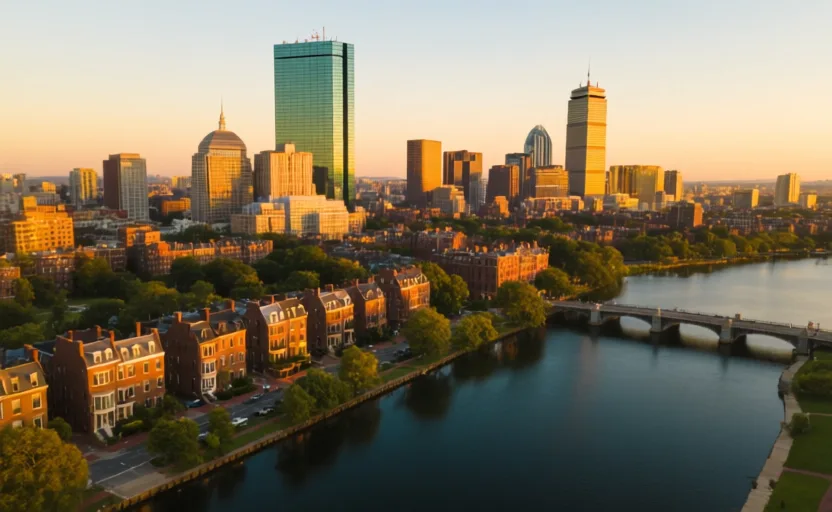 Boston · AI city illustration · Artistic impression
City · North America
Boston
Saved in this browser — no account needed. Sign in later and it comes with you.
Where it is
Most of inner Boston is made ground. The original town was the Shawmut Peninsula, a knob of land with three hills, tied to the mainland by a thin neck and ringed by mudflats, salt marsh and the tidal estuary of Back Bay. More than two-thirds of the modern inner city did not exist in 1630: it was filled in over the centuries with earth from the hills and gravel brought by train. The harbour is an arm of Massachusetts Bay, and the city’s highest point, Bellevue Hill, reaches only 330 feet. Winters are cold and stormy, summers warm and humid, and sea-level rise is now a planning problem for the filled districts.
The land and water around it
The Shawmut Peninsula and Boston Neckpeninsula
The founding town sat on a peninsula with a single narrow land connection to the south. That neck was surrounded by infill from 1803 and widened to dozens of times its original width by about 1900, which is why the old defensive geography is invisible today.
Back Bay and the Charles Riverestuary
The Charles, called Quinobequin, “the meandering one”, by the Massachusett, ends in a tidal estuary beside the peninsula. Gravel carried by train from Needham was used to fill Back Bay, and many older buildings there stand on wooden piles driven into the fill, which stay sound only while kept wet.
Trimountainmountains
The three original hills gave Tremont Street its name. They were levelled to supply fill for the surrounding tidal flats, so the topography of the old centre was literally moved into the harbour edge.
Its history, in short
The Massachusett people lived in seasonal communities around the harbour and along the Charles River, and the peninsula itself was thinly used. An Anglican clergyman, William Blaxton, was living there alone when Puritan colonists from failing Charlestown crossed over in 1630, drawn by a spring. They named the town after Boston in Lincolnshire. Church and school were bound together early: Boston Latin in 1635 and Harvard in 1636, while dissenters such as Anne Hutchinson and Mary Dyer were banished or hanged. Resistance to the Stamp Act, the Massacre of 1770 and the Tea Party of 1773 made the town the centre of the Revolution, and the British left in March 1776. In the nineteenth century trade gave way to mills and railroads, while Irish famine migrants and later arrivals filled neighbourhoods that were still ethnically distinct by 1900. Today universities and biotechnology employ much of the city.
Timeline
Dates are shown on a timeline rather than as changing shapes on the map. The globe draws modern boundaries only, and tinting a modern outline to stand for a historical one would state something we cannot source.
Early modern & oceanic
September 1630
Puritans cross to Shawmut
Blaxton writes to Isaac Johnson at Charlestown about a good spring and invites the colonists over. The town is named on 30 September 1630 under the old calendar.
1635–1636
A school and a college
Boston Latin School opens in 1635, and Harvard College is founded the following year, tying education to the colony’s religious aims.
Well attestedWikipedia1 June 1660
Mary Dyer hanged
A Quaker, she is executed on Boston Common for returning to a colony that had banned Quakers. Dissenters were exiled or punished throughout the Puritan era.
Well attestedWikipedia1770–1776
From Massacre to evacuation
British troops fire into a crowd in 1770, the Tea Party follows in 1773, and the colonists besiege the city after Bunker Hill. The British evacuate on 17 March 1776, and blockades leave a large share of the population gone.
Industrial & imperial
1831
The Liberator
William Lloyd Garrison founds the abolitionist newspaper in Boston, which becomes the centre of the movement.
Well attestedWikipedia9 November 1872
The Great Boston Fire
The fire destroys about 65 acres, including 776 buildings in the financial district, in two days.
Well attestedWikipedia15 January 1919
The Great Molasses Flood
A wave of molasses in the North End kills 21 people and injures 150.
Well attestedWikipedia
Contemporary
2007
The Big Dig is finished
The Central Artery/Tunnel Project, completed after many delays and cost overruns, puts the central highway underground.
Well attestedWikipedia
Places that carry meaning
Boston Common1634
Laid out in 1634 as the country’s first public park, and the place where Mary Dyer was hanged.
North EndLate 19th century onward
By 1900 Italians were the largest group here, one of several enclaves where each wave of immigrants settled together: Irish in South Boston and Charlestown, Russian Jews in the West End. The molasses flood struck here.
Back BayMade land
A district built on filled tidal estuary, on ground that did not exist when the Puritans arrived. It shows how far the engineered shoreline reaches inland.
Languages here
Places are usually multilingual. This lists what is actually spoken, not one language per border.
EnglishGermanic family
The everyday language, with a distinctive regional accent.
The Boston accent belongs to the non-rhotic Eastern New England family and comes with its own slang. In Massachusetts as a whole, English is the first language at home for the large majority.
SpanishRomance family
The largest language after English in the state and the region.
In Massachusetts in 2024 about 670,000 people spoke Spanish at home. Greater Boston includes some 150,000 Dominicans, 134,000 Puerto Ricans, and Salvadoran, Guatemalan, Mexican and Colombian communities, strongest in East Boston and southwest neighbourhoods.
PortugueseRomance family
Spoken by one of the state’s large immigrant communities.
Portuguese is the state’s third language, with about 248,000 speakers in 2024. Cape Verdeans and Haitians are among the groups who share the city’s southwest neighbourhoods with African Americans and Dominicans.
Haitian Creole and Chinese
Immigrant languages with sizeable communities.
Chinese had about 154,000 speakers in Massachusetts in 2024 and Haitian Creole about 87,000. In 1910 the state’s top languages after English were French, Italian, Yiddish and German, which shows how the mix has shifted.
Learn the language here
- 1Understand which languages are spoken hereBoston is multilingual. Start with which languages are used, by whom, and for what — the phrase list only covers one of them.Written by Globe Quest
- 2Learn 12 phrasesCurated everyday phrases for Boston, with audio and a written form.Written by Globe Quest
- 3Say them out loudSpeaking practice with pronunciation feedback, one phrase at a time.Globe Quest material, your own additions
- 4Come back to themSpaced review, so what you learned this week is still there next month.Written by Globe Quest
Check yourself
Roughly how much of inner Boston’s modern land existed when the city was founded?
Less than a third
More than two-thirds of today’s inner land was made by filling tidal areas with earth from the three hills and gravel brought by rail.
Who invited the Puritans to settle on the Shawmut Peninsula?
William Blaxton, the Anglican clergyman already living there
Blaxton wrote to Isaac Johnson at Charlestown in September 1630 and offered a spring on the peninsula, where water was scarce on the other side of the bay.
Worth arguing about
- Boston is built largely on fill, and sea-level rise is now a city priority. Should the filled districts be defended, raised or eventually given back to the water?
- A colony founded on a covenant also banished and hanged its dissenters. How should a city with that start remember its early freedoms and its intolerance together?
What we have not established
These are open questions, listed rather than filled in. We would rather show a gap than a plausible guess.
How many people live in Boston?
The 2020 census count and later estimates differ, and about 1.2 million people are in the city during working hours. The figure depends on whether residents, commuters or the metropolitan area are counted.
Sources
- Wikipedia · BostonWikipedia · encyclopedia · checked 2026-11-24
- Wikipedia · History of BostonWikipedia · encyclopedia · checked 2026-11-24
- Wikipedia · Languages of the United StatesWikipedia · encyclopedia · checked 2026-11-24
Reviewed by Globe Quest editorial on 2026-11-24. Drafted with AI assistance and checked against the sources above before publication.