 Globe Quest
 Human Quest · LearningSign in
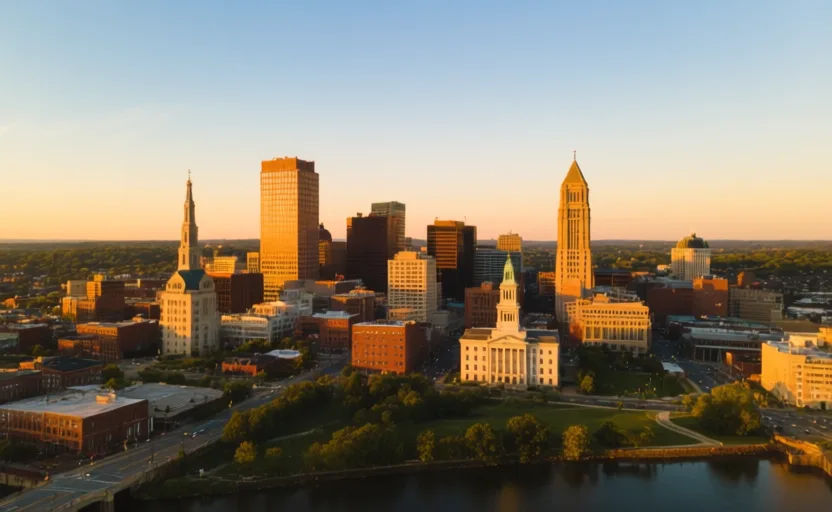 Hartford · AI city illustration · Artistic impression
City · North America
Hartford
Saved in this browser — no account needed. Sign in later and it comes with you.
Where it is
Connecticut's capital is tiny on the map, only 18 square miles, because the suburbs that surround it are separate towns: West Hartford, East Hartford across the river, Windsor and Wethersfield among them. The Connecticut River runs along the city's eastern edge. A second stream, the Park River, once divided the city into north and south and was buried in pipes during the 1940s, and its former course is still visible in the lines of some roads. The climate is hot-summer humid continental, and Hartford gets about 40 per cent more snow than the coastal cities, around 51.7 inches in an average winter. The city had 121,054 residents in 2020, while the metropolitan area has about 1.17 million.
The land and water around it
The Connecticut Riverriver
The river forms Hartford's eastern edge and brought both its trade and its disasters. The Dutch explored up it in 1614, and in April 1909 it reached a record 24.5 feet above the low-water mark and flooded the city. The Bulkeley Bridge crosses it to East Hartford.
The buried Park Riverriver
Once a feature that split Hartford into northern and southern halves and ran through Bushnell Park, the Park River was almost completely enclosed in the 1940s by flood-control works. Jewell Street and the Conland-Whitehead Highway now follow its old route.
A snowier, stormier interiorclimate
Hartford is hot and humid in summer and moderately cold in winter, with seasonal snowfall ranging from 13.5 inches in 1999–2000 to 115.2 inches in 1995–96. Tropical storms rarely arrive intact, but the 1938 New England Hurricane and Hurricane Irene in 2011 both caused heavy damage.
Its history, in short
Several Algonquian peoples lived along this stretch of river, the Saukiog in the area of the city itself. Dutch fur traders built a small fort, the House of Hope, on the Park River in 1623, but it did almost nothing to stop English settlement, and the Dutch left by 1654. In 1635 Thomas Hooker and about a hundred followers walked west from Massachusetts and founded the English town, which was named Hartford in 1637. Because it lay outside Massachusetts's charter, its leaders wrote their own constitution, the Fundamental Orders, which grounded authority in the free consent of the people. The city alternated as capital with New Haven from 1664 and has been the sole capital since 1875. In the nineteenth century it was a centre of abolitionist preaching and of precision manufacturing: Samuel Colt's revolvers, with interchangeable parts, were followed by machine tools, bicycles, cars and typewriters. After the Civil War it was, for several decades, the richest city in the country, and insurance became its signature industry. The postwar years brought Puerto Rican migrants, suburban flight and a long decline, and today Hartford is a city of insurers and hospitals that is also among the poorer ones in the country.
Timeline
Dates are shown on a timeline rather than as changing shapes on the map. The globe draws modern boundaries only, and tinting a modern outline to stand for a historical one would state something we cannot source.
Early modern & oceanic
1623
The Dutch House of Hope
Fur traders from New Amsterdam build a fort on the Park River to control the flow of wampum, the currency of the region's fur trade. The land was formally bought in 1633, and the fort was abandoned by 1654. Its memory survives in Dutch Point and Huyshope Avenue.
1635
Hooker's settlers arrive
Pastor Thomas Hooker and Governor John Haynes lead about a hundred settlers and 130 cattle from Newtown, now Cambridge, Massachusetts, and found the settlement just north of the Dutch fort. It is renamed Hartford in 1637 after the English town of Hertford.
14 January 1639
The Fundamental Orders of Connecticut
The colony adopts a written framework, drawn from Hooker’s argument that authority starts with what the people freely agree to. Some historians read it as an early forerunner of the United States Constitution.
Well attestedWikipedia
Industrial & imperial
15 December 1814
The Hartford Convention
Delegates from five New England states meet to discuss the possibility of New England seceding from the United States.
c. 1850
Colt perfects interchangeable parts
Samuel Colt, born in Hartford, makes thousands of revolvers by a precision process with interchangeable parts. Other firms copy the method, and Hartford becomes a centre for firearms, sewing machines, bicycles, cars and typewriters.
Approximate dateWikipedia1875
Sole capital of Connecticut
Since 1664 the capital had alternated with New Haven. From 1875 it is Hartford alone.
Well attestedWikipedia6 July 1944
The circus fire
A fire at a Ringling Brothers and Barnum and Bailey Circus performance in the north end kills 168 people, mostly children and mothers, and injures several hundred more.
Well attestedWikipedia
Contemporary
2017
Near bankruptcy
After years of a shrinking population and heavy pension obligations, the city considers filing for Chapter 9 bankruptcy, facing a projected $65 million shortfall. A state bailout later in the year prevents it.
Well attestedWikipedia
Places that carry meaning
Ancient Burying GroundOldest historic site
The city's first graveyard and its oldest historic site, where many of the founders and renowned residents are buried.
Bushnell ParkDowntown
The second-oldest publicly funded park in the country, which once held the Park River. The city is also home to the Wadsworth Atheneum, the oldest continuously operating public art museum in the United States.
Asylum Hill19th century onward
A neighbourhood of insurance headquarters, among them the Aetna building, the largest Colonial Revival building in the world, and the homes of Mark Twain and Harriet Beecher Stowe, who wrote Uncle Tom’s Cabin.
Colt complex and Armsmear19th century
The former Colt headquarters and the family estate in Sheldon/Charter Oak, the neighbourhood also known for the Charter Oak monument. The factory complex is being renovated to National Park standards.
Languages here
Places are usually multilingual. This lists what is actually spoken, not one language per border.
EnglishGermanic family
The language of government and daily life.
The Hartford area's Caribbean communities add their own varieties of English, with the Blue Hills neighbourhood home to the largest per capita share of Jamaican American residents in the country.
SpanishRomance family
The main community language alongside English.
About 43 per cent of residents are Hispanic or Latino, mostly of Puerto Rican origin. One in three Hartford residents claims Puerto Rican heritage, and Puerto Rican flags fly from cars and buildings across the city. Smaller groups come from the Dominican Republic, Mexico, Colombia and Peru.
Algonquian languagesAlgonquian family
The languages of the Saukiog and neighbouring peoples.
The Podunks, Poquonocks, Massacoes, Tunxis, Wangunks and Saukiog all spoke Algonquian tongues, and Suckiaug was the name the area’s Native people used before the Dutch came.
PolishSlavic family
The language of an earlier immigrant community.
Large numbers of Poles arrived in the first half of the twentieth century, and some Polish restaurants from that wave still operate. The Italian community of the South End, known as Little Italy, belongs to the same period.
Learn the language here
- 1Understand which languages are spoken hereHartford is multilingual. Start with which languages are used, by whom, and for what — the phrase list only covers one of them.Written by Globe Quest
- 2Learn 13 phrasesCurated everyday phrases for Hartford, with audio and a written form.Written by Globe Quest
- 3Say them out loudSpeaking practice with pronunciation feedback, one phrase at a time.Globe Quest material, your own additions
- 4Come back to themSpaced review, so what you learned this week is still there next month.Written by Globe Quest
Check yourself
What did the Fundamental Orders of Connecticut say about authority?
That it comes from the free consent of the people
Because the settlement was outside Massachusetts's charter, Thomas Hooker and others had to create their own basis for government, and they grounded it in the people.
What happened to the Park River in the 1940s?
It was enclosed and buried by flood-control works
The river once divided the city and ran through Bushnell Park, and its old course now follows streets such as Jewell Street.
Worth arguing about
- Hartford was the richest city in the country after the Civil War and is now one of the poorest, while its metropolitan area ranks among the richest. What does a small city boundary do to a place?
- The Dutch bought the land of Fort Hoop from one nation's leader while others lived there. Who had the right to sell land in a place like this, and who decides after the fact?
What we have not established
These are open questions, listed rather than filled in. We would rather show a gap than a plausible guess.
Who sold the land for the Dutch fort in 1633?
Accounts say Jacob Van Curler bought it from a Pequot chief, but they also place the Saukiog, not the Pequot, in the area of Hartford itself. Who held the right to the land at that moment is not recorded.
Sources
- Wikipedia · Hartford, ConnecticutWikipedia · encyclopedia · checked 2026-11-24
- Wikipedia · History of Hartford, ConnecticutWikipedia · encyclopedia · checked 2026-11-24
- Wikipedia · United StatesWikipedia · encyclopedia · checked 2026-11-24
Reviewed by Globe Quest editorial on 2026-11-24. Drafted with AI assistance and checked against the sources above before publication.