 Globe Quest
 Human Quest · LearningSign in
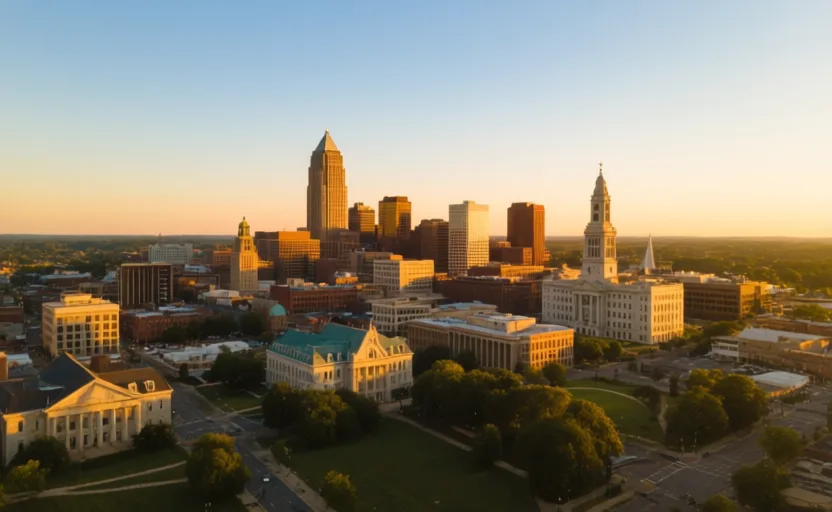 Albany · AI city illustration · Artistic impression
City · North America
Albany
Saved in this browser — no account needed. Sign in later and it comes with you.
Where it is
Albany rises from the west bank of the Hudson about 16 kilometres below the point where the Mohawk joins it, and roughly 217 kilometres north of New York City. The Hudson is still a tidal estuary here, rising and falling with the Atlantic tide, but it is also close to the head of navigation, which made the site a natural meeting point for river and overland traffic. Behind the shore the ground rolls up to a high point of only 115 metres, over sandy soils left by the ancient Lake Albany. Winters are cold and snowy, with about 150 centimetres of snow a season, and summers can turn hot and humid.
The land and water around it
The Hudson Riverestuary
Mohican people called it Mahicannituck, and, in Hendrick Aupaumut's account, called themselves the people of ever-moving waters. At Albany it is still an estuary, its surface lying between two and four feet above sea level as the tide moves, and the city is near the north end of the navigable river. Steamboats ran from New York City by 1807.
The Albany Pine Bushbarrens
A scrub of pitch pine and oak on dry, sandy soil left by the vanished Lake Albany. The scrub once covered a far larger area. A preserve created in 1988 protects what remains: the only sizeable inland pine barrens with sand dunes in the United States, and a refuge for endangered species such as the Karner Blue butterfly.
Its history, in short
The Hudson here was home to the Algonquian-speaking Mohicans, while the Iroquoian-speaking Mohawk of the Haudenosaunee lived to the west along the Mohawk River. Dutch traders built Fort Nassau in 1614 and replaced it with Fort Orange in 1624; the surrounding village, Beverwijck, was incorporated in 1652. The Dutch, Mohawk and Mohican shared the fur trade on terms of mutual advantage, and Beverwijck was never attacked by either nation. In 1664 the English took New Netherland and renamed the town for the Duke of Albany, later James II and VII; a charter followed in 1686. The 1754 Albany Congress produced the first formal plan to unite the colonies, and the city became the permanent state capital in 1797. Turnpikes, steamboats, the Erie Canal and early railways then made it a hub for settlers heading west. From the 1920s a Democratic machine ran the city, and between 1965 and 1978 the building of Empire State Plaza displaced residents. Irish, Italian and Polish immigrants, and later Black families from the rural South, changed the city's population.
Timeline
Dates are shown on a timeline rather than as changing shapes on the map. The globe draws modern boundaries only, and tinting a modern outline to stand for a historical one would state something we cannot source.
Early modern & oceanic
1614
Fort Nassau
Dutch fur traders build Fort Nassau, the first Dutch trading post at Albany, on Castle Island. Floods wreck it, and Fort Orange replaces it in 1624. A French trading fort of about 1540 may have stood on the same island earlier.
1664
English rule and a new name
The English capture New Netherland and rename Beverwijck for the Duke of Albany. The Dutch retake it briefly in 1673, then give it up under the 1674 Treaty of Westminster.
1686
The Dongan Charter
Governor Thomas Dongan charters Albany on 22 July. It is described as the oldest effective city charter in the United States, and Albany is called the longest continuously chartered city in the country.
Well attestedWikipedia1754
The Albany Congress
Delegates from seven colonies meet in the city hall, where Benjamin Franklin presents the Albany Plan of Union, the first formal proposal to unite the colonies. Parliament never adopted it, but it foreshadowed the US Constitution.
1794
Executions after a fire
A fire in November 1793 destroys 26 homes. Three enslaved people, Pompey, Dinah and Bet, are charged with arson and sentenced to death. Governor George Clinton grants a stay, but the two girls are hanged in March and Pompey in April 1794.
1797
Permanent state capital
The legislature, which had moved between Albany, Kingston, Poughkeepsie and New York City, settles the capital permanently at Albany.
Well attestedWikipedia
Industrial & imperial
1807
Steamboats to New York
Robert Fulton starts a steamboat line between New York City and Albany, described as the first successful enterprise of its kind anywhere. By 1810 the city has 10,763 people.
Well attestedWikipedia
Contemporary
1965 to 1978
Empire State Plaza
Governor Nelson Rockefeller and architect Wallace Harrison build a complex of state offices that dominates the skyline. It displaced city residents and remains controversial for both that and its architecture.
Well attestedWikipedia
Places that carry meaning
The Stadt Huys1754 to 1775
Albany's city hall hosted the Albany Congress in 1754, and in 1775 became home to the Albany Committee of Correspondence, which took over local government. Tories and prisoners of war were jailed in it alongside ordinary criminals.
Empire State Plaza1965 to 1978
A cluster of modern government buildings beside the Cultural Education Center, which holds the State Museum, Library and Archives. Admired as a powerful example of late American modernism and criticised for the neighbourhood it cleared.
The Albany Pine Bush PreserveSince 1988
A reserve on the city's western edge, spilling into neighbouring towns, set up to protect a rare inland sand-dune ecosystem that had shrunk with development.
Languages here
Places are usually multilingual. This lists what is actually spoken, not one language per border.
EnglishGermanic family
The everyday language and the de facto national language.
Across the country 77 per cent of residents speak only English at home. The city's Dutch heritage is still celebrated each year in the Tulip Festival, which grew from an older African-Dutch celebration called Pinkster.
MohawkIroquoian family
The language of the Iroquoian-speaking people to the west along the Mohawk River.
The Mohawk, the easternmost of the five nations of the Haudenosaunee, called the Albany area skahnéhtati, meaning “through the pine woods”, after the path they walked to it. They became strong trading partners of the Dutch and English.
MohicanAlgonquian family
The language of the Algonquian-speaking people of the Hudson.
The Mohicans' name for the river valley meant “the fireplace of the Mohican nation”. Hendrick Aupaumut recorded their own name, Muh-he-con-neok, which he glossed as people of restless water.
TriquiOto-Manguean family
Spoken by a community of Mexican Americans in the city.
A community of Mexican Americans who speak Triqui lives in Albany, alongside residents whose ancestry at the 2000 census was most often African American, Irish, Italian, German or English.
Learn the language here
- 1Understand which languages are spoken hereAlbany is multilingual. Start with which languages are used, by whom, and for what — the phrase list only covers one of them.Written by Globe Quest
- 2Learn 12 phrasesCurated everyday phrases for Albany, with audio and a written form.Written by Globe Quest
- 3Say them out loudSpeaking practice with pronunciation feedback, one phrase at a time.Globe Quest material, your own additions
- 4Come back to themSpaced review, so what you learned this week is still there next month.Written by Globe Quest
Check yourself
After whom was Albany named in 1664?
The Duke of Albany, the future James II
When the English captured New Netherland they renamed Beverwijck for the Duke of Albany, a Scottish title that goes back to the Gaelic name for Scotland, Alba.
What was the Albany Plan of Union?
The first formal proposal to unite the British colonies, put forward in 1754
Benjamin Franklin presented it to delegates from seven colonies. Parliament did not adopt it, but it was a forerunner of the Constitution.
Worth arguing about
- Dutch, Mohawk and Mohican traders built a working partnership around furs, and many traders married Mohawk and Mohican women. What does a place owe to arrangements like that, once the fur trade ends?
- A single planned complex of state offices replaced part of a city's neighbourhood. When is a capital justified in reshaping the town around it?
What we have not established
These are open questions, listed rather than filled in. We would rather show a gap than a plausible guess.
Where does Albany rank among American state capitals by age?
One account calls it the second-oldest state capital after Santa Fe, while another names Annapolis as the oldest and Albany as second. The ranking depends on what counts as the founding date.
Sources
- Wikipedia · Albany, New YorkWikipedia · encyclopedia · checked 2026-11-24
- Wikipedia · History of Albany, New YorkWikipedia · encyclopedia · checked 2026-11-24
- Wikipedia · Languages of the United StatesWikipedia · encyclopedia · checked 2026-11-24
Reviewed by Globe Quest editorial on 2026-11-24. Drafted with AI assistance and checked against the sources above before publication.