 Globe Quest
 Human Quest · LearningSign in
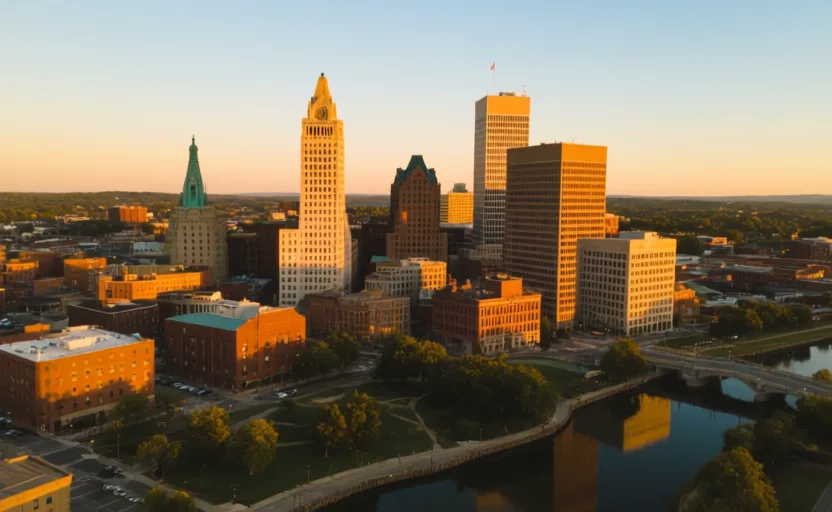 Providence · AI city illustration · Artistic impression
City · North America
Providence
Saved in this browser — no account needed. Sign in later and it comes with you.
Where it is
Narragansett Bay narrows to a river at its northern end, and Providence sits where two small rivers, the Moshassuck and the Woonasquatucket, join to form the short Providence River that runs into the bay. The city limits enclose only about 20 square miles, and about a tenth of that is water. The ground rises steeply from the river on both sides, so the city is one of many claimed to stand on seven hills. The Atlantic keeps winters milder than in most of inland New England. Because it grew before cars, the street plan is irregular and compact: over a thousand streets run off at odd angles from old trading centres such as Market Square.
The land and water around it
The head of Narragansett Baybay
The city sits at the northern end of the bay, so ships could come up almost to its centre. The harbour was why Providence grew into a major port.
The Providence River and its tributariesriver
The Moshassuck and Woonasquatucket meet to form the river through the centre of the city. In the 1990s the rivers were relocated to create Waterplace Park and a riverwalk, and in summer fires burn on the water during WaterFire.
The seven hillsmountains
A string of hills rises east of the river, where the original six-acre house lots ran up to Hope Street. College Hill now holds Brown University and the East Side’s historic districts.
Its history, in short
Roger Williams, a minister banished from the Massachusetts Bay Colony for his opinions, founded the settlement in 1636 as a refuge for religious dissenters, and named it for God’s providence. With no royal charter, the settlers governed themselves and shared out land in 1638, and no meeting house was built until 1700. The Narragansetts burned the town in 1676 in King Philip’s War. Merchants, some of them in the slave trade, made it a major port in the eighteenth century, and in 1772 a Providence crowd burned the customs schooner Gaspee, an early act of armed resistance to British rule. Manufacturing then took over: machine tools, silverware, jewellery and textiles drew immigrants from Ireland, Italy, Portugal, Cape Verde and French Canada, and by 1900 the city held 175,597 people. Decline set in during the 1920s, the 1938 hurricane flooded downtown, and the population fell from 253,504 at its 1940 peak to 179,213 in 1970 as the middle class left for the suburbs. Since the 1990s the rivers have been moved and a riverwalk built, and the economy now rests on hospitals, universities and services.
Timeline
Dates are shown on a timeline rather than as changing shapes on the map. The globe draws modern boundaries only, and tinting a modern outline to stand for a historical one would state something we cannot source.
Early modern & oceanic
June 1636
Roger Williams settles
After banishment from Massachusetts, Williams and companions settle at the junction of two rivers and name it Providence. The land was agreed with Narragansett leaders and formalised in a deed of 1638.
1652
An early anti-slavery law
Providence prohibits indentured servitude for more than ten years, described as the earliest law against slavery in the country. There is no evidence it was ever enforced, and in 1703 the colony legalised slavery.
29 March 1676
Burned in King Philip’s War
A coalition of Native forces burns the settlement to the ground. It is one of two major colonial settlements destroyed in the war.
Well attestedWikipedia1770
Brown moves to Providence
Rhode Island College, later Brown University, relocates from Warren. Choosing Providence over Newport marks a shift in commercial and political weight away from Newport.
Well attestedWikipedia1772
The Gaspee Affair
A group from Providence burns a British customs schooner south of the town, an event described as the opening act of armed resistance to British rule on the continent.
Well attestedWikipedia
Industrial & imperial
1831
City charter
Residents ratify a city charter as the population passes 17,000. The economy has shifted from shipping to manufacturing.
Well attestedWikipedia1938
The New England Hurricane
The storm floods downtown and finishes off many struggling textile mills, which never reopen.
Well attestedWikipedia1940–1970
Population drains to the suburbs
The city falls from 253,504 to 179,213. Its white middle class left faster than that of any other American city except Detroit, and the population began to grow again in 1980.
Well attestedWikipedia
Places that carry meaning
The First Baptist Church in America1638 onward
The congregation Roger Williams founded, standing on the East Side, which holds the largest contiguous area of listed historic buildings in the country.
Federal HillEarly 20th century onward
The Italian quarter, often called Little Italy. Around 14% of the city’s people claim Italian ancestry.
Fox Point19th–20th century
A Portuguese neighbourhood at the southern end of the East Side, where the settlers first rounded the point on their way to the river junction.
Languages here
Places are usually multilingual. This lists what is actually spoken, not one language per border.
EnglishGermanic family
The main language, spoken in a non-rhotic New England accent.
The city shares the non-rhotic accent of the state, which can be heard on local media.
SpanishRomance family
The language of the largest minority.
Hispanic and Latino residents were 43.5% of the population in 2020 and the majority of public-school students as of 2007. Dominicans make up about half of them, with Puerto Ricans, Guatemalans and Colombians also present.
PortugueseRomance family
A heritage language of the Fox Point community.
Portuguese immigrants arrived to work in the city’s industries, together with Cape Verdeans, and Fox Point is the Portuguese neighbourhood.
Learn the language here
- 1Understand which languages are spoken hereProvidence is multilingual. Start with which languages are used, by whom, and for what — the phrase list only covers one of them.Written by Globe Quest
- 2Learn 12 phrasesCurated everyday phrases for Providence, with audio and a written form.Written by Globe Quest
- 3Say them out loudSpeaking practice with pronunciation feedback, one phrase at a time.Globe Quest material, your own additions
- 4Come back to themSpaced review, so what you learned this week is still there next month.Written by Globe Quest
Check yourself
Why did Roger Williams name the town Providence?
In honour of God’s merciful providence, which he believed had given him a haven
Williams, banished from Massachusetts, saw the refuge as an act of providence. He founded the settlement for religious dissenters and kept it without an official religion.
What happened to the city’s population between 1940 and 1970?
It fell by about a quarter as residents left for the suburbs
It fell from 253,504 to 179,213. Textile mills had closed and the white middle class left for the suburbs, leaving a poorer and older population behind.
Worth arguing about
- A colony founded for religious freedom also ran a slave-trading port. How should a city tell a founding story that includes both?
- The city moved its rivers and put fire on the water to revive its centre. Is a reinvented waterfront a restoration or a new invention?
What we have not established
These are open questions, listed rather than filled in. We would rather show a gap than a plausible guess.
Whose land did Roger Williams settle?
One account says the first settlement at Rumford was on land the Wampanoag gave Williams, and another that he agreed the land at Providence verbally with the Narragansett sachems Canonicus and Miantonomo, formalised in 1638. The accounts differ on who granted what, and Narragansett and Wampanoag views of the transaction are not given.
Sources
- Wikipedia · Providence, Rhode IslandWikipedia · encyclopedia · checked 2026-11-24
- Wikipedia · History of Providence, Rhode IslandWikipedia · encyclopedia · checked 2026-11-24
Reviewed by Globe Quest editorial on 2026-11-24. Drafted with AI assistance and checked against the sources above before publication.