 Globe Quest
 Human Quest · LearningSign in
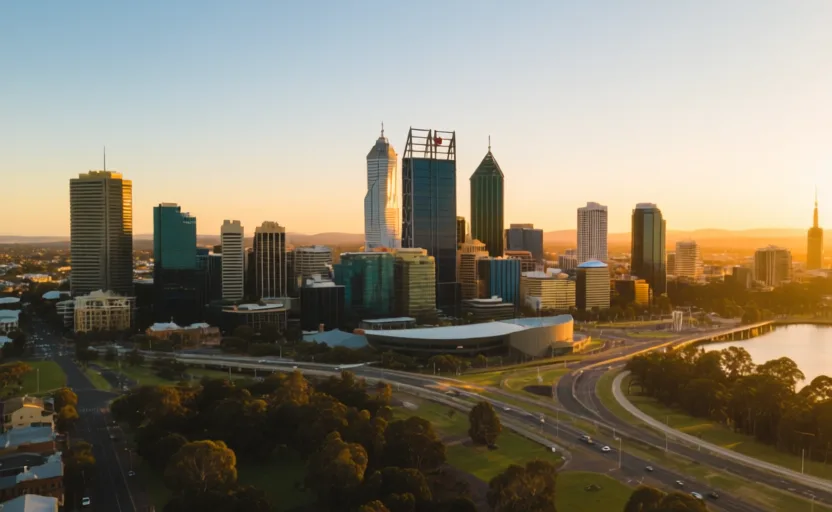 Perth · AI city illustration · Artistic impression
City · Oceania
Perth
Saved in this browser — no account needed. Sign in later and it comes with you.
Where it is
Most of Perth lies on the Swan Coastal Plain, a flat strip of sandy, infertile ground between the Indian Ocean and the low Darling Scarp. The Swan River, Derbarl Yerrigan, winds through it and bounds the central business district to the south and east. Winter rain, hot dry summers and about 3,200 hours of sunshine a year make it the sunniest Australian capital. The most striking constraint is distance: the nearest city of over 100,000 people, Adelaide, is more than 2,100 kilometres away, and Perth lies closer to Timor-Leste and Jakarta than to Sydney.
The land and water around it
The Swan Coastal Plainplain
A low, sandy plain with little natural fertility, where most of the city and its suburbs sit. The Darling Scarp forms the eastern boundary.
The Swan River (Derbarl Yerrigan)river
Vlamingh named it Swarte Swaene-Revier after the black swans he saw in 1697. The city grew outward from the first British settlements on its banks, and the port of Fremantle lies where it meets the sea.
The Perth wetlandsmarsh
A chain of freshwater wetlands once ran from Herdsman Lake in the west to Claisebrook Cove in the east, and colonial Perth was built over much of it. For Noongar people the wetlands carry spiritual significance as well as being a source of food.
Its history, in short
Noongar people have lived on the plain for at least 48,000 years by archaeological reckoning, and in their own tradition since time immemorial. The central business district stands on the land of the Mooro, a Whadjuk clan led by Yellagonga at the time of settlement, within the south-west block of fourteen Noongar groups. Dutch captain Willem de Vlamingh explored the river in 1697 and named it for its black swans. Captain James Stirling founded the Swan River Colony in 1829 as a free settlement, and from 1831 clashes with the Noongar over land escalated, including Yagan's death in 1833 and, a year later, the Pinjarra massacre. Convicts were brought in from 1850 to relieve a labour shortage, and nearly 9,700 arrived in eighteen years. The gold rushes at Coolgardie and Kalgoorlie lifted the population from roughly 8,500 in 1881 to about 61,000 twenty years later. Western Australia joined the federation last, and in 1933 two-thirds of voters chose secession, a result London declined to act on. Mining booms later made Perth the base of the state's resource industry.
Timeline
Dates are shown on a timeline rather than as changing shapes on the map. The globe draws modern boundaries only, and tinting a modern outline to stand for a historical one would state something we cannot source.
Early human world
Since time immemorial
Noongar Country
Noongar tradition holds that its people have occupied the south-west of Western Australia since time immemorial. The wetlands of the Swan Coastal Plain are central to their mythology and to their food.
Oral historyWikipediaNoongar tradition
At least 48,000 years ago
Archaeological evidence
Excavated evidence places people around Perth for no fewer than 48,000 years.
Approximate dateWikipedia
Industrial & imperial
1829
The Swan River Colony
Captain James Stirling proclaims the colony on 18 June, naming the town for Perth in Scotland, and colonists first see the mainland on 4 June. It is the first comprehensive European settlement in the west of the continent.
Well attestedWikipedia1831 to 1834
Conflict over land
From 1831 settlers and the Noongar clash over competing ideas of land and its value. Killings on both sides follow, including the execution without trial of the Whadjuk elder Midgegooroo, the killing of his son Yagan, and the 1834 Pinjarra massacre.
Well attestedWikipedia1850 to 1868
Convicts arrive
At the request of farmers and business people short of labour, Western Australia accepts convicts. 9,721 arrive on 43 ships, more than the roughly 7,300 free settlers.
Well attestedWikipedia1927 to 1954
Banned from the city
Indigenous people are prohibited from entering large parts of Perth under threat of imprisonment, a ban that lasts until 1954.
Well attestedWikipedia1933
The secession vote
Two-thirds of Western Australians vote to leave the federation. The government elected that same day does not back the move, but petitions London anyway, and the House of Commons committee declines to consider it.
Well attestedWikipedia
Contemporary
2006 to 2021
Native title
In 2006 the Federal Court rules that Noongar native title persists over the Perth area. The decision is partly overturned on appeal in 2008, and the South West Native Title Settlement, with the Whadjuk agreement covering Perth, is finalised on 1 December 2021.
Well attestedWikipedia
Places that carry meaning
Kings Park and Botanic GardenAt the western end of the city
The most visited green space in Perth and among the largest parks inside any city, beside the western edge of the central business district.
Rottnest IslandNamed 1697
Willem de Vlamingh named the island on the voyage during which he found the black swans of the Swan River. It is now one of the most popular natural features near the city.
Fremantle1950s and 1960s
Fremantle was often the first landfall for migrant ships from Europe. Italians, Greeks, Dutch, Germans, Turks, Croats and Macedonians arrived, and its “Cappuccino strip” and the annual blessing of the fishing fleet record the Italian influence.
Languages here
Places are usually multilingual. This lists what is actually spoken, not one language per border.
EnglishGermanic family
The everyday language, spoken alone at home by 74 per cent of residents.
Perth has an unusually large share of British- and Irish-born residents: 169,938 England-born people at the 2021 census, more than in Sydney.
Noongar
The language of the south-west block of Noongar peoples, also called Bibbulmun.
Fourteen groups make up the Noongar socio-linguistic block of the south-west, of which the Whadjuk are one. The Noongar name for the river, Derbarl Yerrigan, and for the city area are still used.
Community languages
Mandarin, Italian, Vietnamese, Punjabi and Cantonese lead.
At the 2021 census Mandarin was spoken at home by 2.3 per cent, Italian by 1.1, Vietnamese by 1.0, and Punjabi and Cantonese by 0.9 each. Italian is a legacy of postwar migration, with a festival of San Nicola every December in Northbridge.
Learn the language here
- 1Understand which languages are spoken herePerth is multilingual. Start with which languages are used, by whom, and for what — the phrase list only covers one of them.Written by Globe Quest
- 2Learn 11 phrasesCurated everyday phrases for Perth, with audio and a written form.Written by Globe Quest
- 3Say them out loudSpeaking practice with pronunciation feedback, one phrase at a time.Globe Quest material, your own additions
- 4Come back to themSpaced review, so what you learned this week is still there next month.Written by Globe Quest
Check yourself
After what is the city of Perth named?
Perth in Scotland, to honour the colonial secretary George Murray
The name appeared in Stirling's 1829 proclamation, and Charles Fremantle's diary says the town was named for Sir George Murray, who represented Perthshire.
How far is Perth from Adelaide, its nearest city of more than 100,000 people?
About 2,100 kilometres
More than 2,100 kilometres separate the two, which makes Perth one of the most isolated big cities in the world. Timor-Leste and Jakarta are closer than Sydney.
Worth arguing about
- In 1933 two-thirds of Western Australians voted to secede. What conditions in an isolated city make separatism feel plausible?
- The 2021 native title settlement covers the Perth region, and yet Indigenous people were barred from much of it until 1954. How should a city hold both facts?
Sources
- Wikipedia · PerthWikipedia · encyclopedia · checked 2026-11-24
Reviewed by Globe Quest editorial on 2026-11-24. Drafted with AI assistance and checked against the sources above before publication.