 Globe Quest
 Human Quest · LearningSign in
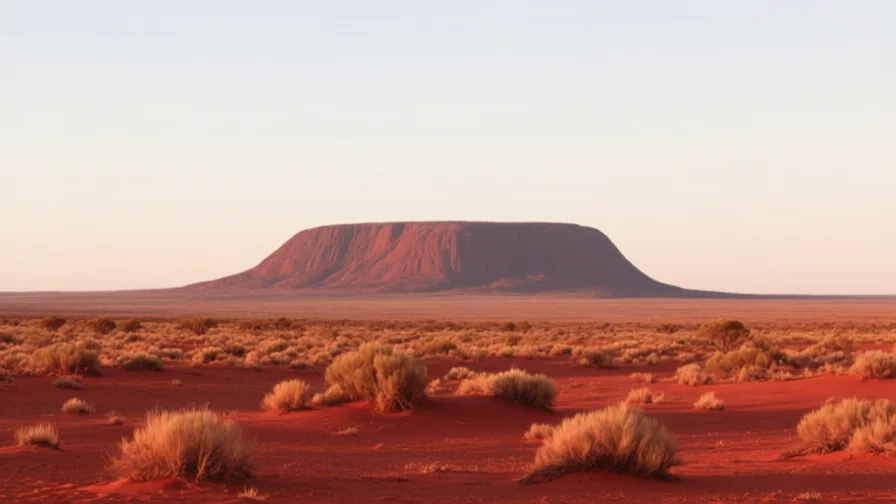 Australia · AI landscape illustration · Artistic impression
Country · Oceania
Australia
Saved in this browser — no account needed. Sign in later and it comes with you.
Where it is
Australia fills a continent and an island, Tasmania, between the Indian and Pacific oceans, and is the flattest and driest inhabited landmass on Earth. Rain averages about 470 millimetres a year across the mainland, about seven-tenths of the land is arid or semi-arid, and desert covers roughly 18 per cent. Rainfall also swings sharply from year to year under the influence of El Niño and the Indian Ocean Dipole, so droughts and floods both recur. The continent sits inside its tectonic plate, with no active volcanoes on the mainland. People live mostly in the temperate coastal zones of the east, south-east and south-west, especially on the south-eastern seaboard, leaving a vast, sparsely settled interior.
The land and water around it
The arid interiordesert
Most of the continent receives little rain, and about half of the country's rivers drain inland to end in salt lakes. The heart of the country, the Outback, is sparsely settled and mostly semi-arid or desert.
The Eastern Highlandsmountains
A belt of high country along the east, including the Great Dividing Range, separates the coast from the plains and basin of the interior. The population concentrates in the coastal zones to its east and south-east.
Torres Strait and Bass Straitstrait
When the last glacial period ended, rising seas cut the mainland off from New Guinea and from Tasmania, and left thousands of islands scattered through the Torres Strait and along the coast. Accounts date the Tasmanian separation anywhere from about 14,000 to about 6,000 years ago.
Its history, in short
Aboriginal peoples have lived on this continent for 50,000 to 65,000 years, and Torres Strait Islanders, a distinct Melanesian people, have their own island homelands to the north. When Europeans arrived there were some 250 languages and around 600 groups, each tied to its own Country, with authority held by elders rather than chiefs. Dutch navigators charted the western and northern coasts from 1606 and named the land New Holland, and Macassan trepangers visited the north from about 1720. Britain claimed the east coast in 1770 and founded a penal colony at Sydney Cove in 1788. Further colonies followed, most gaining self-government between 1855 and 1890, and six of them federated in 1901. The new Commonwealth passed the Immigration Restriction Act, excluded Aboriginal people from its first franchise, and left Indigenous affairs largely to the states, whose Protection Boards controlled lives and removed children. After 1945 mass immigration changed the country, and a 1967 referendum brought Aboriginal Australians into the census and gave the federal government power to legislate for them.
Timeline
Dates are shown on a timeline rather than as changing shapes on the map. The globe draws modern boundaries only, and tinting a modern outline to stand for a historical one would state something we cannot source.
Early human world
50,000 to 65,000 years ago
The first Australians
Ancestors of Aboriginal Australians arrive from what is now South-East Asia, crossing on land bridges and over short stretches of sea. How many separate migrations took part is uncertain. Madjedbebe, a rock shelter in Arnhem Land, may be the oldest site of human presence.
Early modern & oceanic
1606
The Duyfken lands
The Dutch ship Duyfken under Willem Janszoon makes the first documented European landing and meets Aboriginal people. Dutch voyages go on to map most of the western and northern coasts.
26 January 1788
The First Fleet at Sydney Cove
Captain Arthur Phillip lands the first convict settlers at Port Jackson. Aboriginal people, who spoke more than 250 languages, now face a colony that grows to span the continent.
Industrial & imperial
1 January 1901
Federation
Six colonies become the Commonwealth of Australia. One of its first laws is the Immigration Restriction Act, the centrepiece of the White Australia policy. A year later the Commonwealth gives women the vote, but excludes Aboriginal people who do not already hold a state vote.
1937
Absorption policy
A conference of state and Commonwealth officials endorses absorbing people of mixed Aboriginal descent into the white community. In the following decades children of mixed descent are taken from their families, increasingly on the grounds of child welfare.
Well attestedWikipedia
Contemporary
After 1945
“Populate or perish”
The government encourages a large wave of immigration from across Europe, whose arrivals are called “New Australians”. From the 1960s the White Australia policy is gradually relaxed.
Well attestedWikipedia1967
The referendum
Voters approve a change that lets the federal government make laws about Aboriginal Australians. Aboriginal people are counted fully in the census for the first time.
Well attestedWikipedia1986
The Australia Act
The Act cuts the last ties binding the British Parliament to the Australian states, completing the long path from colony to independent nation.
Places that carry meaning
Madjedbebe50,000 to 65,000 years ago
A rock shelter in Arnhem Land in the north, possibly the oldest site showing human presence on the continent. It is the nearest thing to a record of the first arrivals.
Lake MungoAbout 41,000 to 42,000 years ago
The oldest human remains found in Australia were discovered here in New South Wales. The site includes one of the world's oldest known cremations, an early sign of ritual.
Country and the DreamingFrom the beginning, in Aboriginal accounts
In Aboriginal belief, ancestral beings made every natural feature of the land and set the laws and ceremonies that keep life and Country going. Each group's own Country therefore gives both physical and spiritual nourishment. The Dreaming is held and passed on by Aboriginal communities themselves.
Aboriginal Australian traditions, as the Dreaming is described
CanberraSince 1911
The Australian Capital Territory was formed in 1911 for a future capital. Melbourne served as the seat of government from 1901 until the move to Canberra in 1927.
Languages here
Places are usually multilingual. This lists what is actually spoken, not one language per border.
EnglishGermanic family
The de facto national language, though it has no legal status.
English was the only language spoken at home by 72 per cent of people in 2021. Australian English has its own accent and vocabulary, and General Australian is the standard form.
Aboriginal and Torres Strait Islander languages
More than 250 languages were spoken at contact; between 120 and 170 are used now.
A 2018–19 survey found more than 120 varieties in use or being revived, 70 of them endangered, and the 2021 census recorded 167 spoken at home by 76,978 Indigenous people. The most-spoken are the creoles Yumplatok and Kriol, followed by Djambarrpuyngu, Pitjantjatjara, Warlpiri, Murrinh Patha and Tiwi. In Torres Strait, Kalaw Lagaw Ya and Meriam Mir are also spoken. The last speaker of a traditional Tasmanian language died in 1905, and palawa kani is being rebuilt from surviving words. In 2016 Malcolm Turnbull became the first prime minister to speak an Indigenous language in Parliament, using Ngunnawal.
Community languages from migration
Spoken at home by 22.8 per cent of people, 5.8 million, in 2021.
Mandarin leads at 2.7 per cent, then Arabic at 1.4, followed by Vietnamese, Cantonese, Punjabi, Greek, Italian, Hindi, Spanish and Nepali. Postwar refugees from Europe and a sharp rise in Asian immigration in the twenty-first century widened the list.
Auslan
The country's own sign language.
About 16,242 people used Auslan at home in the 2021 census, and some Indigenous communities keep their own sign systems, which were used to complement speech or replace it when speech was forbidden for cultural reasons.
Learn the language here
Check yourself
What did the 1967 referendum change?
It let the federal government legislate for Aboriginal Australians and counted them in the census
Before 1967 Aboriginal affairs were mainly a state matter, and Aboriginal people were not fully counted. The vote opened the way to national laws and a full count.
Which was the most-spoken classifiable Indigenous language at home at the 2021 census?
Yumplatok (Torres Strait Creole)
With 7,596 speakers, Yumplatok narrowly led Kriol at 7,403. Both are English-based creoles that arose after European contact.
Worth arguing about
- Some start Australia's story in 1788, some in 1901, and others more than 50,000 years earlier. What changes when the starting date moves?
- English has no legal status as an official language, yet 72 per cent speak only English at home. What would formal recognition of Indigenous languages add?
What we have not established
These are open questions, listed rather than filled in. We would rather show a gap than a plausible guess.
When did rising seas separate Tasmania from the mainland?
Accounts give about 14,000 years ago in some places and about 6,000 years ago in others.
How many Aboriginal people lived on the continent in 1788?
Estimates run from 300,000 to one million. The estimates differ by a factor of more than three, and the figure remains open.
Sources
- Wikipedia · AustraliaWikipedia · encyclopedia · checked 2026-11-24
- Wikipedia · History of AustraliaWikipedia · encyclopedia · checked 2026-11-24
- Wikipedia · Geography of AustraliaWikipedia · encyclopedia · checked 2026-11-24
- Wikipedia · Languages of AustraliaWikipedia · encyclopedia · checked 2026-11-24
Reviewed by Globe Quest editorial on 2026-11-24. Drafted with AI assistance and checked against the sources above before publication.