 Globe Quest
 Human Quest · LearningSign in
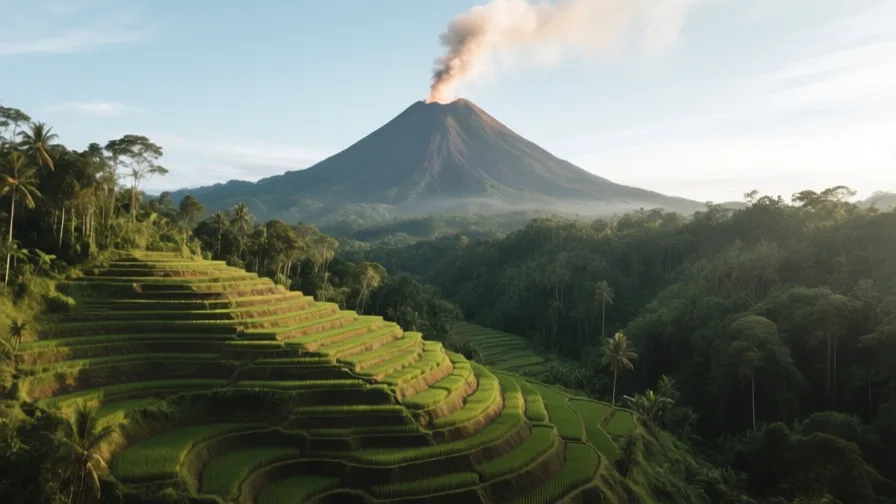 Indonesia · AI landscape illustration · Artistic impression
Country · Southeast Asia
Indonesia
Saved in this browser — no account needed. Sign in later and it comes with you.
Where it is
Indonesia is mostly water. Measured from end to end, its islands span about 5,120 km and three time zones, straddling the equator between the Indian and Pacific oceans, and its waters cover more area than its land. The big islands are mountainous and volcanic: a chain of about 400 volcanoes, some 150 of them active, runs from Sumatra through Java and the Lesser Sundas and round to Sulawesi, because several tectonic plates converge here. Straits such as Malacca, Sunda and Lombok carry shipping between the two oceans. The climate is hot and humid, with a wet season from November to April and a drier one from May to October.
The land and water around it
The volcanic arcvolcano
The volcanoes form one long arc: from Sumatra along Java and the Lesser Sundas, then round through the Banda Islands and up to the north-east tip of Sulawesi. Tambora's eruption in 1815 killed 92,000 people and Krakatau's in 1883 killed 36,000, and ash makes farmland fertile but also makes farming unpredictable. Mount Merapi in Java is the most active.
The straits of Malacca, Sunda and Lombokstrait
Narrow channels between the islands that serve as strategic sea lanes between the Indian and Pacific oceans, and they explain why the archipelago has been a crossroads of trade for so long.
Wallaceaisland
Sulawesi, Maluku and most of Nusa Tenggara sit on the line where Asian and Australian wildlife meet, and many of their animals and plants live nowhere else. Sulawesi sits on three tectonic plates, and deep seas surround these islands.
Its history, in short
Humans have lived in the archipelago for more than a million years, and some of the oldest known paintings in the world are in caves on Sulawesi. Austronesian-speaking farmers and sailors arrived from about 2000 BCE, and the islands joined Asian maritime trade by the first millennium BCE. Hindu and Buddhist kingdoms grew up in the early centuries CE, and Islam spread from the late medieval period, by which time Maluku's spices drew Portuguese, Dutch and other merchants. The Dutch East India Company, founded in 1602, took Jayakarta in 1619 and renamed it Batavia, and by the early 20th century Dutch control covered almost the whole archipelago. Nationalists took up the name Indonesia and a form of Malay as the national language, which the Youth Pledge of 1928 declared a language of unity. Independence followed the Second World War. Sukarno's Guided Democracy gave way to Suharto's New Order, which ended in 1998, and since then the country has decentralised power and held competitive elections. It remains a place of enormous variety, with hundreds of ethnic groups and over 700 languages, held together by the national motto of unity in diversity.
Timeline
Dates are shown on a timeline rather than as changing shapes on the map. The globe draws modern boundaries only, and tinting a modern outline to stand for a historical one would state something we cannot source.
Early human world
at least 51,200 years ago
Cave painters of Sulawesi
A painting of human-like figures with a pig, in a cave at Leang Karampuang on Sulawesi, has a minimum age of 51,200 years. Other Sulawesi caves hold hunting scenes and hand stencils nearly as old.
First cities & states
from c. 2000 BCE
Austronesian settlers
Austronesian-speaking communities move south from Taiwan through the Philippines into the archipelago, and related languages spread across most of the islands. Settlers combine fishing, hunting, gathering and farming.
Early modern & oceanic
1619
Batavia
The Dutch East India Company, formed in 1602, captures Jayakarta and renames it Batavia. The town becomes an administrative and commercial centre and attracts Chinese migrants and others from across the archipelago.
Well attestedWikipedia
Industrial & imperial
1815
Tambora erupts
Mount Tambora on Sumbawa erupts in one of the two most violent volcanic events in modern times, killing about 92,000 people.
Well attestedWikipedia1928
The Youth Pledge
A congress of youth associations declares one homeland, one nation and one language, naming Indonesian as the language of unity. Malay had served for centuries as the common tongue between ethnic groups.
Contemporary
1945
Independence
Indonesia proclaims independence in the aftermath of the Second World War, and Indonesian becomes the official language. The early republic faces armed opposition from the Darul Islam rebellion and a dispute with the Netherlands over western New Guinea.
1998–2002
The fall of Suharto and Reformasi
After the 1997 Asian financial crisis hits Indonesia hardest of all, Suharto's presidency collapses. Reform brings constitutional amendments, competitive elections, a referendum in East Timor and the transfer of power to local governments.
26 December 2004
The Indian Ocean earthquake and tsunami
A massive undersea earthquake devastates Aceh and North Sumatra, with approximately 225,000 deaths and over 425,000 people left homeless. The disaster helps push the government and rebels in Aceh towards peace talks.
Places that carry meaning
Trinil and SangiranOver 700,000 years old
The Java sites where the fossils of Homo erectus, the “Java Man”, were found, first by Eugène Dubois at Trinil in 1891 and later at Sangiran. Cut marks on animal bones at Sangiran show tool use between 1.5 and 1.6 million years ago.
The cave art of SulawesiOver 40,000 years ago
Painted caves such as Leang Bulu' Sipong and Leang Tedongnge hold some of the earliest known figurative art, including a hunting scene dated to at least 43,900 years ago and a painted hand stencil of at least 39,900 years.
FloresOver a million years
Stone tools on the island date back to about a million years, the earliest hint of seafaring, and it is where the small-bodied hominin Homo floresiensis was found.
JakartaFrom 1619
The capital grew from the Dutch town of Batavia, which the company founded in 1619 on the site of Jayakarta. The United Nations lists it as the most populous city in the world, and more than half of Indonesians live on its island, Java.
Languages here
Places are usually multilingual. This lists what is actually spoken, not one language per border.
IndonesianAustronesian family
The official and national language, and the lingua franca of the archipelago.
A standardised form of Malay, it was declared a language of unity in 1928 and has been the official language since independence. Over 97% of Indonesians were fluent in it in the 2020 census, and it dominates commerce, administration, schools and the media, though most people use another language at home.
JavaneseAustronesian family
The most widely spoken first language.
Native speakers made up 31.8% of the population in 2010, mostly in central and eastern Java, and Javanese migrants have carried it into many other provinces. Sundanese, local Malay, Madurese and Minangkabau come next. In Yogyakarta, Javanese holds a regional official status.
Papuan languages
More than 150 languages in Papua and Maluku, unrelated to the Austronesian majority.
Eastern Indonesia, particularly Papua and the Maluku Islands, is home to more than 150 Papuan languages that sit outside the Austronesian family. Indonesian Papua has more languages than any other part of the country.
Heritage languages
Languages of Chinese, Indian, Arab and Dutch descendants.
Trade with China and India from the 7th century, followed by Dutch and Portuguese colonisation, left heritage languages. Hokkien, Hakka and Mandarin are the most common, Tamil is spoken among many Indians, and Arabic and Dutch survive in small numbers, while Dutch has no official status.
Learn the language here
Check yourself
What is Indonesian, the national language, based on?
Malay, long used between the archipelago's ethnic groups
Malay had served for centuries as a language of contact between groups, which made it a neutral choice, and nationalists named it Indonesian and adopted it as the language of unity in 1928.
Roughly how many volcanoes does Indonesia have, and how many are active?
About 400, of which around 150 are active
Indonesia sits where several plates meet, so it holds a long arc of volcanoes; two of the most violent eruptions in modern times, Tambora in 1815 and Krakatau in 1883, happened here.
Worth arguing about
- More than half of Indonesians live on Java, yet the country spans three time zones and thousands of islands. How should a state balance a crowded core against a very large periphery?
- Indonesia took Malay, a language of trade contact, as its national language rather than Javanese, the language of the largest group. What did that choice make possible, and what did it cost?
What we have not established
These are open questions, listed rather than filled in. We would rather show a gap than a plausible guess.
How many islands does Indonesia have?
The main country article says more than 13,000 islands, while the history and geography articles say more than 17,000. Counts depend on whether very small and seasonal islands are included, and on which survey is used.
How many people live in Indonesia?
The 2020 census recorded 270.2 million. The country article also says over 290 million, and other estimates for 2021 and 2025 range from about 275 to 286 million, so the figure depends on the year and the source.
Sources
- Wikipedia · IndonesiaWikipedia · encyclopedia · checked 2026-11-24
- Wikipedia · History of IndonesiaWikipedia · encyclopedia · checked 2026-11-24
- Wikipedia · Geography of IndonesiaWikipedia · encyclopedia · checked 2026-11-24
- Wikipedia · Languages of IndonesiaWikipedia · encyclopedia · checked 2026-11-24
Reviewed by Globe Quest editorial on 2026-11-24. Drafted with AI assistance and checked against the sources above before publication.