 Globe Quest
 Human Quest · LearningSign in
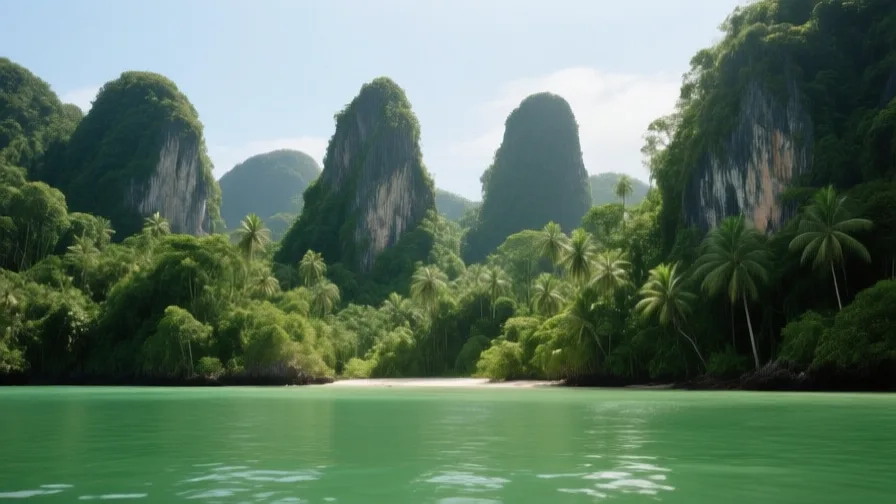 Malaysia · AI landscape illustration · Artistic impression
Country · Southeast Asia
Malaysia
Saved in this browser — no account needed. Sign in later and it comes with you.
Where it is
Malaysia is two countries’ worth of geography held under one flag: Peninsular Malaysia, at the southern end of the Malay Peninsula, and East Malaysia on the northern coast of Borneo, with the South China Sea between them. Together they cover 330,803 square kilometres and no other country has territory on the mainland of Asia and in the Malay archipelago both. Both parts have coastal plains rising to hills and mountains, and sit on the tectonically quiet Sunda Shelf. The climate is equatorial, hot and humid all year, with about 250 centimetres of rain on average and two monsoons, the south-west from late May to September and the wetter north-east from October to March.
The land and water around it
The Strait of Malaccastrait
The strait between Sumatra and the peninsula carries about 40 per cent of the world’s trade, which is why the ports along it, Malacca, Penang and Singapore, mattered to every empire in the region.
The Titiwangsa Mountainsmountains
A forested granite spine that divides the peninsula’s east and west coasts and rises to 2,183 metres at Mount Korbu. The west coast, where the plain is wider, is where the major cities grew.
The Borneo highlands and cavesmountains
In Sabah, the Crocker Range holds Mount Kinabalu, the highest peak in the country at 4,095 metres. In Sarawak, limestone has weathered into the Mulu Caves, among the largest in the world, with a chamber 700 metres long and 70 metres high.
Its history, in short
Trading ports on the Malay Peninsula took in Indian and Chinese influence from the first centuries CE, and the south of the peninsula lay within the maritime empire of Srivijaya from the 7th to the 13th century. In the early 15th century the exiled king Parameswara, formerly of Singapura, founded the Malacca Sultanate, where Islam took root among the court. The Portuguese took Malacca in 1511 and the Dutch in 1641. The British arrived at Penang in 1786, added Singapore in 1819, and from the Pangkor Treaty of 1874 placed residents in the Malay states, while Chinese and Indian labourers were encouraged to migrate for the tin mines and plantations. Japan occupied the territory from 1941 to 1945. Malaya became independent on 31 August 1957, after a communist insurgency known as the Emergency, and joined Sabah, Sarawak and Singapore to form Malaysia in 1963. Singapore left in 1965. Since independence the constitution has given Malays and other indigenous peoples a privileged status, a policy defended as affirmative action and criticised as unequal treatment of Chinese and Indian citizens.
Timeline
Dates are shown on a timeline rather than as changing shapes on the map. The globe draws modern boundaries only, and tinting a modern outline to stand for a historical one would state something we cannot source.
Post-classical world
early 15th century
The Malacca Sultanate
Parameswara, exiled from Singapura and linked to the old Srivijayan court, founds the sultanate and converts to Islam. Malacca becomes a commercial hub and a base for the spread of Islam.
Approximate dateWikipedia
Early modern & oceanic
1511
Portuguese Malacca
Portugal conquers Malacca, the first European power to establish itself on the peninsula. The Dutch take it in 1641.
1786
The British at Penang
The Sultan of Kedah leases Penang Island to the East India Company. By 1826 the British control Penang, Malacca, Singapore and Labuan as the Straits Settlements.
Well attestedWikipedia
Industrial & imperial
1874
The Pangkor Treaty
After years of disorder in the tin districts, including the Klang and Larut wars, a treaty sets up British residents in the Malay states. Frank Swettenham later wrote that the British came in at the invitation of the Malay rulers.
Well attestedWikipedia
Contemporary
1948–1960
The Emergency
Mostly ethnically Chinese rebels under the Malayan Communist Party fight a guerrilla war against British and Commonwealth troops, after the Federation of Malaya replaces the short-lived Malayan Union.
Well attestedWikipedia31 August 1957
Independence of Malaya
Malaya becomes an independent member of the Commonwealth. A plan is drawn up to join it with North Borneo, Sarawak and Singapore.
Well attestedWikipedia16 September 1963
Malaysia formed
Malaya unites with North Borneo, which becomes Sabah, with Sarawak and with Singapore. The original plan had been for 31 August.
Well attestedWikipediaAugust 1965
Singapore separates
Singapore is separated from the federation and becomes an independent country.
Well attestedWikipedia
Places that carry meaning
Kuala LumpurFrom c. 1857
The national capital and largest city, a tin-mining depot on the Klang River that became the capital of the federation. Putrajaya is the federal administrative capital.
George Town, PenangFrom 1786
The British settlement leased from Kedah in 1786 and the capital of the Straits Settlements for a time. Penang is one of three places in Malaysia where Muslims are under half the population.
Niah Caves40,000 years ago
In Sarawak, the cave where a 40,000-year-old skull was found, among the oldest modern human remains in Southeast Asia. The area is now Niah National Park.
Languages here
Places are usually multilingual. This lists what is actually spoken, not one language per border.
MalayAustronesian family
The national and official language.
Standard Malay, called Bahasa Melayu, is promoted as a unifying symbol of the nation. The National Language Act of 1967 specifies Latin script, though it does not forbid the older Jawi script. It is often a second language to the regional Malay varieties locals call dialects.
EnglishGermanic family
An active second language, official alongside Malay in Sarawak.
Once the de facto administrative language, English is compulsory in schools, widely used in cities and is the medium for much law and private education. Parliament moved to Malay in 1969, but English stays official in the state courts and assemblies of Sabah and Sarawak.
Chinese varieties and Tamil
The community languages of the Chinese and Indian minorities.
Mandarin is the lingua franca among Chinese who speak mutually unintelligible varieties, alongside Hokkien, Cantonese and Hakka. Tamil is the main Indian language. The state provides primary schooling in Malay, Mandarin and Tamil.
Iban, Kadazan-Dusun and the Orang Asli languages
Indigenous languages of Borneo and the peninsula.
Iban is the main native language of Sarawak, and Kadazan-Dusun languages are spoken in Sabah. On the peninsula, the Orang Asli speak Negrito, Senoi and Malayic languages. Malaysia has 137 living languages in all, and several are endangered.
Learn the language here
Check yourself
What separates Peninsular Malaysia from East Malaysia?
The South China Sea
The two regions lie on either side of the South China Sea, which is why Malaysia alone spans the Asian mainland and the Malay archipelago.
What happened to Singapore in 1965?
It was separated from the federation and became independent
Singapore joined Malaya, Sabah and Sarawak in 1963 to form Malaysia, but left two years later in August 1965.
Worth arguing about
- The constitution gives a privileged status to Malays and other bumiputera. Is a long-running preference programme a fair way to correct an imbalance, or does it divide the nation it aims to hold together?
- Malaysia is a country in two pieces with different languages and laws on some matters. What should hold such a federation together?
What we have not established
These are open questions, listed rather than filled in. We would rather show a gap than a plausible guess.
How many people live in Malaysia?
The 2020 census gave 32,447,385 residents, of whom 90.1 per cent are citizens, while the present population is described as over 34 million. Figures depend on the year and on who is counted.
Sources
- Wikipedia · MalaysiaWikipedia · encyclopedia · checked 2026-11-24
- Wikipedia · History of MalaysiaWikipedia · encyclopedia · checked 2026-11-24
- Wikipedia · Geography of MalaysiaWikipedia · encyclopedia · checked 2026-11-24
- Wikipedia · Languages of MalaysiaWikipedia · encyclopedia · checked 2026-11-24
Reviewed by Globe Quest editorial on 2026-11-24. Drafted with AI assistance and checked against the sources above before publication.