 Globe Quest
 Human Quest · LearningSign in
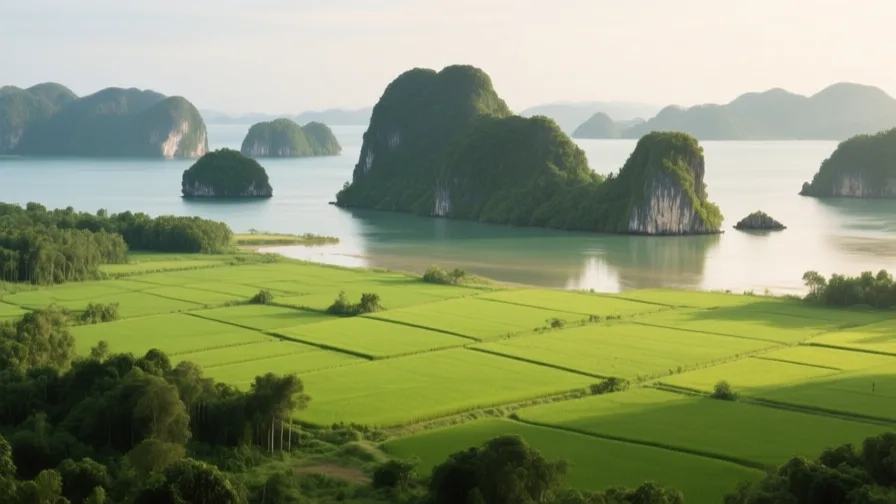 Thailand · AI landscape illustration · Artistic impression
Country · Southeast Asia
Thailand
Saved in this browser — no account needed. Sign in later and it comes with you.
Where it is
Thailand occupies the centre of mainland Southeast Asia, from the foothills of the northern mountains down the long, narrow Malay Peninsula. The north is highlands, topped by Doi Inthanon at 2,565 metres. The northeast is the Khorat Plateau, edged by the Mekong. In the middle, a flat floodplain drains the Chao Phraya River into the Gulf of Thailand, and that plain, suited to wet rice, is where most of the country’s history was made. A monsoon governs the year: a rainy season from mid-May to mid-October, a mild dry spell until mid-February and then heat. The southern peninsula is the country’s only land link to Malaysia and Singapore.
The land and water around it
The Chao Phraya valleyplain
A fertile, predominantly flat floodplain running to the Gulf of Thailand, suited to wet-rice farming, which drew settlers in preference to the poorer uplands. Successive capitals stood along the river, and Ayutthaya’s kings looked out to sea for trade rather than inland.
The Khorat Plateau and the Mekongplateau
The northeast, known as Isan, is a plateau bounded on the east by the Mekong, which marks the border with Laos for 920 kilometres. The Chao Phraya and the Mekong are the two indispensable watercourses of rural Thailand.
The southern peninsulapeninsula
South of the Kra Isthmus the country narrows into the Malay Peninsula, with the Gulf of Thailand on one side and the Andaman Sea on the other. Rivers here are short and steep, and anyone travelling by land from the mainland to Malaysia or Singapore has to pass through it.
Its history, in short
Bronze was being worked at Ban Chiang in the northeast by around 2000 to 1000 BCE, and by the first millennium the territory held Mon, Lawa, Khmer and Malay peoples under strong Indian cultural influence. Tai-speaking groups moved in from the north between the 8th and 10th centuries, mixed with the existing populations and set up their own states: Sukhothai in 1238, Lan Na in the north and Ayutthaya, which became the regional power in the 14th century and sacked Angkor. Burmese armies destroyed Ayutthaya in 1767. Within fifteen years Rama I had founded the Chakri dynasty and moved the capital to Bangkok in 1782. Siam was the only Southeast Asian state to avoid European colonisation, though it paid for that in territory and in unequal treaties, and under King Chulalongkorn it centralised into an absolute monarchy. A bloodless revolution in 1932 made it a constitutional monarchy, and the country was later renamed Thailand. Since the 1970s it has swung between elected government and military rule, with coups in 2006 and 2014.
Timeline
Dates are shown on a timeline rather than as changing shapes on the map. The globe draws modern boundaries only, and tinting a modern outline to stand for a historical one would state something we cannot source.
First cities & states
2000–1000 BCE
Bronze at Ban Chiang
The site near Udon Thani is the oldest known place in Southeast Asia where copper and bronze were made, and its techniques spread widely across the region. Rice farming also appears about 2000 BCE.
Post-classical world
7th–11th centuries
Dvaravati
The Mon people’s Dvaravati culture flourishes in the Chao Phraya basin, with Nakhon Pathom and U Thong as major centres. Its inscriptions are in Sanskrit and Mon, written in scripts derived from south India.
1238
Sukhothai
Pho Khun Bang Klang Hao rallies local people against the Khmer and crowns himself first king of Sukhothai, which Thai tradition treats as the beginning of Thai history. Under Ramkhamhaeng the Thai script is created in 1283.
c. 1350
Ayutthaya
The Ayutthaya Kingdom emerges from the earlier Lavo and Suphannaphum and becomes the main power in the region, a loose set of principalities that governed themselves and provinces that paid tribute. It invades the Khmer Empire three times before the end of the 15th century and sacks Angkor.
Approximate dateWikipedia
Early modern & oceanic
1767
The fall of Ayutthaya
Burmese forces under the Konbaung dynasty destroy the capital in the 1765–1767 war. Within about seven months Chao Tak retakes it, crowns himself King Taksin and sets up a temporary capital at Thonburi.
Well attestedWikipedia1782
Bangkok becomes the capital
A coup removes Taksin, and Phutthayotfa Chulalok, who becomes Rama I and starts the Chakri dynasty, establishes the Rattanakosin Kingdom and moves the capital to Bangkok.
Well attestedWikipedia
Industrial & imperial
Until 1907
A buffer between empires
Siam keeps its independence as a buffer between British-controlled Burma and Malaya and French Indochina, but it ceded territory, trade rights and legal privileges, and lost over half its earlier territory to French claims.
1932
The revolution
The Khana Ratsadon carries out a bloodless coup that forces King Prajadhipok to sign a constitution and turns Siam into a constitutional monarchy; the name Thailand was adopted afterwards.
Places that carry meaning
Ban Chiang2000–1000 BCE
An archaeological site in the northeast, around Udon Thani, the oldest known place in Southeast Asia where bronze was made, and part of the Maritime Jade Road trading network.
Sukhothai1238–1438
The first Thai kingdom, where a rebellion against Khmer rule produced a state whose kings were seen as rulers according to dharma. Its king Ramkhamhaeng is credited with the Thai script.
Ayutthayac. 1350–1767
The riverine capital that outlasted Khmer power and traded by sea on both the Gulf of Thailand and the Andaman coasts until the Burmese destroyed it in 1767. Europeans first arrived here in 1511, when Portuguese envoys came.
BangkokFrom 1782
The capital, chosen by Rama I when the Chakri dynasty began, and the largest city.
Languages here
Places are usually multilingual. This lists what is actually spoken, not one language per border.
Thai (Central Thai)Kra–Dai family
The sole official language, used in government and schools.
Standard Thai is based on the speech of the central plain and is written in an alphabet that developed from the Khmer script. It is closely related to Lao and Shan. The Bangkok accent carries the most social prestige, although fewer than half the population say Central Thai is their everyday language.
Northern Thai, Isan and Southern ThaiKra–Dai family
Regional languages of the north, northeast and south.
Northern Thai is spoken in the old kingdom of Lan Na, Isan is a Lao variety of the northeast, and Southern Thai shares its origin with Central Thai. Most linguists treat these as separate languages, whereas the Thai state has historically called them dialects of Thai.
Malay, Khmer, Karen and Lao
Border and minority languages.
Malay is spoken in the far south, Khmer near Cambodia, Karen along the Myanmar border and Lao along the Lao border. The government officially recognises 62 domestic languages, and the Muslim south, mostly Sunni, is largely Malay-speaking.
Chinese, Burmese and English
Languages of migrants, workers, expatriates and business.
The Bangkok accent has been associated with Teochew settlers, and Chinese communities live in towns across the country. International languages include Burmese, English, Chinese, Japanese and Vietnamese, spoken mostly by workers, expatriates and business people.
Learn the language here
Check yourself
Who moved the capital to Bangkok, and when?
Rama I, in 1782
After Ayutthaya fell, Taksin made Thonburi his capital, but Rama I overthrew him, founded the Chakri dynasty and moved the court to Bangkok in 1782.
What is Isan, the language of Thailand’s northeast?
A Thai variety of Lao
Isan is a Lao variety spoken on the Khorat Plateau, which the Thai government has historically classed as a dialect of Thai even though most linguists regard it as a separate language.
Worth arguing about
- Siam avoided colonisation but lost large territories and signed unequal treaties. Was independence kept or bought?
- Isan and Northern Thai are called dialects by the state and languages by linguists. Who should decide, and what is at stake in the choice?
What we have not established
These are open questions, listed rather than filled in. We would rather show a gap than a plausible guess.
Where did the Tai peoples come from?
One account has them originating in the Điện Biên Phủ region from the 5th century, while another traces them to the Yangtze basin as early as the 12th century BCE. Either way they reached modern Thailand between about the 8th and 10th centuries, and the earlier homeland is not settled.
In which year was Ayutthaya founded?
Accounts give 1350 and 1351, and the merger of local kingdoms is dated to 1349 in Chinese records. The exact founding year depends on which of those events counts as the beginning.
Sources
- Wikipedia · ThailandWikipedia · encyclopedia · checked 2026-11-24
- Wikipedia · History of ThailandWikipedia · encyclopedia · checked 2026-11-24
- Wikipedia · Geography of ThailandWikipedia · encyclopedia · checked 2026-11-24
- Wikipedia · Languages of ThailandWikipedia · encyclopedia · checked 2026-11-24
Reviewed by Globe Quest editorial on 2026-11-24. Drafted with AI assistance and checked against the sources above before publication.