 Globe Quest
 Human Quest · LearningSign in
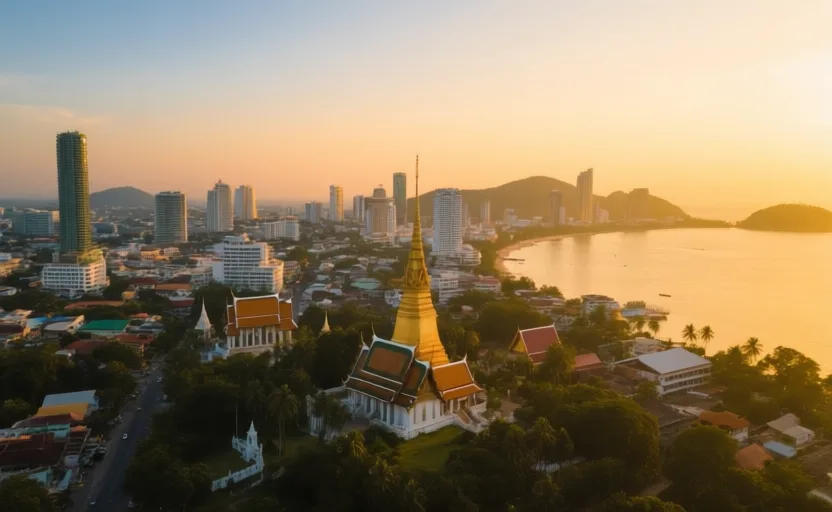 Phuket · AI city illustration · Artistic impression
City · Southeast Asia
Phuket
Saved in this browser — no account needed. Sign in later and it comes with you.
Where it is
Thailand’s largest island lies off the west coast in the Andaman Sea, joined to the mainland province of Phang Nga by the Sarasin Bridge, about 863 kilometres south of Bangkok. It is 48 kilometres long and 21 wide, and a mountain range runs down its western side, reaching about 529 metres. The west coast has sandy beaches and the east coast mostly muddy ones. Around 60 per cent of the island is forest, rubber and oil-palm plantation. The climate is tropical monsoon, with warm temperatures all year, a dry season from December to March and a wet season for the remaining eight months.
The land and water around it
Phuket Island and its rangeisland
Thailand’s largest island is itself mountainous along the west, the tail end of a range that extends about 440 kilometres from the Kra Isthmus. The island’s name comes from a Malay word for hill, which is what it looks like from the sea.
The Andaman coastcoast
The sandy western beaches, Patong, Karon, Kata and Kamala among them, face the open sea and were hit by the 2004 tsunami, which killed about 250 people in Phuket. The eastern shore looks onto Phang Nga Bay and is muddy.
The India–China sea routesea
A major trading route between India and China passed the island, which explains why so many foreign ships appear in early logs, and why it attracted attention from the Portuguese, French, Dutch and English without being conquered.
Its history, in short
For centuries the island sat on the sea route between India and China, and Portuguese, Dutch, English and French ships noted it as Junk Ceylon, a corruption of a Malay name for the cape. It never became anyone’s colony. Seventeenth-century traders came for tin, and in 1685 King Narai gave the French a tin monopoly, a deal that fell away after the 1688 revolution in Siam. The island’s known history is mostly told by foreigners, because local records are scarce and the Burmese destroyed every settlement in 1810. In 1785 Burmese forces besieged Thalang, and the defence led by the widow of the late governor and her sister is still celebrated. In the 19th century Chinese labourers, mostly Hokkien speakers, poured into the tin mines, and in 1868 under Chulalongkorn Phuket became the administrative centre for Siam’s tin-producing south. Tin declined in the 20th century and rubber took over. Tourism began in earnest in the 1980s and, after the 2004 tsunami, the island rebuilt its beaches and resorts.
Timeline
Dates are shown on a timeline rather than as changing shapes on the map. The globe draws modern boundaries only, and tinting a modern outline to stand for a historical one would state something we cannot source.
Early modern & oceanic
1545
An early European account
The Portuguese traveller Fernão Mendes Pinto describes Junk Ceylon as an important port of call for supplies, though he notes that pirates and difficult seas were already weakening its prominence.
Approximate dateWikipedia1685
A French tin monopoly
King Narai grants the French a tin monopoly in Phuket, partly to reduce Dutch and English influence, after appointing a French missionary as governor. The 1688 revolution in Siam cuts back the French presence.
Well attestedWikipedia13 March 1785
The siege of Thalang
After the governor’s death, the Burmese expect an easy conquest. His widow Than Phu Ying Chan and her sister Mook have the island’s women dress as soldiers along the walls, and the Burmese withdraw after a month-long siege. Rama I later honours the sisters, and the city seal shows their monument.
Approximate dateWikipedia
Industrial & imperial
1810
Settlements destroyed
Burmese forces destroy all the settlements on the island, which probably explains why no local records survive from earlier than the 18th century.
Approximate dateWikipedia1868–1910
Centre of the tin south
During the reign of Chulalongkorn, Phuket is designated the administrative centre of the tin-producing southern provinces of Siam.
Well attestedWikipedia1876
The miners’ uprising
Chinese labourers in the tin mines of Phuket and neighbouring provinces rise up, reportedly because of falling tin prices and strict government finance policies.
Well attestedWikipedia1933
A province of its own
Monthon Phuket is dissolved and Phuket becomes a separate province.
Well attestedWikipedia
Contemporary
26 December 2004
The Indian Ocean tsunami
A tsunami from an earthquake off Sumatra devastates the west coast, killing about 250 people in Phuket and around 5,300 in Thailand. After it, detection buoys are installed about 1,000 kilometres offshore in 2006.
Well attestedWikipedia
Places that carry meaning
Thalang17th century onward
The old capital in the north of the island, and the older name of Phuket itself, from a Malay word for cape. It was the scene of the 1785 siege and of the 1689 French attempt to retake it.
The Two Heroines Monument20th century
A monument on Highway 402 to Than Phu Ying Chan and her sister Mook, who became Thao Thep Kasattri and Thao Si Sunthon. It is on the provincial seal, and a fair is held every 13 March in their memory.
The old tin and Peranakan community19th century onward
Descendants of 19th-century Chinese tin miners, among them the Peranakan community known locally as Phuket Babas, who have links with the Peranakans of Penang and Malacca. Their Vegetarian Festival in the ninth lunar month includes fire-walking and ladder-climbing on blades.
Languages here
Places are usually multilingual. This lists what is actually spoken, not one language per border.
ThaiKra–Dai family
The national language, brought south as Siamese kingdoms expanded.
Thai speakers settled the island after southward expansion by Siamese kingdoms, most recently Rattanakosin. Central Thai and Southern Thai share an origin and are mutually intelligible.
HokkienSino-Tibetan family
The language of the Chinese community descended from tin miners.
Phuket’s Chinese festivals, including the Vegetarian and Ghost festivals, are described locally by their Hokkien names. The island is described as a Hokkien Chinese labour entrepôt of the tin industry.
MalayAustronesian family
The historical language of the island and of its Muslim community.
Austronesian Malays lived on Phuket before the Thai settled, and the island’s name, Thalang and Junk Ceylon all come from Malay. About a fifth of the population is Muslim, most descended from the island’s original Austronesian inhabitants.
Burmese, Lao, Khmer and English
Languages of migrant workers and the large expatriate population.
More than 64,000 legally registered workers from Myanmar, Laos and Cambodia were recorded, and the 2010 census counted about 115,000 expatriates. Visitors come mainly from Western Europe, China, Russia and the United States.
Learn the language here
- 1Understand which languages are spoken herePhuket is multilingual. Start with which languages are used, by whom, and for what — the phrase list only covers one of them.Written by Globe Quest
- 2Learn 11 phrasesCurated everyday phrases for Phuket, with audio and a written form.Written by Globe Quest
- 3Say them out loudSpeaking practice with pronunciation feedback, one phrase at a time.Globe Quest material, your own additions
- 4Come back to themSpaced review, so what you learned this week is still there next month.Written by Globe Quest
Check yourself
Where does the name Phuket come from?
A Malay word for hill, which is how the island looks from a distance
Phuket is a corruption of the Malay bukit, “hill”. The older name Thalang comes from a Malay word for cape, and Europeans wrote Junk Ceylon.
How did Thalang survive the Burmese attack of 1785?
The governor’s widow and her sister had the island’s women dress as soldiers on the walls
The deception made the Burmese overestimate the defence, and they left after a month-long siege. The two sisters were honoured by Rama I as heroines.
Worth arguing about
- A place no European power ever colonised, yet whose history is told mostly in foreign logs. Whose record counts when the local archive was destroyed?
- Tin made Phuket, and tourism has remade it. What do the two booms have in common in who comes and who stays?
What we have not established
These are open questions, listed rather than filled in. We would rather show a gap than a plausible guess.
How many people live in Phuket?
The 2010 census counted about 525,000 and the 2015 census about 387,000, only 360,905 were on the house registration in 2012, and estimates run from around 600,000 to far higher, with seasonal visitors lifting the island past a million. Registered residents do not include migrants or expatriates.
What is the island’s highest point?
Khao Mai Thao Sip Song, at 529 metres, is the traditional answer, but reports suggest an unnamed peak in the Kamala Hills may reach about 542 metres.
Sources
- Wikipedia · Phuket provinceWikipedia · encyclopedia · checked 2026-11-24
- Wikipedia · Languages of ThailandWikipedia · encyclopedia · checked 2026-11-24
Reviewed by Globe Quest editorial on 2026-11-24. Drafted with AI assistance and checked against the sources above before publication.