 Globe Quest
 Human Quest · LearningSign in
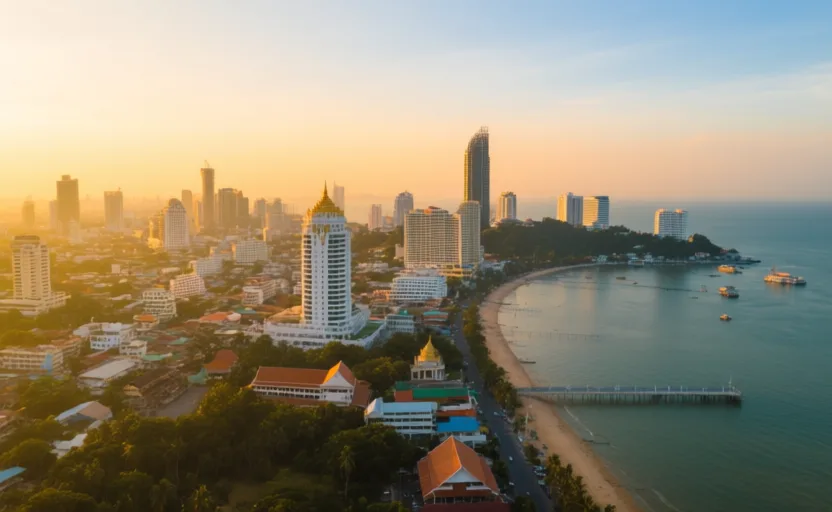 Pattaya · AI city illustration · Artistic impression
City · Southeast Asia
Pattaya
Saved in this browser — no account needed. Sign in later and it comes with you.
Where it is
A curving bay on the east shore of the Gulf of Thailand, about 150 to 160 kilometres south-east of Bangkok in Chonburi province, holds Pattaya. The shoreline is a narrow strip of sand under a small headland, Phra Tamnak Hill, with Jomtien Beach running south and a scatter of islands offshore. The climate is tropical wet and dry: hot and dry from December to February, hot and humid in March and April, and hot and rainy from May to November. The city sits inside the industrial Eastern seaboard, among Si Racha, Laem Chabang and Chonburi, and monsoon downpours regularly flood its roads.
The land and water around it
Pattaya Bay and its beachesbay
The main beach runs about 2.7 kilometres along the city centre and was once 35 metres wide, but erosion cut it to two or three metres in places. A 429 million baht restoration begun in 2018 imports sand from the offshore island of Ko Rang Kwian to widen it to 50 metres, and researchers had warned that, without action, the beaches might vanish within about ten years.
Phra Tamnak Hillheadland
A headland immediately south of the main beach, nicknamed Buddha Hill for the temples that stand on it, Wat Phra Yai among them. It separates Pattaya’s main beach from Jomtien Beach, which lies to the south.
The offshore islandsisland
Ko Lan, Ko Sak and Ko Krok lie about 7 kilometres from the shore, with a farther group including Ko Phai and Ko Man Wichai beyond them. Labels such as “near islands” and “far islands” are marketing terms and do not appear on the Thai navy’s charts.
Its history, in short
Pattaya was a fishing village until the 1960s. The story of its name goes back to the march of Phraya Tak, later King Taksin, from Ayutthaya towards Chanthaburi before 1767: a local leader called Nai Klom came out to stop him, was impressed by his bearing and his army’s discipline, and joined him, and the spot became known as Thap Phraya, “the army of the Phraya”, later shortened to Phatthaya. After the Second World War local landowners gave land to the administration, which started the modern town. Tourism began when American servicemen came on rest and recreation during the Vietnam War, some based at U-Tapao, and news of the beach spread by word of mouth. Pattaya was granted city status in 1978 and became a specially governed city, and from the 2010s its authorities have tried to change its reputation as a sex-tourism centre into a family-friendly one. Coastal erosion, flooding and pollution of the sea water are persistent problems, and the city now sits at the centre of the Eastern Economic Corridor.
Timeline
Dates are shown on a timeline rather than as changing shapes on the map. The globe draws modern boundaries only, and tinting a modern outline to stand for a historical one would state something we cannot source.
Early modern & oceanic
Before 1767
Thap Phraya
In the telling of the town’s name, Phraya Tak’s army meets and wins over the local leader Nai Klom during the march from Ayutthaya to Chanthaburi. The place becomes known as Thap Phraya, which later became Phatthaya.
Oral historyWikipediaThe local tradition recounting how the name came about
Contemporary
29 June 1959
A group from Korat
A party of American servicemen from a base in Korat takes leases on houses from Phraya Sunthorn at the southern end of the sand, in the area now called the Strip, and is credited with recommending Pattaya to others.
Approximate dateWikipedia29 November 1978
City status
The Thai government grants Pattaya city status, and it becomes a specially governed city.
Well attestedWikipedia1981
The Sanctuary of Truth
Businessman Lek Viriyaphan begins building the Sanctuary of Truth, made entirely of wood. It remains unfinished.
Well attestedWikipedia2004
The first elected mayor
Nirun Wattanasartsaton becomes Pattaya’s first democratically elected mayor.
Well attestedWikipedia2018
Rebuilding the beach
A 429 million baht scheme starts to restore the eroded Pattaya Beach with 360,000 cubic metres of sand taken offshore. The first stretch is badly damaged by flooding within a month of finishing.
Well attestedWikipedia27 August 2021
The worst flood in a decade
Torrential rain leaves important roads under up to two metres of water, which city officials call Pattaya’s worst flood for ten years.
Well attestedWikipedia2023
A documentary reopens the question
A Deutsche Welle documentary, banned in Thailand, revives allegations about the sex industry and child exploitation in Pattaya. The prime minister orders an investigation, while Thai media warn that the film could harm a tourist trade still recovering from the pandemic.
DisputedWikipediaDeutsche Welle’s documentary and its claims, set against Thai officials and local media who describe the damage it could do to the industry
Places that carry meaning
Pattaya Beach and the StripFrom the late 1950s
The 2.7-kilometre central beach, and the street at its southern end where the first group of American servicemen rented houses. Walking Street begins at the beach’s southern entrance, and the number of go-go bars along it has declined since the 2010s.
Phra Tamnak Hill and Wat Phra YaiHistoric
The temple on top of the hill is the favourite viewpoint over the bay. The hill is also wanted for its quieter, more natural setting between Jomtien and the city.
Sanctuary of TruthFrom 1981
An unfinished building made entirely of wood, begun by the businessman Lek Viriyaphan in 1981 and still under construction.
Languages here
Places are usually multilingual. This lists what is actually spoken, not one language per border.
ThaiKra–Dai family
The national language and the language of local government and daily life.
Thai is the only official language, and most people counted in Pattaya are Thai. Many casual Thai workers in the city remain registered in their home towns, so official counts understate who lives there.
Migrant and visitor languages
Spoken by workers from neighbouring countries, long-term expatriates and tourists.
Migrant workers from neighbouring nations, and retirees, self-employed expatriates and contract workers, are mostly left out of official counts. Across Thailand, Burmese, English, Chinese, Japanese and Vietnamese are the main international languages used by workers, expatriates and business people.
Learn the language here
- 1Understand which languages are spoken herePattaya is multilingual. Start with which languages are used, by whom, and for what — the phrase list only covers one of them.Written by Globe Quest
- 2Learn 11 phrasesCurated everyday phrases for Pattaya, with audio and a written form.Written by Globe Quest
- 3Say them out loudSpeaking practice with pronunciation feedback, one phrase at a time.Globe Quest material, your own additions
- 4Come back to themSpaced review, so what you learned this week is still there next month.Written by Globe Quest
Check yourself
How did Pattaya’s tourist trade begin?
American servicemen on rest and recreation during the Vietnam War told others about it
Pattaya was a fishing village until the 1960s. Servicemen from nearby bases, among them U-Tapao and a group from Korat, spread its fame by word of mouth.
According to the local account, what did the name Pattaya come from?
Thap Phraya, “the army of the Phraya”, later changed to Phatthaya
The name is traced to Phraya Tak’s army meeting the local leader Nai Klom before 1767. Phatthaya is also the word for the wind that blows from the south-west at the start of the rainy season.
Worth arguing about
- A fishing village became a city because foreign soldiers took leave there. How far can a place change its reputation when its economy still rests on the same visitors?
- The city has outgrown its legal boundary several times over. Who should plan for people who live and work there but are registered elsewhere?
What we have not established
These are open questions, listed rather than filled in. We would rather show a gap than a plausible guess.
How many people live in Pattaya?
The city municipality has about 119,500 registered residents, Greater Pattaya about 351,000, and no reliable total has ever been published. Migrant workers, long-term expatriates and Thais registered in other provinces are left out, and some estimates reach half a million.
Sources
- Wikipedia · PattayaWikipedia · encyclopedia · checked 2026-11-24
- Wikipedia · Languages of ThailandWikipedia · encyclopedia · checked 2026-11-24
Reviewed by Globe Quest editorial on 2026-11-24. Drafted with AI assistance and checked against the sources above before publication.