 Globe Quest
 Human Quest · LearningSign in
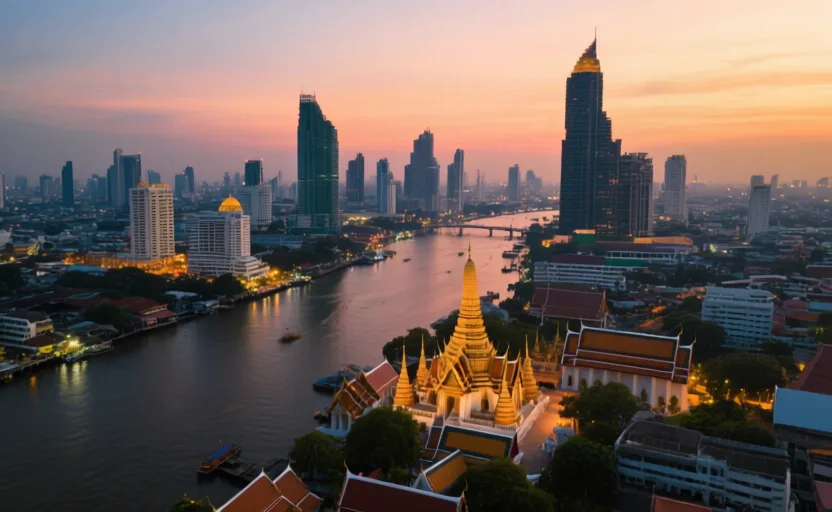 Bangkok · AI city illustration · Artistic impression
City · Southeast Asia
Bangkok
Also known as Krung Thep, กรุงเทพ
Saved in this browser — no account needed. Sign in later and it comes with you.
Where it is
Water decides what Bangkok is. The city stands on the flat floor of the Chao Phraya delta, on average only about 1.5 metres above sea level, with the river meandering south through it and reaching the Gulf of Thailand roughly 25 kilometres below the centre. Most of the ground was swamp until canals, called khlong, drained and irrigated it between the 16th and 19th centuries. The climate is tropical savanna: hot all year, a rainy season that begins with the southwest monsoon in mid-May and peaks in September, and a dry, cooler spell from October to February.
The land and water around it
The Chao Phraya deltadelta
A low, flat plain of former swampland on Thailand’s central plain. Digging canals to drain and irrigate it for farming took three centuries, and the khlong network that resulted is why Bangkok was once described through its waterways and why parts of the Thonburi side still feel like a canal town.
The Chao Phraya Riverriver
The river runs south through the city and divides the old Thonburi side on the west from Rattanakosin on the east. Shortcut canals have altered its course through the city, and its mouth has always been what made the site strategic.
Monsoon rainsclimate
Average temperatures run between a low of 23.2 degrees Celsius in December and a high of 35.7 in April. September is the wettest month, with an average of 335.9 millimetres of rain, a heavy load for ground that barely rises above the sea.
Its history, in short
The town began in the early 15th century as a village on the west bank of the Chao Phraya, under Ayutthaya, and its position near the river mouth made it a customs post with forts on both banks. When the Burmese destroyed Ayutthaya in 1767, King Taksin chose it for his capital at Thonburi. In 1782 Rama I moved across to the east bank and founded Rattanakosin, and the city pillar raised on 21 April 1782 is taken as the foundation of Bangkok as a capital. Trade with China and then the West grew through the 19th century, and under Mongkut and Chulalongkorn the steam engine, printing press, railways and utilities arrived. In 1932 the city was where the absolute monarchy ended, and it has been the stage for the country’s coups, uprisings and protests ever since. After the Second World War, American aid and investment fuelled rapid growth, and the metropolitan government was created in the early 1970s. Bangkok now dwarfs every other Thai city, with a population many times that of the next largest.
Timeline
Dates are shown on a timeline rather than as changing shapes on the map. The globe draws modern boundaries only, and tinting a modern outline to stand for a historical one would state something we cannot source.
Post-classical world
Early 15th century
A village on the river
A small village stands on the Chao Phraya’s western bank, ruled from Ayutthaya. Its place near the river mouth makes it a customs post, with forts facing each other across the water. The origin of its name is unclear; it may come from a word for a village on an island or from a local olive-like fruit.
Approximate dateWikipedia
Early modern & oceanic
1688
The siege of Bangkok
The forts at Bangkok are the site of a siege in which the French are expelled from Siam.
Well attestedWikipedia1767
Thonburi
After the fall of Ayutthaya, the newly crowned King Taksin makes the river town his capital, the base of the Thonburi Kingdom.
Well attestedWikipedia21 April 1782
Rattanakosin
Rama I succeeds Taksin and moves the capital to Rattanakosin Island on the east bank. The City Pillar erected on this date is regarded as the foundation of Bangkok as the capital.
Industrial & imperial
1851–1910
Modernisation under Mongkut and Chulalongkorn
The reigns of Rama IV and Rama V bring the steam engine, printing press, rail transport, utilities, formal education and healthcare to the city. Chulalongkorn formalises its administration in 1906.
Well attestedWikipedia1932
End of the absolute monarchy
Bangkok becomes the stage of power struggles between the military and the political elite as absolute monarchy is abolished. The Memorial Bridge, opened the same year, links Thonburi and Bangkok.
Contemporary
The 1960s
Population surge
US aid, government investment and the city’s role as an American military rest destination fuel growth, and migration from the countryside takes the population from about 1.8 million to 3 million within ten years.
Approximate dateWikipedia1973
The student uprising
A popular uprising overthrows the military regime, the first of a series of mass protests in the city, followed by 1976, 1992, the movements from 2006 and a student-led movement in 2020.
Places that carry meaning
Rattanakosin Island and the Grand PalaceFrom 1782
The old royal core on the east bank, with the Grand Palace and temples including Wat Phra Kaew and Wat Pho. It is the point from which the city’s modern history is dated.
Wat ArunHistoric
A historic temple once known as Wat Makok. The name supports one theory that Bangkok comes from Bang Makok, the village of the makok tree.
YaowaratSince the early days of the city
Bangkok’s Chinatown, the main concentration of a Chinese community that traded for the city from its start. Estimates suggest Chinese people formed up to three-quarters of the population in 1828 and nearly half in the 1950s.
ThonburiFrom 1767
The west bank, where Taksin made his capital and which was a separate province until it merged with Phra Nakhon in the early 1970s. Fifteen of Bangkok’s fifty districts are on this side.
Languages here
Places are usually multilingual. This lists what is actually spoken, not one language per border.
ThaiKra–Dai family
The language of government, schooling and everyday life.
Standard Thai rests on the central dialect, and the Bangkok accent is used as a courtesy even among speakers of other Thai varieties. It has the highest social prestige of any accent in the country.
Chinese languagesSino-Tibetan family
Spoken in Yaowarat and by Thai Chinese families.
Chinese were once the majority of the city, and the Bangkok accent is itself traditionally associated with Teochew settlers who were absorbed into Central Thai in the early 20th century. Immigration was restricted from the 1930s and effectively ended after 1949, and younger generations have adopted a Thai identity.
Burmese, Khmer and Lao
Languages of migrant workers from neighbouring countries.
The census counted well over 200,000 Burmese, about 73,000 Cambodians and about 52,000 Lao in the city. Roughly half of Bangkok’s residents are also internal migrants from other Thai provinces, who bring their own regional varieties.
Learn the language here
- 1Understand which languages are spoken hereBangkok is multilingual. Start with which languages are used, by whom, and for what — the phrase list only covers one of them.Written by Globe Quest
- 2Learn 12 phrasesCurated everyday phrases for Bangkok, with audio and a written form.Written by Globe Quest
- 3Say them out loudSpeaking practice with pronunciation feedback, one phrase at a time.Globe Quest material, your own additions
- 4Come back to themSpaced review, so what you learned this week is still there next month.Written by Globe Quest
Check yourself
Which date is regarded as the foundation of Bangkok as the capital?
21 April 1782, when the City Pillar was erected
Rama I moved the capital across the river to Rattanakosin and erected the City Pillar on 21 April 1782, the date the city counts as its foundation. Taksin’s Thonburi had been the capital for the 15 years before.
What did the khlong, or canals, dug between the 16th and 19th centuries do?
They drained and irrigated the swampland for agriculture
Most of the delta around Bangkok was swamp, and the canals gradually drained it and irrigated it for farming. They also gave the city its waterway network.
Worth arguing about
- In 1980 Bangkok was fifty-one times larger than the second-largest Thai city. What does extreme concentration in one capital do to a country’s politics?
- A city built on swamp has been drained, canalled and built over again. How should it plan for being only 1.5 metres above the sea?
What we have not established
These are open questions, listed rather than filled in. We would rather show a gap than a plausible guess.
How many people live in Bangkok?
Estimates range from about 5.7 million registered residents in 2018 to 9.1 million in 2024 and 10.5 million in a 2020 estimate. Roughly half the city are internal migrants, the daytime population is swelled by commuters, and the metropolitan region holds more than 17 million, so the total depends on who is counted and where the line falls.
When was the Bangkok Metropolitan Administration created?
One account dates it to 1972 and another to 1975. Provinces east and west of the river were merged by decrees in 1971–1972, which may explain the difference.
Sources
- Wikipedia · BangkokWikipedia · encyclopedia · checked 2026-11-24
- Wikipedia · History of BangkokWikipedia · encyclopedia · checked 2026-11-24
- Wikipedia · ThailandWikipedia · encyclopedia · checked 2026-11-24
- Wikipedia · Languages of ThailandWikipedia · encyclopedia · checked 2026-11-24
Reviewed by Globe Quest editorial on 2026-11-24. Drafted with AI assistance and checked against the sources above before publication.