 Globe Quest
 Human Quest · LearningSign in
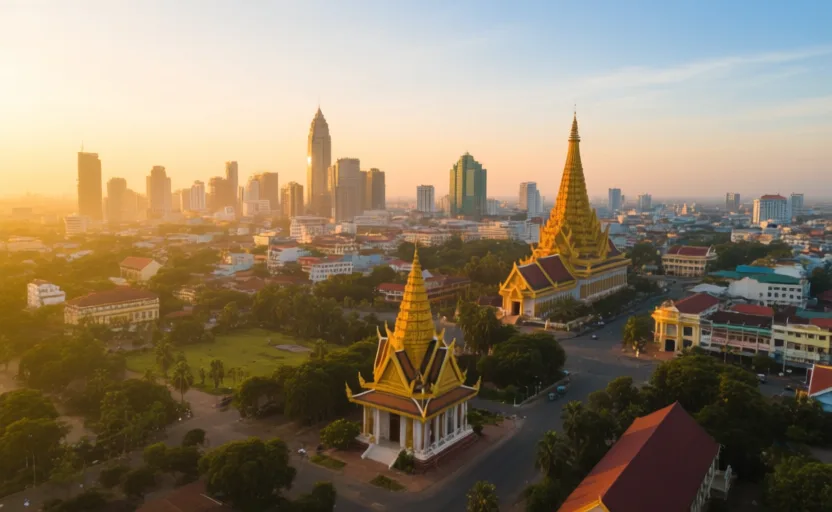 Phnom Penh · AI city illustration · Artistic impression
City · Southeast Asia
Phnom Penh
Also known as Phnum Pénh
Saved in this browser — no account needed. Sign in later and it comes with you.
Where it is
Phnom Penh stands where the Tonlé Sap meets the Mekong, at the point where the Bassac River begins. Its old official name, Krong Chaktomuk, means “city of Brahma’s faces”, and the full royal title given by Ponhea Yat speaks of a “place of four rivers”. The city is on flat flood plain, only about 11 metres above sea level, so the monsoon floods are a recurring problem. Heat is constant, with a wet season from May to November and a dry one from December to April. The municipality covers about 679 square kilometres and is entirely surrounded by Kandal province.
The land and water around it
Chaktomuk, the meeting of the riversriver
The Tonlé Sap joins the Mekong here and the Bassac begins. The royal title given to the city by Ponhea Yat refers to this meeting of waters as “the place of four rivers”, and the rivers still supply the city with fresh water and other resources.
The flood plainplain
The city lies on a typical Cambodian flood plain, and the rivers sometimes overflow in the monsoon. Boeung Kak, the largest freshwater lake in the city, was filled in 2010 for property development, a decision that was controversial.
Wat Phnom hillhill
The low hill on the west bank of the Tonlé Sap that gave the city its name. According to the founding legend it was raised by hand to hold the statues Penh found, and a shrine on top became Wat Phnom, at the north end of the central city.
Its history, in short
A potters’ settlement at Choeung Ek, on the southern side of today’s city, seems to have existed from about the 5th century. The city proper is traced to a legend from 1372 in which a widow named Penh found sacred statues in a floating tree and raised a hill to house them. After Angkor fell to Siam, King Ponhea Yat moved the capital here in the 1430s, but it was given up again in the 16th century and kings moved from one site to another for roughly 360 years. Phnom Penh became the permanent capital in 1865, under the French protectorate. After independence it was modernised under Sihanouk, with the “New Khmer” architecture of Vann Molyvann, and in the civil war of the early 1970s it filled with refugees, reaching a population of 2 to 3 million by 1975. On 17 April 1975 the Khmer Rouge took the city and drove out everyone in it. The city stayed largely empty until 1979, when Vietnamese-backed forces arrived and people began to return.
Timeline
Dates are shown on a timeline rather than as changing shapes on the map. The globe draws modern boundaries only, and tinting a modern outline to stand for a historical one would state something we cannot source.
Classical world
from the 5th century
Potters at Choeung Ek
A kiln site at Choeung Ek, found in the 2000s, produced ceremonial vessels called kendi between the 5th and 13th centuries. A circular earthwork 740 metres across surrounds the community, built in the 11th century.
Approximate dateWikipedia
Post-classical world
1372
Lady Penh’s legend
A widow named Penh finds a floating koki tree after a storm, with four Buddha statues and one of Vishnu inside, and builds a hill-shrine for them. The legend was first written down about a century after it is said to have happened.
Oral historyWikipediaKhmer founding legend, recorded about a century after the event it describes
1430s
First period as capital
King Ponhea Yat moves the capital from Angkor Thom after its capture by Siam. Accounts give the capital’s span as 1434 to 1497 in one place and 1432 to 1505 in another; either way, the kings later moved their seats elsewhere.
Approximate dateWikipedia
Industrial & imperial
1865
Capital again
The city regains the status of capital during the French colonial era, after about 360 years in which the royal courts sat at other places, such as Longvek and Oudong.
Well attestedWikipedia
Contemporary
1950s–1960s
The New Khmer architecture
Under Sihanouk, the architect Vann Molyvann is named chief national architect in 1956. His style combines Bauhaus, post-modern European forms and elements from Angkor, and produced the National Theatre, the Royal University and the National Sports Centre.
Well attestedWikipedia17 April 1975
The evacuation of the city
After a siege that cut off supplies for over a year, the Khmer Rouge take the city and force out the whole population, including the wealthy and educated, to labour in the countryside. The security centre known as S-21, now Tuol Sleng, stood at the centre of their repressive system.
1979
Vietnamese-backed forces enter
Vietnamese forces drive out the Khmer Rouge, and residents begin to return. Rebuilding is financed by France, Australia, Japan, the Asian Development Bank and the World Bank.
Well attestedWikipedia2019
Over two million again
The census records 2,129,371 people, well above 862,000 in 1998 and 1.3 million in 2008, though sources give a figure of over 2.2 million for the same year.
Approximate dateWikipedia
Places that carry meaning
Wat PhnomLegend dates it to 1372
The hill-top temple that names the city, with a stupa on the hill. The founding legend ties the city’s origin to a local woman rather than to a king.
Khmer founding legend
Tuol Sleng, the former S-21 prison1975–1979
A centrally located prison that UNESCO describes as the high point of the Khmer Rouge security system. It is now the Tuol Sleng Genocide Museum, part of the Cambodian Memorial Sites together with the Choeung Ek execution site and the M-13 prison.
The Royal Palace and the independence-era buildings1950s–1960s
The seat of the monarchy stands in the city, and the Preah Suramarit National Theatre and the Vann Molyvann House are among the buildings of the New Khmer period.
Languages here
Places are usually multilingual. This lists what is actually spoken, not one language per border.
KhmerAustroasiatic family
The official language, spoken by the 95 per cent of residents who are ethnic Khmer.
The Phnom Penh variety is one of the recognised dialects of Khmer. The 2017 survey put the share of Khmer residents at 95.3 per cent.
English and French
Foreign languages heard in the capital.
Both are used in the city. French is the legacy of the colonial period, and English has been replacing it as the main foreign language since 1993.
ChamAustronesian family
The language of the Cham minority, about 4 per cent of residents.
The Cham are descendants of refugees from the wars of the old kingdom of Champa and are mostly Muslim. Smaller groups of Chinese, Vietnamese and other minorities make up the remaining 0.7 per cent.
Learn the language here
- 1Understand which languages are spoken herePhnom Penh is multilingual. Start with which languages are used, by whom, and for what — the phrase list only covers one of them.Written by Globe Quest
- 2Learn 11 phrasesCurated everyday phrases for Phnom Penh, with audio and a written form.Written by Globe Quest
- 3Say them out loudSpeaking practice with pronunciation feedback, one phrase at a time.Globe Quest material, your own additions
- 4Come back to themSpaced review, so what you learned this week is still there next month.Written by Globe Quest
Check yourself
What does Ponhea Yat’s royal title for the city refer to?
A meeting of four rivers
The title calls it the “place of four rivers”, for the junction of the Tonlé Sap, the Mekong and the start of the Bassac.
When did Phnom Penh become the permanent capital again?
1865
The kings who succeeded Ponhea Yat moved the court many times over about 360 years, and the city regained the role during the French protectorate in 1865.
Worth arguing about
- A city of 2 to 3 million was emptied in a day and then repopulated. What does a place have to rebuild besides its buildings?
- Boeung Kak lake was filled in for development in 2010. Who should decide when a city’s water is worth more as land?
What we have not established
These are open questions, listed rather than filled in. We would rather show a gap than a plausible guess.
When was Phnom Penh first the capital, and for how long?
The accounts give 1434 to 1497 in one place and 1432 to 1505, or 73 years, in another, and only early chronicles bear on it. The span is left approximate.
How many people live in Phnom Penh?
The 2019 census count was 2,129,371, though the same year is also reported as over 2.2 million, depending on the area counted. Earlier figures are not consistent either.
Sources
- Wikipedia · Phnom PenhWikipedia · encyclopedia · checked 2026-11-24
- Wikipedia · CambodiaWikipedia · encyclopedia · checked 2026-11-24
- Wikipedia · Demographics of CambodiaWikipedia · encyclopedia · checked 2026-11-24
- UNESCO · Cambodian Memorial Sites: From centres of repression to places of peace and reflectionUNESCO World Heritage Centre · intergovernmental · checked 2026-11-24
Reviewed by Globe Quest editorial on 2026-11-24. Drafted with AI assistance and checked against the sources above before publication.