 Globe Quest
 Human Quest · LearningSign in
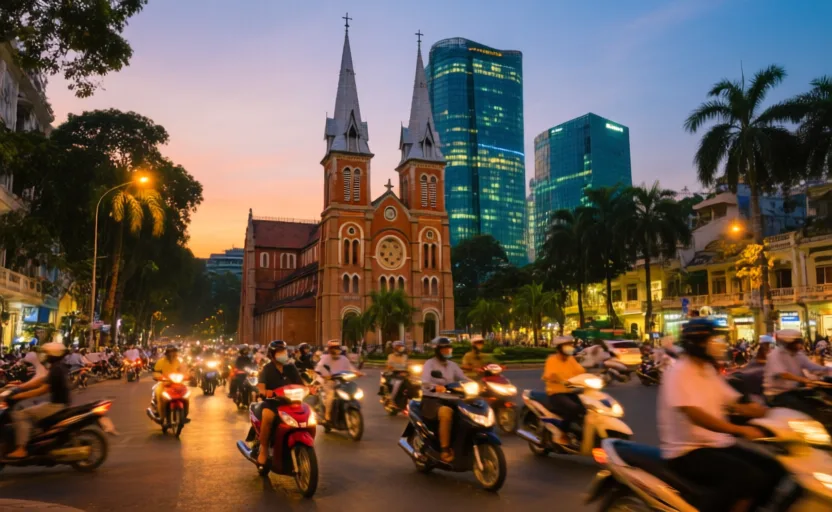 Ho Chi Minh City · AI city illustration · Artistic impression
City · Southeast Asia
Ho Chi Minh City
Also known as Saigon, Sài Gòn, Thành phố Hồ Chí Minh, Prey Nokor
Saved in this browser — no account needed. Sign in later and it comes with you.
Where it is
Ho Chi Minh City is built on low, wet ground at the edge of the Mekong Delta in south-eastern Vietnam, only about 5 metres above sea level in the centre and 16 in the suburbs. The Saigon River is the largest of its many rivers and canals, and the city is fringed by tidal flats, some turned to farming. Floods come in the rainy season, when tides, heavy rain, the flow of the Saigon and Đồng Nai rivers and sinking ground combine, and a once-in-a-century flood would put about 23 per cent of the city under water. The climate is tropical savanna: wet from May to November, with about 1,800 millimetres of rain, then dry until April.
The land and water around it
The Saigon Riverriver
The largest of the waterways running through the city. Together with the Đồng Nai, it feeds the floods of the wet season. The city’s port, the Port of Saigon, is among the busiest container ports in Southeast Asia.
The edge of the Mekong Deltadelta
The city lies on the Mekong Delta, and its edges are tidal flats modified for agriculture. The flat, damp ground is why drainage, canals and flood management are a constant concern, and why subsidence is a problem.
Two seasonsclimate
A rainy season from May to November with about 150 rainy days a year, and a dry season from December to April. The average temperature is around 28 degrees Celsius, humidity runs between 78 and 82 per cent, and the sun shines for 2,400 to 2,700 hours a year.
Its history, in short
People have lived on this stretch of the river for a long time: a Funan-era temple site from the 4th century, a Cham village called Baigaur in the 11th, and then, after the Khmer Empire took it around 1145, a fishing settlement the Cambodians called Prey Nokor. Vietnamese settlers arrived in the early 17th century and turned the Khmer name into Sài Gòn. Chinese refugees from the Qing settled here in 1679, and the Nguyễn rulers established Vietnamese administration in 1698. France took the citadel in 1859 and held the city by treaty from 1862, making it capital of Cochinchina and, in two periods, of French Indochina, and building the boulevards, cathedral and market that still define the centre. From 1949 it served as seat of the State of Vietnam and then of the Republic of Vietnam, and was the commercial and industrial heart of the South. North Vietnam took the city in 1975, and in 1976 it was merged with the province of Gia Định and named after Ho Chi Minh. How that moment, and that name, are read depends on who is speaking, and both names are in daily use. In 2025 the city absorbed two neighbouring provinces and gained an industrial and coastal hinterland.
Timeline
Dates are shown on a timeline rather than as changing shapes on the map. The globe draws modern boundaries only, and tinting a modern outline to stand for a historical one would state something we cannot source.
Post-classical world
c. 1145
Prey Nokor
The Khmer Empire takes the Cham settlement of Baigaur, which becomes the fishing village of Prey Nokor. It is the earliest recorded name behind “Sài Gòn”, which Vietnamese settlers later adapted from the Khmer.
Approximate dateWikipedia
Early modern & oceanic
1698
From Cambodian to Vietnamese rule
The Nguyễn rulers of Huế send Nguyễn Hữu Cảnh to set up Vietnamese administration. One account describes a gift to the Nguyễn after a royal marriage in 1620, and another describes the detachment of the area from Cambodia as part of the southward expansion known as Nam tiến, with Cambodia too weak to intervene.
DisputedWikipediaVietnamese accounts of a peaceful gift and settlement, set against accounts of the area’s detachment from Cambodia through Nam tiến expansion
Industrial & imperial
1862
Ceded to France
After the French destroyed the citadel in 1859, the 1862 Treaty of Saigon gives them the city, which they plan as a colonial town. Gia Định Báo, the first newspaper published in Vietnam, appears here in 1865.
Well attestedWikipedia
Contemporary
1949–1955
Capital of the State of Vietnam
On 14 June 1949 Bảo Đại makes Saigon the seat of the State of Vietnam. After the 1954 Geneva Agreement divides the country, Ngô Đình Diệm deposes Bảo Đại in the 1955 referendum and Saigon becomes the capital of the Republic of Vietnam.
Well attestedWikipedia30 April 1975
The end of the Republic
North Vietnam takes the city, and a single communist state follows in 1976. Vietnam keeps 30 April as the national holiday of Reunification Day, and one of the city’s parks is named for the date.
The Vietnamese state, which describes the day as a victory and reunification, and southern Vietnamese and exiles, who remember the fall of Saigon and the years of reeducation and flight that followed
July 1976
Renamed Ho Chi Minh City
On the establishment of the unified Socialist Republic, Saigon, including Cholon, is joined with Gia Định province and two suburban districts and renamed after Ho Chi Minh. Saigon survives as an everyday name and, since 2025, as the formal name of the city’s administrative centre.
Well attestedWikipediaThe state, which uses the name of the revolutionary leader, and the many residents and overseas Vietnamese who still say Saigon
29 October 2002
The International Trade Center fire
A fire in the International Trade Center building kills 60 people and injures 90.
Well attestedWikipedia2025
Merger with Bình Dương and Bà Rịa–Vũng Tàu
The two provinces are merged into the city, which inherits their industrial and coastal areas. Its population is reported at more than 14 million.
Well attestedWikipedia
Places that carry meaning
Chợ Lớn (Cholon)From the 17th century
The Chinese quarter, home to the largest Chinese community in Vietnam. Its temples include Thiên Hậu, first built around 1760, and the area has roots in the Qing refugees who settled in 1679.
The French colonial centre19th–20th centuries
City Hall, the Central Post Office, Notre-Dame Cathedral Basilica and Bến Thành Market are French colonial buildings that give the centre its character. In the colonial period Saigon was called the Pearl of the Orient and the Paris of the Far East.
Independence PalaceRepublic of Vietnam era
A modernist building that replaced an earlier Baroque Revival palace, and an example of the Vietnamese modernist architecture that developed under the Republic. It stands beside Tao Đàn Park.
War Remnants MuseumModern
One of the city’s museums on the Vietnam War, among the sights that draw visitors interested in the French period and the war.
Languages here
Places are usually multilingual. This lists what is actually spoken, not one language per border.
VietnameseAustroasiatic family
The language of the large majority and of all public life.
About 93.5 per cent of residents are ethnic Vietnamese (Kinh). The city name itself shows the layering: Sài Gòn is a Vietnamese reshaping of an earlier Khmer name.
Chinese varietiesSino-Tibetan family
Spoken by the Hoa, the city’s largest minority.
The Hoa are 5.78 per cent of residents and speak Cantonese, Teochew, Hokkien, Hainanese and Hakka, with smaller numbers speaking Mandarin. Cholon is the centre of the community.
Khmer and Cham
Languages of two minorities with deep roots in the area.
Khmer speakers, about 0.34 per cent of the population, and Cham, about 0.1 per cent, belong to peoples who each ruled the site before the Vietnamese.
French and the expatriate languagesRomance family
A colonial legacy plus the languages of foreign workers.
French is used as a second language by some educated Vietnamese, especially those educated in the former South. Koreans, Japanese, Americans, Russians, Filipinos, French and Britons live in the city as expatriate workers, mostly in Thủ Đức and Phú Mỹ Hưng.
Learn the language here
- 1Understand which languages are spoken hereHo Chi Minh City is multilingual. Start with which languages are used, by whom, and for what — the phrase list only covers one of them.Written by Globe Quest
- 2Learn 12 phrasesCurated everyday phrases for Ho Chi Minh City, with audio and a written form.Written by Globe Quest
- 3Say them out loudSpeaking practice with pronunciation feedback, one phrase at a time.Globe Quest material, your own additions
- 4Come back to themSpaced review, so what you learned this week is still there next month.Written by Globe Quest
- 5Practise with people: Vietnamese practice · Ho Chi Minh CityAn in-person practice circle. It is a prepared plan and needs a host before it runs.Run by members
Check yourself
What did the Khmer call the settlement that became Saigon?
Prey Nokor
Baigaur was the earlier Cham name; after the Khmer Empire took the site, they called it Prey Nokor, and Vietnamese settlers later adapted that to Sài Gòn.
Which community is the centre of Cholon?
The Hoa, ethnic Chinese Vietnamese
Cholon has the largest Chinese community in Vietnam. Chinese refugees from the Qing settled in the area in 1679, and the Thiên Hậu temple was first built around 1760.
Worth arguing about
- The city has two names, and people choose between them without agreeing on what the choice says. When a place carries two names, should an atlas pick one or keep both?
- A city that was Cham, then Khmer, then Vietnamese, French, and the capital of a state that no longer exists. Whose history is the city’s history?
What we have not established
These are open questions, listed rather than filled in. We would rather show a gap than a plausible guess.
How many people live in Ho Chi Minh City?
The 2019 census gave about 8.9 million in the city proper, and the mayor admitted in 2017 that earlier estimates of 8 to 10 million were badly low, putting the real number, with unregistered residents, near 13 million. The 2025 figure of over 14 million follows the merger with two provinces, so the numbers are not directly comparable.
Which name do the people of the city use?
Ho Chi Minh City is the official name, and Saigon is in everyday use and the formal name of the administrative centre since 2025. No survey in the sources checked records how residents actually name their city.
Sources
- Wikipedia · Ho Chi Minh CityWikipedia · encyclopedia · checked 2026-11-24
- Wikipedia · VietnamWikipedia · encyclopedia · checked 2026-11-24
Reviewed by Globe Quest editorial on 2026-11-24. Drafted with AI assistance and checked against the sources above before publication.
Related places
Themes: How cities work