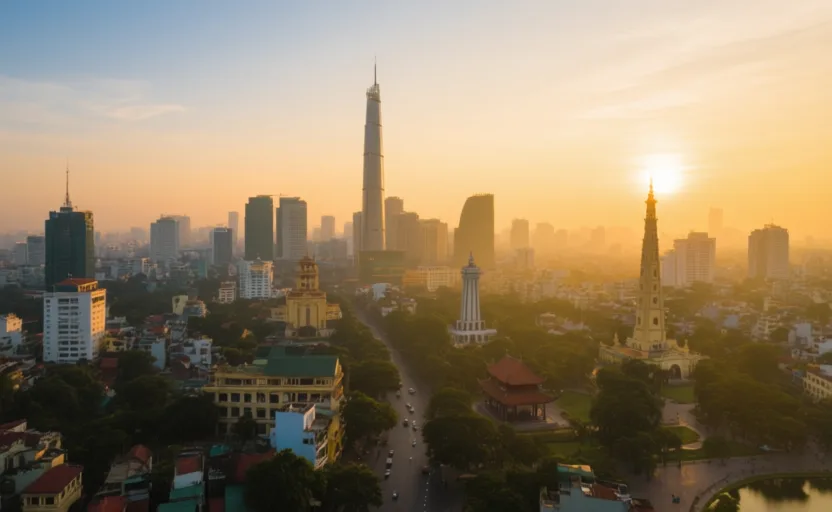
 Hanoi · AI city illustration · Artistic impression
City · Southeast Asia
Hanoi
Also known as Thăng Long, Hà Nội, Đông Kinh
Saved in this browser — no account needed. Sign in later and it comes with you.
Read its story
Where it is
Hanoi sits on the right bank of the Red River, on the delta the river built, about a hundred kilometres inland from the Gulf of Tonkin. Its name means the city inside the river — it is ringed by water, and the river beside it runs at times above the level of the streets, held off by dykes. Lakes are scattered through it, several of them former river channels left behind when the water moved.
The land and water around it
The Red Riverriver
Named for its sediment load. Confined by dykes for a millennium, so it deposits on its own bed and rises; the dykes have to rise with it.
Hoàn Kiếm and the lakeslake
Several of the city's lakes are abandoned river channels. West Lake, the largest, is a cut-off meander — the river's earlier course, still holding water.
The delta plaindelta
Flat, low and among the most densely farmed land anywhere. The city is spreading onto rice fields that took centuries to level.
Its history, in short
The city was founded as Thăng Long in 1010 and has been the seat of power for most of the thousand years since, with interruptions when other dynasties built elsewhere. It was the capital of French Tonkin and then of the Indochinese Union, which gave it a French quarter of villas and boulevards alongside the guild streets of the old quarter. It was the capital of North Vietnam from 1954, was bombed during the war, and became the capital of the reunified country in 1976. Since the đổi mới reforms of 1986 it has grown very quickly, and the argument over what to keep is live in every district.
Timeline
Dates are shown on a timeline rather than as changing shapes on the map. The globe draws modern boundaries only, and tinting a modern outline to stand for a historical one would state something we cannot source.
Post-classical world
1010
Thăng Long founded
The Lý dynasty moves the capital here from Hoa Lư. The name means ascending dragon, from an account of the move.
Well attestedUNESCO World Heritage Centre1070–1076
The Temple of Literature
A Confucian temple is founded and an academy established beside it, training officials for the examinations. Stone stelae on tortoise pedestals record the names of graduates over centuries.
Well attestedEncyclopædia Britannica1288
Bạch Đằng again
Mongol-Yuan forces are defeated on the Bạch Đằng river east of the city, by the same tide-and-stakes tactic used in 938. The capital had been evacuated and occupied more than once during the campaigns.
Well attestedEncyclopædia Britannica
Industrial & imperial
1802
The capital moves to Huế
The Nguyễn dynasty establishes its capital in the centre of the country, and Thăng Long is renamed and demoted. Much of the citadel is dismantled in the decades that follow.
Well attestedUNESCO World Heritage Centre1902
Capital of French Indochina
Hanoi becomes the capital of the Indochinese Union. The French quarter is laid out with boulevards and villas beside the older commercial streets, and the Long Biên bridge crosses the river.
Well attestedEncyclopædia Britannica
Contemporary
September 1945
Independence declared
Independence is declared in Ba Đình square. Nine years of war with France follow, ending with the French defeat at Điện Biên Phủ and the partition of the country in 1954.
Well attestedEncyclopædia BritannicaDecember 1972
The bombing
An eleven-day American bombing campaign hits the city. Casualty figures given by Vietnamese authorities and by American sources differ substantially, and the campaign's effect on the negotiations that followed is still argued.
DisputedEncyclopædia BritannicaVietnamese and American accounts differ on casualties and on whether the campaign changed the negotiating position. Both the numbers and the interpretation are contested.
2010
A thousand years, and an inscription
The city marks a millennium since its founding, and the central sector of the imperial citadel is inscribed as World Heritage — a site excavated only in the 2000s, when a new parliament building was planned over it.
Well attestedUNESCO World Heritage Centre
Places that carry meaning
The Imperial Citadel of Thăng Long1010 onward
Stratified remains of successive dynasties on one site, found during construction and excavated instead of built over. The decision to change the building plan is why it exists as heritage.
The Old Quarter15th century onward
Streets named for the trade once practised on them, still legible: silk, tin, votive paper, baskets. Tube houses, narrow at the front because frontage was taxed, run deep behind.
The Temple of Literature1070 onward
The graduate stelae are inscribed with the names of examination successes over three centuries — a public record of who passed, on stone, in a system that claimed to promote on merit.
Languages here
Places are usually multilingual. This lists what is actually spoken, not one language per border.
VietnameseAustroasiatic family
The national language; Hanoi's variety is the pronunciation standard.
Six tones in the northern standard, against five in the southern. Broadcast Vietnamese is Hanoi's, which makes the capital's accent the one learners are taught.
FrenchRomance family
An administrative and elite language from the 1880s to the 1950s.
Largely displaced after independence, and now a minority second language, but it left a layer of loanwords for things that arrived with it — coffee, cheese, stations, gears.
EnglishGermanic family
The main foreign language taught today.
Now the dominant second language in schools and in business, a shift that happened within a generation of the 1986 reforms.
Learn the language here
- 1Understand which languages are spoken hereHanoi is multilingual. Start with which languages are used, by whom, and for what — the phrase list only covers one of them.Written by Globe Quest
- 2Learn 11 phrasesCurated everyday phrases for Hanoi, with audio and a written form.Written by Globe Quest
- 3Say them out loudSpeaking practice with pronunciation feedback, one phrase at a time.Globe Quest material, your own additions
- 4Come back to themSpaced review, so what you learned this week is still there next month.Written by Globe Quest
- 5Practise with people: Vietnamese practice · Ho Chi Minh CityAn in-person practice circle. It is a prepared plan and needs a host before it runs.Run by members
- 6Read why the language is what it isThe quest for this place covers how its languages got here and who speaks them.Written by Globe Quest
Check yourself
What does the name Hanoi describe?
The city inside the river
Hà Nội means inside the river. Thăng Long, the older name, is the ascending dragon.
Why was the imperial citadel excavated in the 2000s?
A planned government building over the site prompted the dig
Construction plans led to the excavation, and the plans changed. The World Heritage inscription followed in 2010.
Worth arguing about
- A construction plan uncovered a thousand years of capitals, and the plan changed. Who should decide when that happens?
- The capital's accent is the one everyone learns. What does a standard pronunciation do to the varieties it is not?
What we have not established
These are open questions, listed rather than filled in. We would rather show a gap than a plausible guess.
How many people died in the December 1972 bombing?
Vietnamese authorities and American sources give substantially different figures, and independent verification for the period does not exist. We record that the accounts differ rather than choosing one.
Sources
- UNESCO · Central Sector of the Imperial Citadel of Thang Long - HanoiUNESCO World Heritage Centre · intergovernmental · checked 2026-09-08
- UNESCO · Complex of Hué MonumentsUNESCO World Heritage Centre · intergovernmental · checked 2026-09-08
- Britannica · HanoiEncyclopædia Britannica · encyclopedia · checked 2026-09-08
- Britannica · Vietnam WarEncyclopædia Britannica · encyclopedia · checked 2026-09-08
Reviewed by Globe Quest editorial on 2026-09-08.