 Globe Quest
 Human Quest · LearningSign in
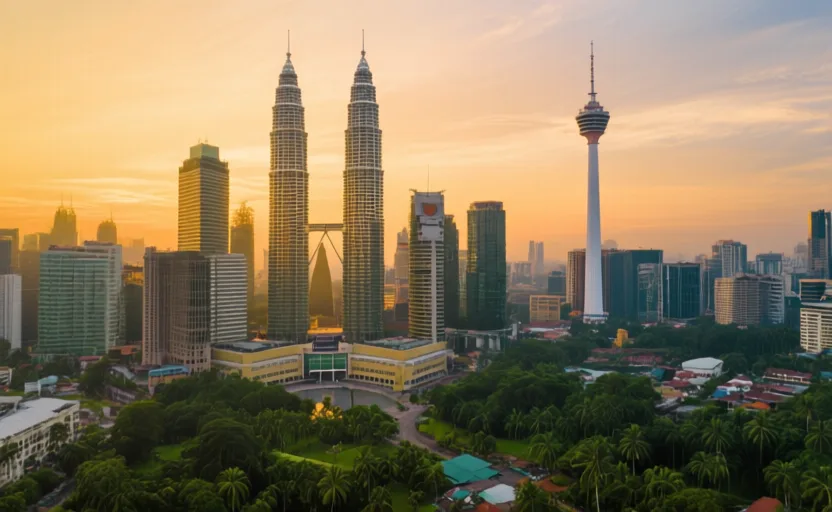 Kuala Lumpur · AI city illustration · Artistic impression
City · Southeast Asia
Kuala Lumpur
Also known as KL
Saved in this browser — no account needed. Sign in later and it comes with you.
Where it is
Kuala Lumpur takes its name from a river junction: the Gombak and Klang rivers meet here, and the Malay word kuala names a place where rivers merge. The city sits in the wide Klang Valley, with the Titiwangsa Mountains to the east and the Strait of Malacca to the west, on the broader coastal plain of the peninsula’s west side. Its centre is low, averaging about 82 metres above sea level, with the highest point, Bukit Nanas, at 94 metres. The climate is a hot, humid rainforest one with at least 2,600 millimetres of rain a year, among the most frequent thunderstorm regions on Earth, and recurring floods in the centre.
The land and water around it
The Gombak–Klang confluenceriver
The city’s original site, where the muddy waters of two rivers join. Boats could not easily go further up the Klang River, so the junction became the depot for the Ampang tin mines.
The Klang Valleyvalley
A wide valley bounded by the Titiwangsa Mountains to the east and smaller ranges to north and south, opening to the Strait of Malacca. The flat land of the west coast let the city and its neighbours, such as Petaling Jaya, Klang and Shah Alam, spread into one urban region of about 8.8 million people.
Bukit Nanasforest
A 10.52-hectare forest reserve in the city centre, the first to be gazetted in the country, and the city’s highest point at 94 metres. It is counted among the world’s oldest virgin forests within a city.
Its history, in short
The place was a small settlement before the city was formally begun. By the account taken as official, Raja Abdullah of Klang sent Chinese miners up the river in 1857 to open tin mines at Ampang, and the confluence was as far upriver as boats could conveniently carry supplies. Tin made the town and nearly destroyed it: the Selangor civil war saw it burnt in 1872 and retaken in 1873, and cholera, fire and floods followed. Yap Ah Loy, the Chinese headman, and Frank Swettenham, the British Resident from 1882, rebuilt it. It became capital of Selangor in 1880, then of the Federated Malay States and, after 1957, of independent Malaya and Malaysia. Rubber more than doubled the population in the first two decades of the century, to 80,000. Japan occupied the city from 1942 to 1945. Since 1974 it has been a federal territory, separated from Selangor, and the federal administration moved to Putrajaya from about 1999.
Timeline
Dates are shown on a timeline rather than as changing shapes on the map. The globe draws modern boundaries only, and tinting a modern outline to stand for a historical one would state something we cannot source.
Industrial & imperial
c. 1857
Tin miners at the confluence
Raja Abdullah bin Raja Jaafar raises money from Malaccan Chinese merchants to hire miners from Lukut. They land at the confluence and walk on to Ampang, where the first mine opens, and the first tin is exported in 1859.
The official account of the city’s founding; the sources note earlier settlement by Temuan, Chinese and Mandailing Sumatran miners
1872–1873
The Selangor Civil War
Rival Chinese secret societies and Malay chiefs fight over tin revenues. Kuala Lumpur is captured and burnt in 1872, and recaptured in March 1873 with help from Pahang’s forces.
Well attestedWikipedia1880
Capital of Selangor
The British administration moves the state capital from Klang to Kuala Lumpur. The Resident places government buildings west of the river, apart from the Chinese and Malay settlements on the east bank, and a police force of 200 to 300, mostly Malays from rural Malacca, is recruited.
1900–1920
The rubber boom
Rubber planting in Selangor, driven by demand for car tyres, raises the number of residents from 30,000 at the start of the century to 80,000 by 1920. The city’s area grows from 0.65 square kilometres in 1895 to 20 in 1903.
Well attestedWikipedia1942–1945
Japanese occupation
The city is captured on 11 January 1942. At least 5,000 Chinese are killed in a few weeks, and thousands of Indians are sent as forced labour to the Burma Railway.
Contemporary
31 August 1957
Independence declared
The Malayan flag is raised at Merdeka Square, where the Union Jack comes down, and Tunku Abdul Rahman proclaims independence at the new Stadium Merdeka.
13 May 1969
The May 13 riots
Parts of the city are damaged in one of the worst episodes of racial rioting in Malaysian history.
Well attestedWikipedia1 February 1974
Federal Territory
Kuala Lumpur is separated from Selangor and placed directly under the federal government, expanding to 243 square kilometres. Selangor’s capital moves to Shah Alam in 1978.
Well attestedWikipedia
Places that carry meaning
Merdeka Square1957
The old cricket field where the first Malayan flag was raised at independence.
Colonial-era railway station and Jamek Mosquelate 19th–early 20th century
Buildings by the architect Arthur Benison Hubback, part of a stock of colonial-era structures in Mughal, Moorish Revival and other styles that were adapted to the hot, humid climate with local materials.
FRIM Forest Park Selangorfrom the 1920s
On the outskirts of the city, a forest planted on land devastated by tin mining. A century on, it holds a human-made tropical rainforest as biodiverse as natural ones in Malaysia, and is inscribed by UNESCO.
Petronas Towers1990s onward
Twin towers in the new city centre around Jalan Ampang, once the tallest buildings in the world and a symbol of Malaysian development.
Languages here
Places are usually multilingual. This lists what is actually spoken, not one language per border.
MalayAustronesian family
The national and official language.
Standard Malay is taught across all communities as a unifying language. After the 13 May riots it replaced English as the main medium of education, and bumiputera, a category that includes Malays, are now the largest group in the city.
Cantonese, Mandarin and HokkienSino-Tibetan family
The languages of the Chinese community.
Cantonese is the Chinese variety mostly spoken in Kuala Lumpur, while Mandarin is the lingua franca between Chinese speaking mutually unintelligible varieties and the language of Chinese schools. Hokkien is common elsewhere on the peninsula.
TamilDravidian family
The main language of the Indian community.
Tamil is used mostly by Tamils, who are the majority of Malaysian Indians, and taught in primary schools. About 8 per cent of Kuala Lumpur’s residents are Hindu.
EnglishGermanic family
A widely used second language.
English is widely understood in the cities, compulsory in schools and a medium of instruction in private colleges and universities. Laws are published in both Malay and English.
Learn the language here
- 1Understand which languages are spoken hereKuala Lumpur is multilingual. Start with which languages are used, by whom, and for what — the phrase list only covers one of them.Written by Globe Quest
- 2Learn 12 phrasesCurated everyday phrases for Kuala Lumpur, with audio and a written form.Written by Globe Quest
- 3Say them out loudSpeaking practice with pronunciation feedback, one phrase at a time.Globe Quest material, your own additions
- 4Come back to themSpaced review, so what you learned this week is still there next month.Written by Globe Quest
Check yourself
What does “Kuala Lumpur” mean in Malay?
Muddy confluence
Kuala marks a river confluence and lumpur means mud. The name comes from the meeting of the Gombak and Klang rivers where the city began.
What first made the settlement at the confluence worth building?
Tin mines at Ampang
It was the last point on the Klang River reachable by boat, so it became the depot for tin mines opened in 1857. Rubber came later.
Worth arguing about
- The city began as a frontier town of Chinese miners, then became a Malay-majority capital. How should a city’s present identity relate to its founding communities?
- The federal government moved to Putrajaya, but Parliament and the king remain in Kuala Lumpur. What does a capital keep when its ministries leave?
What we have not established
These are open questions, listed rather than filled in. We would rather show a gap than a plausible guess.
How many people live in Kuala Lumpur?
The city proper is given as 2.076 million in 2024 and 2,111,536 in 2026, while greater Kuala Lumpur is put at 8.81 million in 2024, against 7.25 million in a 2017 estimate. The boundary used for the metropolitan area drives the difference.
Who founded Kuala Lumpur?
The official account credits Raja Abdullah and the miners he sent in 1857, yet it is unclear who the first settlers were, since people were living at the confluence and mining nearby from the 1820s or earlier.
Sources
- Wikipedia · Kuala LumpurWikipedia · encyclopedia · checked 2026-11-24
- Wikipedia · History of Kuala LumpurWikipedia · encyclopedia · checked 2026-11-24
- Wikipedia · MalaysiaWikipedia · encyclopedia · checked 2026-11-24
- Wikipedia · Languages of MalaysiaWikipedia · encyclopedia · checked 2026-11-24
- UNESCO · Forest Research Institute Malaysia Forest Park SelangorUNESCO World Heritage Centre · intergovernmental · checked 2026-11-24
Reviewed by Globe Quest editorial on 2026-11-24. Drafted with AI assistance and checked against the sources above before publication.