 Globe Quest
 Human Quest · LearningSign in
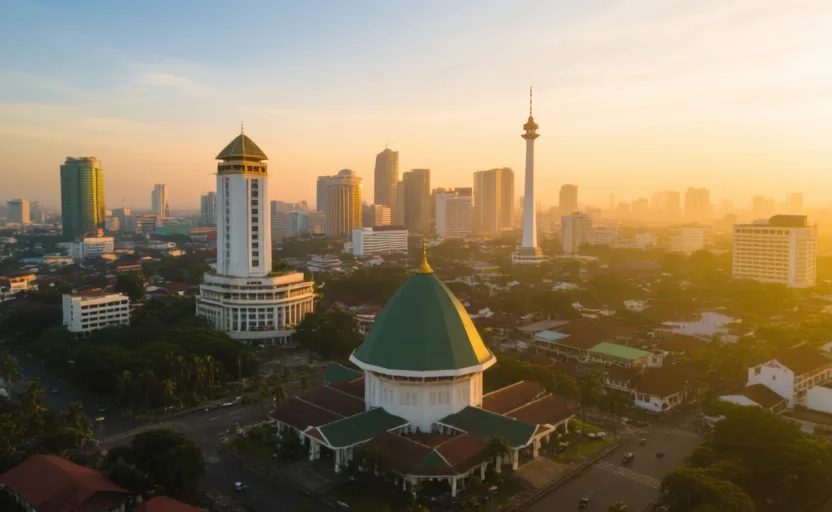 Surabaya · AI city illustration · Artistic impression
City · Southeast Asia
Surabaya
Saved in this browser — no account needed. Sign in later and it comes with you.
Where it is
The north-eastern corner of Java faces Madura across a narrow strait, and Surabaya sits where the Brantas River delta meets it. The city stands at the mouth of the Kali Mas, which once made it the sea gateway to the Majapahit capital inland. It has a tropical wet and dry climate, with rain from October to May, a dry season of about four months, and temperatures that barely change, around 31 degrees Celsius by day and 23 at night. The land within the city limits covers roughly 335 square kilometres, and a built-up region many times larger has grown around it.
The land and water around it
The Madura Straitstrait
The narrow channel between Java and Madura gives Surabaya a sheltered natural harbour, and sits on the sea road from Malacca to the Spice Islands that runs along the Java Sea, which is why the town was already a major port by the early 1500s.
The Brantas delta and the Kali Masdelta
The Brantas River reaches the sea in a delta that now lies partly under modern Surabaya and Sidoarjo. The Kali Mas was the route by which goods and visitors travelled inland towards the Majapahit capital.
A tropical wet and dry climateclimate
The wet season runs from October to May, with the rain at its heaviest from December to February. September to November are the hottest months, even though average temperatures stay remarkably level through the year.
Its history, in short
Surabaya was a river port long before it was a city. The earliest written mention is a Chinese trade account of 1225, and by the 14th and 15th centuries it was one of several harbours serving the Majapahit empire's inland capital, with Chinese settlers and Zheng He's fleet visiting the coast. As Majapahit weakened, its lord resisted the Muslim sultanate of Demak until 1530 and became independent again in 1546, while the preacher Sunan Ampel founded a religious settlement that made the city a centre of Islam in Java. The Dutch East India Company took the city in 1743. For the next two centuries it ranked as the colony's biggest city, a naval base and the centre of Java's plantation economy, and in 1926 it became capital of East Java. Its best-known moment came in November 1945, when Republican fighters held out against British and allied forces for days, an event Indonesians remember as Heroes' Day. Today it is the second-largest city in Indonesia, a port and industrial centre with a distinctive local speech and a reputation for being direct.
Timeline
Dates are shown on a timeline rather than as changing shapes on the map. The globe draws modern boundaries only, and tinting a modern outline to stand for a historical one would state something we cannot source.
Post-classical world
1225
The earliest record
The Chinese book Zhu Fan Zhi, written by Zhao Rukuo, mentions the place under a Chinese rendering of its name. It is the earliest historical record of Surabaya.
Well attestedWikipedia31 May 1293
The traditional founding date
The city celebrates its anniversary on the day Raden Wijaya's Majapahit forces are said to have beaten a Mongol invasion. The name Surabaya, “bravely facing danger”, is tied to this by one reading of a prophecy of the king Jayabaya of Kediri, who foresaw a battle between a shark and a crocodile. The two animals are now the city's emblem.
DisputedWikipediaA traditional reading that links the prophecy of Jayabaya to the Mongol invasion of 1293; the date was set as the city's anniversary rather than recorded as its founding
1413
Zheng He's treasure ships
Ma Huan, who sailed on Zheng He's fourth expedition, describes the Javanese coast. He lists Supaerhya, or Surabaya, among the new trading towns, then travels inland by smaller boat up the Brantas towards the Majapahit capital.
Well attestedWikipedia
Early modern & oceanic
1530–1546
Between Majapahit and Demak
The lord of Surabaya resists the rise of the Demak Sultanate and submits to it only in 1530. When Sultan Trenggana of Demak dies in 1546, Surabaya regains its independence.
Well attestedWikipediaNovember 1743
The Dutch take over
The Dutch East India Company takes the city from a weakened Mataram, then governs through local magnates, including leading members of the Han family of Lasem.
Well attestedWikipedia
Industrial & imperial
1926
Capital of East Java
Surabaya is designated capital of the province of East Java, having become a municipality in 1905 and built a modern port in 1910. By then only Batavia is bigger in the colony.
Well attestedWikipedia
Contemporary
10 November 1945
The Battle of Surabaya
The British brigadier Aubertin Mallaby is killed near the Red Bridge on 30 October, allegedly by a stray bullet. When Republican fighters refuse an ultimatum to surrender, a battle on 10 November costs thousands of lives. Indonesians now mark the day as Heroes' Day.
Well attestedWikipedia13 May 2018
The church bombings
Bombs hit three churches in the city in a coordinated attack by the militant group Jamaah Ansharut Daulah, and a bombing at police headquarters follows the next day. Twenty-eight people are killed, including the attackers.
Well attestedWikipedia
Places that carry meaning
Jembatan Merah, the Red BridgeBefore 1900
Before 1900 the city centre revolved around this crossing, and the brigadier was killed nearby in 1945. It marks the old colonial heart of the town.
AmpelLate 15th century
The district around the Ampel Mosque in the north of the city was founded by the preacher Sunan Ampel. His tomb is a sacred site, visited by Surabayans and by pilgrims from across Indonesia, and recalls the city's part in the spread of Islam in Java.
Tanjung Perak Harbour1910
A modern port facility built in 1910 that underpinned the city's export trade in sugar, tobacco and coffee. The city also hosts a large shipyard and several naval schools.
The old shophouse streetsBefore the Second World War
Around Kembang Jepun and the nearby Karet, Gula, Slompretan and Rajawali streets stand surviving two-storey shophouses that blend European and Chinese building traditions, now preserved as heritage.
Languages here
Places are usually multilingual. This lists what is actually spoken, not one language per border.
Javanese (Suroboyoan)Austronesian family
The everyday speech of most residents.
Most people speak Suroboyoan, a variety of East Javanese and a sub-dialect of Arekan. It mixes Indonesian and Javanese with influence from Madurese and is looser in its use of speech levels than Central Javanese. Its speakers are proud of it, promote it in local media and the Ludruk theatre, and keep it wherever they go.
IndonesianAustronesian family
The national language, used in schooling, administration and between groups.
Surabaya draws migrants and students from across the archipelago, including Sundanese, Minang, Batak, Balinese, Papuan, Minahasan, Bugis and others, for whom Indonesian is the common tongue.
MadureseAustronesian family
The language of the large minority from across the strait.
Madurese people make up about 7% of the population, about as many as the Chinese, and the language has left a mark on the local Javanese dialect.
Learn the language here
- 1Understand which languages are spoken hereSurabaya is multilingual. Start with which languages are used, by whom, and for what — the phrase list only covers one of them.Written by Globe Quest
- 2Learn 11 phrasesCurated everyday phrases for Surabaya, with audio and a written form.Written by Globe Quest
- 3Say them out loudSpeaking practice with pronunciation feedback, one phrase at a time.Globe Quest material, your own additions
- 4Come back to themSpaced review, so what you learned this week is still there next month.Written by Globe Quest
Check yourself
Why is Surabaya called the City of Heroes?
The Battle of Surabaya in 1945 rallied support for Indonesian independence
The battle with British and allied forces on 10 November 1945 cost thousands of lives, and the date is now commemorated as Heroes' Day for its effect on opinion at home and abroad.
What does the name Surabaya mean, in the traditional explanation?
Bravely facing danger
The name is read as the Javanese sura ing baya, linked to the prophecy of a shark and a crocodile, whose images are the city's emblem.
Worth arguing about
- A city whose founding date comes from a reading of a prophecy rather than a record. Does it matter how a city dates itself, if the date does its work?
- Surabaya once led the Dutch East Indies and is now second to Jakarta. What does a city that has been first, then second, owe to the place that overtook it?
What we have not established
These are open questions, listed rather than filled in. We would rather show a gap than a plausible guess.
When was Surabaya founded?
Its anniversary is fixed at 31 May 1293, but another account says the area was settled in the 10th century by the Janggala kingdom, which was itself formed in 1045, and the first written record is from 1225. The date is therefore a civic convention rather than an established founding.
How many people live in Surabaya?
The city proper counted 2,874,314 in 2020 and roughly 3.0 million in mid-2024 and mid-2025, but the figures do not line up. For the wider metropolitan area the estimates run from about 8.3 million for Greater Surabaya in 2015 to over 10 million and over 12 million, depending on which neighbouring regencies are included.
Sources
- Wikipedia · SurabayaWikipedia · encyclopedia · checked 2026-11-24
- Wikipedia · Languages of IndonesiaWikipedia · encyclopedia · checked 2026-11-24
Reviewed by Globe Quest editorial on 2026-11-24. Drafted with AI assistance and checked against the sources above before publication.