 Globe Quest
 Human Quest · LearningSign in
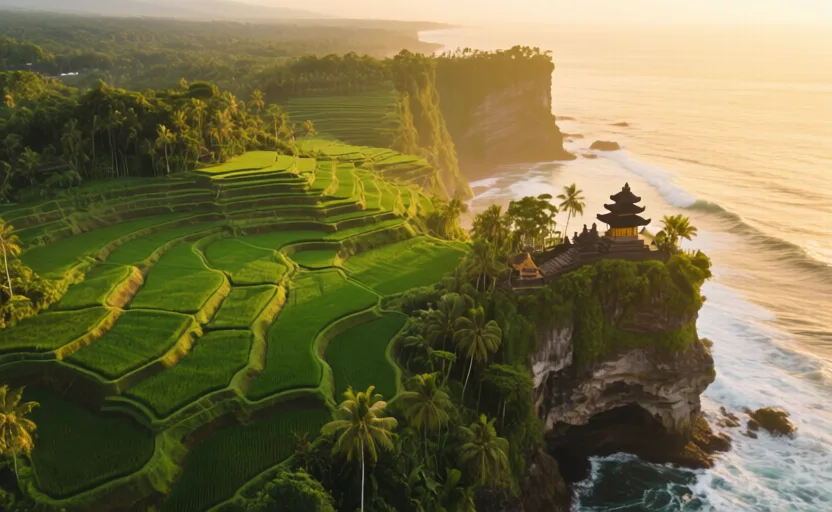 Bali · AI city illustration · Artistic impression
City · Southeast Asia
Bali
Saved in this browser — no account needed. Sign in later and it comes with you.
Where it is
Bali is an island province of Indonesia, only 3.2 km east of Java across the Bali Strait and about eight degrees south of the equator. It measures roughly 153 km from east to west and 112 km from north to south. A chain of volcanoes runs through the centre, with several peaks above 2,000 metres and Mount Agung at 3,031 metres. The rain that falls on these mountains feeds the rice country on the gentler southern slopes, while the northern side drops more steeply to the sea. Temperatures stay near 30 degrees Celsius all year, and the west monsoon from October to April brings the heaviest rain. Coral reefs surround the coast.
The land and water around it
The central volcanoesvolcano
Mount Agung, the “mother mountain”, and the active Mount Batur anchor a spine of peaks. Their ash makes the soil exceptionally fertile and their height catches the rain that waters the farmland. Agung began erupting again in late 2017 and forced large evacuations. Balinese orientation follows them: kaja means towards the mountain and kelod towards the sea, with the gods and ancestors in the hills and demons in the sea.
The Lombok Strait and the Wallace Linestrait
The Lombok Strait to the east is where animal life changes character, with Asian species on one side and Australasian species on the other. Alfred Russel Wallace proposed the transition zone, after a visit to Bali in 1860.
The southern rice plainplain
South of the mountains, a broad gently falling plain grows most of the island's rice, watered by an elaborate system of irrigation that impressed Wallace on his visit. The northern slopes, by contrast, are the main coffee-growing area.
Its history, in short
Austronesian settlers reached Bali around 2000 BCE. The first written records are small clay stupas from around the 8th century and a pillar of 914 inscribed in both Sanskrit and Old Balinese, which show Buddhism and Shaivism practised side by side under a local dynasty. Marriages between the Balinese and Javanese royal houses brought more Javanese culture, and in 1343 the Majapahit empire's prime minister Gajah Mada defeated the Balinese king, after which Javanese arts, scripts and theatre flowed in. When Majapahit fell, Javanese aristocrats are believed to have fled to Bali, deepening its Hindu character. The island later split into nine small kingdoms, which the Dutch played against each other, taking control from the 1840s on the north coast and in the late 1890s in the south. Bali became part of independent Indonesia in 1949 and a province in 1958. Mount Agung's 1963 eruption and the anti-communist violence of 1965–66 were its greatest twentieth-century disasters. Since then tourism, which now supplies about 80% of the island's economy, has reshaped its cities and its water supply, although Balinese Hinduism and village ritual life remain at the centre of island society.
Timeline
Dates are shown on a timeline rather than as changing shapes on the map. The globe draws modern boundaries only, and tinting a modern outline to stand for a historical one would state something we cannot source.
First cities & states
c. 2000 BCE
Austronesian settlers
Austronesian peoples who migrated from Taiwan settle on the island. Stone tools from this period have been found near Cekik in the west.
Approximate dateWikipedia
Post-classical world
914
The Belanjong pillar
A pillar at Sanur, inscribed in Sanskrit and Old Balinese in two scripts, mentions King Sri Kesari Warmadewa. It is one of the earliest sources for the name Bali itself, in the compound Vali-dvipa, meaning “island”.
1343
Majapahit conquest
Gajah Mada, prime minister of the Javanese king, defeats the Balinese king at Bedulu. The Majapahit capital in Bali is set up at Samprangan and later Gelgel, and Javanese influence on architecture, dance, theatre and script grows strongly. The Balinese who rejected it are the Bali Aga, still found in a few isolated villages.
Well attestedWikipedia
Early modern & oceanic
1512
First European contact
The first known European contact is thought to be a Portuguese sighting of the northern shore by António de Abreu and Francisco Serrão. The island is charted on the same voyage.
Industrial & imperial
1840s onward
Dutch control begins in the north
The Dutch begin to pit rival Balinese realms against one another on the north coast, and in the late 1890s they exploit conflicts among kingdoms in the south to extend their hold.
Approximate dateWikipedia
Contemporary
1963
Mount Agung erupts
The eruption kills thousands and wrecks the economy, and many displaced Balinese are resettled elsewhere in Indonesia.
Well attestedWikipedia1965–1966
The anti-communist killings
After a purported coup attempt in Jakarta, the army blamed the Communist Party, the PKI, and led a violent purge. Most estimates put the national toll at no fewer than 500,000, with around 80,000 killed in Bali, about 5% of the island's people. Local rivalries between the PKI and the nationalist PNI, and over the caste system and land reform, fed the violence there, and upper-caste PNI landlords are reported to have led the killing of PKI members.
DisputedWikipediaThe army's account of a communist coup attempt it put down, set against accounts that the army itself instigated the purge, with support from Western powers
2002 and 2005
The Kuta bombings
A bombing by militant Islamists in the tourist district of Kuta kills 202 people, mostly foreigners, and another attack in 2005 further reduces tourism. The island goes through severe economic hardship in the years that follow.
Well attestedWikipedia
Places that carry meaning
The Belanjong pillar914
A stone inscribed at Sanur, now one of the oldest written records of the island's kings. It uses both Sanskrit and Old Balinese, showing a Hindu-Buddhist court that was already speaking its own distinct dialect.
Goa Gajahc. 10th century
A stone temple whose iconography combines Buddhist and Hindu Shaivite elements, made around the same period as the Belanjong pillar.
The subak of JatiluwihListed 2012
Bali's traditional system of irrigated paddy fields at Jatiluwih was listed as a World Heritage Site in June 2012. Wallace praised the elaborate system when he visited in 1860.
Ubud and SingarajaCultural and colonial centres
Ubud, in the uplands, is regarded as the cultural centre of the island. Singaraja on the north coast, the old colonial capital, is the second city, and it is where the Dutch first took hold of the island.
Languages here
Places are usually multilingual. This lists what is actually spoken, not one language per border.
BalineseAustronesian family
The island's own language, spoken at home and in ritual.
The language is heavily stratified into levels of speech, a feature tied to the old caste system. Most Balinese are bilingual or even trilingual.
IndonesianAustronesian family
The national language and the common language of the tourist areas.
Around the tourist districts Indonesian is the usual language of conversation, because many workers there come from Java, Lombok, Sumatra and elsewhere in the country instead of being Balinese.
Old Balinese and Sanskrit
Languages of early inscriptions and of religion.
Inscriptions such as the Belanjong pillar were written in both Old Balinese and Sanskrit, and Kawi script and Javanese literary forms arrived under Majapahit.
Learn the language here
- 1Understand which languages are spoken hereBali is multilingual. Start with which languages are used, by whom, and for what — the phrase list only covers one of them.Written by Globe Quest
- 2Learn 12 phrasesCurated everyday phrases for Bali, with audio and a written form.Written by Globe Quest
- 3Say them out loudSpeaking practice with pronunciation feedback, one phrase at a time.Globe Quest material, your own additions
- 4Come back to themSpaced review, so what you learned this week is still there next month.Written by Globe Quest
Check yourself
What does the Wallace Line, running through the strait east of Bali, divide?
The faunas of the Indomalayan realm and Australasia
Alfred Russel Wallace proposed a transition zone between two major biomes, and the strait between Bali and Lombok marks it, so animals on either side differ sharply despite the short distance.
What religion do about 86% of Balinese people practise, in a country that is mostly Muslim?
Balinese Hinduism
It is the one province of Indonesia where Hindus are in the majority, and its religion blends local beliefs with Hindu traditions from South and Southeast Asia, strengthened by Javanese influence after 1343.
Worth arguing about
- Tourism provides about 80% of the island's economy and has dried up half of its rivers, according to one count. Can an island live on a visitor economy without exhausting the water that sustains it?
- The 1965–66 killings in Bali are remembered unevenly. How should a community that remains closely tied to its ancestral villages come to terms with a violence its own neighbours carried out?
What we have not established
These are open questions, listed rather than filled in. We would rather show a gap than a plausible guess.
How many people were killed in Bali in 1965–66?
The figure of about 80,000, or roughly 5% of the island's population, is an estimate, as is the national toll of at least 500,000. The sources give only estimates, and accounts of who bore responsibility differ, so the totals are shown as estimates.
How many people live in Bali?
The 2020 census counted 4,317,404, while the official mid-2024 estimate is 4,461,260 and another count for 2024 is 4,433,300, so the current total depends on the source and date. About 109,801 foreigners were also reckoned to live on the island in 2021.
Sources
- Wikipedia · BaliWikipedia · encyclopedia · checked 2026-11-24
- Wikipedia · History of BaliWikipedia · encyclopedia · checked 2026-11-24
Reviewed by Globe Quest editorial on 2026-11-24. Drafted with AI assistance and checked against the sources above before publication.