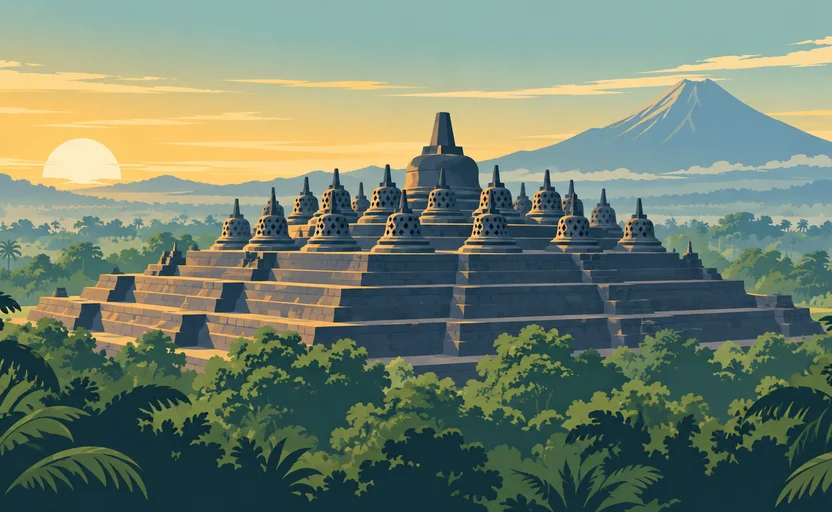
 Borobudur · AI illustration, not a photograph
Historical place · Southeast Asia
Borobudur
Also known as Barabudur
A terraced Buddhist monument in central Java, built in stone as a single ascending structure.
Saved in this browser — no account needed. Sign in later and it comes with you.
Where it is
Borobudur stands on a low rise in the Kedu plain of central Java, ringed by volcanoes — Merapi and Merbabu to the north-east, Sumbing and Sindoro to the north-west — with the Progo and Elo rivers meeting nearby. The plain's volcanic soil is exceptionally fertile, which is what supported the population and the surplus that a monument of this size required. It is not a building with rooms; it is a single stepped structure of some two million blocks of andesite laid over an earth core.
The land and water around it
The Kedu plainbasin
A fertile volcanic basin between four volcanoes. The ash that periodically buries the region is also what makes its soil productive, which is the standing bargain of living in central Java.
Merapivolcano
One of the most active volcanoes on Earth, about 25 kilometres north-east. Its ash has fallen on the monument repeatedly, including in 2010, when the stones were covered and had to be cleaned.
The hill beneathplateau
The monument is built over a natural hill rather than raised from flat ground, which is why it has no interior. That choice is also its structural weakness: the earth core moves, and the stone above it has to follow.
Its history, in short
It was built in the eighth and ninth centuries under the Shailendra rulers, at a period when central Java also produced the Hindu temple complex at Prambanan a short distance away — two great religious monuments of different faiths, within a few decades and a few kilometres of one another. Within about a century the centre of Javanese power moved east and the monument fell out of use; volcanic ash and vegetation gradually covered it. It was cleared under Raffles in 1814, badly restored, damaged by nineteenth-century souvenir removal, and then dismantled and rebuilt in a UNESCO-backed campaign in the 1970s and 1980s that also gave it a drainage system it had always needed.
Timeline
Dates are shown on a timeline rather than as changing shapes on the map. The globe draws modern boundaries only, and tinting a modern outline to stand for a historical one would state something we cannot source.
Post-classical world
c. 780–850
Built
Construction under the Shailendra rulers, in several phases with at least one substantial change of plan visible in the fabric. There is no foundation inscription, so the dating is from style, from the buried reliefs and from comparison with dated neighbours.
Approximate dateUNESCO World Heritage Centrec. 9th century
The hidden foot
An outer casing was added early in construction, covering a band of carved reliefs at the base. Whether this was to buttress a slumping structure or to conceal reliefs depicting desire and its consequences is not resolved; a small section is left open for viewing.
DisputedUNESCO World Heritage CentreStructural and doctrinal explanations for the encasing of the base are both current among specialists, and the fabric supports neither decisively.
c. 10th century
Java's centre moves east
Political power shifts to eastern Java and the Kedu monuments cease to be maintained. The usual explanations are volcanic disruption and political change; the sequence is not documented.
Approximate dateEncyclopædia Britannica
Industrial & imperial
1814
Cleared
Under the British lieutenant-governorship of Stamford Raffles, the site is cleared of soil and vegetation by a survey team. The clearance began the monument's modern life and also its era of removals: statuary and relief panels left the site for decades afterwards.
Well attestedEncyclopædia Britannica1907–1911
The first restoration
A Dutch engineer, Theodoor van Erp, reconstructs the upper terraces. The work stabilised the monument's appearance but not its drainage, which was the actual problem.
Well attestedEncyclopædia Britannica
Contemporary
1975–1982
Taken apart and rebuilt
An international campaign dismantles the lower terraces stone by stone, treats the hill core, installs drainage and filters, and reassembles them. Over a million blocks were individually recorded and replaced.
Well attestedUNESCO World Heritage Centre2010
Merapi
A major eruption covers the monument in acidic ash. Cleaning takes months, and the episode is a reminder that the threat here is not neglect but the volcano the monument was built beside.
Well attestedNASA Earth Observatory
Places that carry meaning
The relief galleries9th century
Several kilometres of narrative relief along the terrace walls, read by walking clockwise and rising as you go. The design makes the doctrine a route rather than a text.
Prambanan9th century
A large Hindu temple complex about 40 kilometres east, built within decades of Borobudur. Two monumental religious programmes of different faiths in one small region and one short period.
The perforated stupas9th century
The upper terraces carry bell-shaped stupas of pierced stone, each containing a seated Buddha visible only partially from outside — a deliberate half-concealment at the top of a monument whose lower reliefs are entirely legible.
Languages here
Places are usually multilingual. This lists what is actually spoken, not one language per border.
JavaneseAustronesian family
The language of the region, then and now.
One of the largest languages in the world without being a national one. It has elaborate speech levels — different vocabulary depending on the relative status of speaker and listener — which makes fluency a social skill as much as a linguistic one.
Sanskrit and Old JavaneseIndo-Aryan and Austronesian family
The languages of the inscriptions and the literature.
Old Javanese absorbed a very large Sanskrit vocabulary while keeping its own grammar — the linguistic signature of a region that adopted Indian religion and statecraft without being ruled from India.
IndonesianAustronesian family
The national language.
Standardised from Malay, a trade language, rather than from Javanese, the language of the largest group — a deliberate choice at independence to avoid making the state the property of its biggest ethnicity.
Learn the language here
Check yourself
Why does Borobudur have no interior?
It is built over a natural hill rather than raised from flat ground
The hill is the core, which is also why the earth beneath it moves and the stone has to follow.
Why is Indonesia's national language based on Malay rather than Javanese?
Malay was a trade language, so it did not belong to the largest ethnic group
A deliberate choice at independence: the shared language is nobody's home advantage.
Worth arguing about
- A Buddhist and a Hindu monument, decades and kilometres apart. What does that say about how religions actually coexist?
- The 1970s restoration took the monument apart to save it. When is that the right call, and when is it a rebuild?
What we have not established
These are open questions, listed rather than filled in. We would rather show a gap than a plausible guess.
Why was the base encased?
Structural buttressing and doctrinal concealment are both argued and the fabric does not decide between them. No foundation inscription survives to settle it.
Sources
- UNESCO · Borobudur Temple CompoundsUNESCO World Heritage Centre · intergovernmental · checked 2026-09-08
- UNESCO · Prambanan Temple CompoundsUNESCO World Heritage Centre · intergovernmental · checked 2026-09-08
- Britannica · BorobudurEncyclopædia Britannica · encyclopedia · checked 2026-09-08
- NASA Earth Observatory · Eruption at Mount Merapi, IndonesiaNASA Earth Observatory · government · checked 2026-09-08
Reviewed by Globe Quest editorial on 2026-09-08.
Related places
Themes: Religion & pilgrimage, Empires & independence