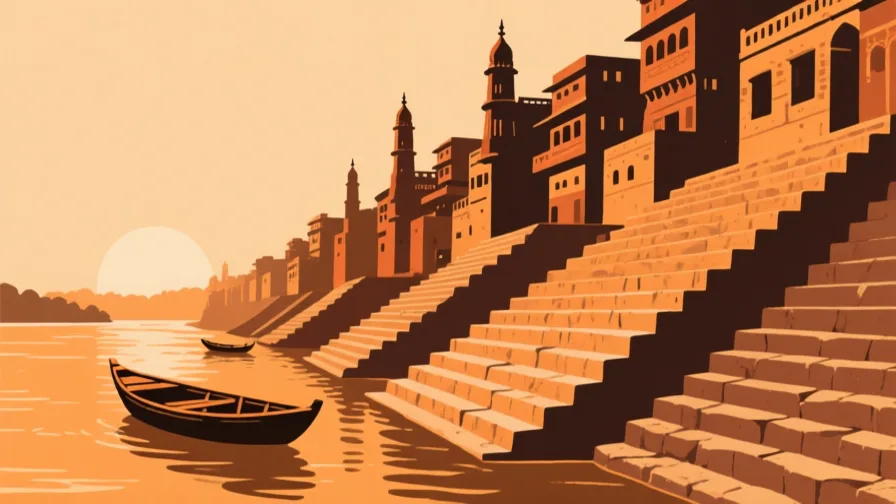
 Varanasi · AI illustration, not a photograph
Historical place · South Asia
Varanasi
Also known as Banaras, Kashi, Benares
A city on the Ganges' western bank, continuously inhabited for millennia and a principal Hindu pilgrimage destination.
Saved in this browser — no account needed. Sign in later and it comes with you.
Read its story
Where it is
Varanasi stands on the Ganges in Uttar Pradesh, on the outer, higher bank of a bend where the river briefly turns north. The opposite bank is low sand that floods each monsoon and is largely empty. That asymmetry is not a planning decision: a river erodes its outer bank and deposits on the inner one, so one side is high and stable and the other is not. The city's stone steps down to the water — the ghats — run for several kilometres along that high bank.
The land and water around it
The Gangesriver
The river the city faces, whose level varies by many metres between the dry season and the monsoon. The ghats are stepped precisely so that access works at any level.
The bendriver
A stretch where the river runs north rather than south-east. In a tradition where the source lies in the Himalaya to the north, a reach that appears to flow back toward its source is read as significant.
Its history, in short
Varanasi is among the longest continuously inhabited cities anywhere, with settlement from at least the first millennium BCE. It has been a centre of Hindu practice and pilgrimage for most of that time, and also of Buddhist tradition — Sarnath, where the Buddha is held to have given his first teaching, is a few kilometres away. It has been ruled by Hindu and Muslim states in turn, and much of the visible built fabric on the riverfront is comparatively recent, built or rebuilt from the eighteenth century by rulers and merchants from across India. It is a weaving city as well as a religious one, and its silk industry is largely Muslim-run — a fact frequently absent from accounts that present the city as singularly Hindu.
Timeline
Dates are shown on a timeline rather than as changing shapes on the map. The globe draws modern boundaries only, and tinting a modern outline to stand for a historical one would state something we cannot source.
Classical world
c. 8th century BCE onward
Early settlement
Occupation is attested from at least the first millennium BCE, during the urbanisation of the Ganges plain. Dating rests on excavation and is a range.
Approximate dateUNESCO World Heritage Centrec. 5th century BCE
Sarnath
Buddhist tradition places the Buddha's first teaching at Sarnath, a few kilometres from the city. The site holds later stupas and monastic remains. The traditional dating of the Buddha's life is itself debated within a range of about a century.
Approximate dateUNESCO World Heritage CentreThe Buddha's dates are reconstructed from textual traditions that differ; historians work with a range rather than a fixed year.
Post-classical world
12th century onward
Conquest, destruction and rebuilding
The city comes under Delhi Sultanate control; temples are destroyed and rebuilt repeatedly over the following centuries under different rulers. Several of the disputes this produced are legally and politically live today.
DisputedUNESCO World Heritage CentreThe history of specific religious sites in Varanasi is the subject of ongoing litigation and of sharply opposed communal narratives in India. This entry records that destruction and rebuilding occurred repeatedly and does not adjudicate any individual site.
Early modern & oceanic
18th century
The riverfront as it now looks
Much of the present ghat architecture is built or rebuilt in this period by rulers and merchant families from across India — Maratha, Rajput, Bengali — which is why a walk along the river passes patronage from many regions.
Well attestedUNESCO World Heritage Centre
Contemporary
1986 onward
River-cleaning programmes
Successive national programmes target pollution in the Ganges here and elsewhere. Improvement has been partial, for structural reasons: sewage growth outpacing treatment capacity, plants needing continuous power and maintenance, dispersed industrial discharge, and responsibility split across states.
Well attestedEncyclopædia Britannica
Places that carry meaning
The ghatsLargely 18th century onward, on much older use
Stone steps running several kilometres along the high bank, giving access to water at any level. Bathing, laundry, boats, pilgrimage and cremation all happen on them, sometimes within a few hundred metres of each other.
Sarnath3rd century BCE onward
The site associated with the Buddha's first teaching, with Ashokan remains, stupas and a monastic complex. Its presence makes Varanasi a place of two major traditions rather than one.
Languages here
Places are usually multilingual. This lists what is actually spoken, not one language per border.
BhojpuriIndo-Aryan family
The everyday spoken language of much of the city and the surrounding region.
Officially often treated as a Hindi dialect and by its speakers frequently as a language in its own right. Which it is has been a live political question for decades, and no purely linguistic test settles it.
HindiIndo-Aryan family
The language of administration, schooling and public life.
Standard Hindi is a register used in official and educational settings; it is not identical to what people speak at home here.
UrduIndo-Aryan family
Used by part of the city's Muslim population, including in the weaving trade.
Shares a grammatical core with Hindi and is written in a Perso-Arabic script with a distinct literary vocabulary. Treating the two as entirely separate languages, or as entirely the same, both misdescribe the situation.
SanskritIndo-Aryan family
Liturgical and scholarly, taught in the city's traditional institutions.
Not a community's first language, and in continuous ritual and scholarly use here for a very long time.
Learn the language here
- 1Understand which languages are spoken hereVaranasi is multilingual. Start with which languages are used, by whom, and for what — the phrase list only covers one of them.Written by Globe Quest
- 2Read why the language is what it isThe quest for this place covers how its languages got here and who speaks them.Written by Globe Quest
Check yourself
Why is one bank densely built and the other nearly empty?
The built bank is the high outer bank of a bend; the other is low, flood-prone sand
Rivers erode the outer bank of a bend and deposit on the inner one. Varanasi is on the high side.
What practical problem do the ghats solve?
They give access to water whose level varies by metres between seasons
Stepped access works at any water level, which is the point.
Worth arguing about
- A river that is sacred, a water supply and a drain at once. When those uses conflict, whose claim should win?
- Accounts of Varanasi often present it as singularly Hindu. What does that leave out, and who does the omission serve?
What we have not established
These are open questions, listed rather than filled in. We would rather show a gap than a plausible guess.
How old is continuous settlement at Varanasi, precisely?
Claims of three thousand years or more are common and rest on a mixture of textual tradition and excavation at different spots in a continuously occupied city, where clean stratigraphy is hard to obtain. We say 'at least the first millennium BCE' rather than repeat a rounder, older number.
What is the current measured water quality at the ghats?
Indian pollution-control boards publish monitoring data, but sampling points, parameters and reporting periods change between series, and we have not fixed one we can cite and re-check consistently.
Sources
- UNESCO · Kathmandu ValleyUNESCO World Heritage Centre · intergovernmental · checked 2026-09-08
- UNESCO · Archaeological Ruins at MoenjodaroUNESCO World Heritage Centre · intergovernmental · checked 2026-09-08
- Britannica · Ganges RiverEncyclopædia Britannica · encyclopedia · checked 2026-09-08
Reviewed by Globe Quest editorial on 2026-09-08.
Related places
Themes: Religion & pilgrimage, Rivers & cities, How cities work