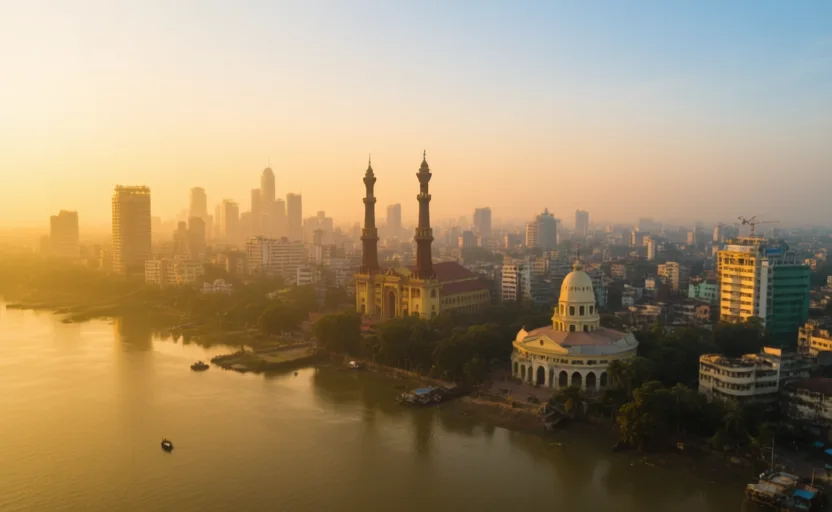
 Kolkata · AI city illustration · Artistic impression
City · South Asia
Kolkata
Also known as Calcutta
Saved in this browser — no account needed. Sign in later and it comes with you.
Read its story
Where it is
Kolkata stands on the east bank of the Hooghly, a western distributary of the Ganges, about 150 kilometres inland from the Bay of Bengal in the Bengal delta. It is very flat, very wet in the monsoon, and built on ground the river made. The city's whole existence depends on a channel that has been silting since before it was founded, kept navigable only by a barrage upstream diverting Ganges water into it.
The land and water around it
The Hooghlyriver
A distributary, not the main channel. It has been silting for centuries, and the Farakka barrage upstream diverts Ganges flow into it specifically to keep it moving — an entire city's port sustained by an engineering decision that its downstream neighbour objects to.
The delta plaindelta
Flat, low, and among the most densely populated rural landscapes on earth. Kolkata sits a few metres above sea level on it.
The East Kolkata Wetlandslagoon
A system of shallow ponds east of the city where sewage is treated by fish farming and vegetable growing rather than by plant. It is a working wastewater system that is also a livelihood, and it is under continuous pressure from building.
Its history, in short
The East India Company established a trading post here in the 1690s, on a site chosen because ocean-going ships could then reach it. It became the capital of British India and, for a century and a half, the largest city and principal port of the colonial economy — jute, tea, coal and opium moving out through it. It was the intellectual centre of the Bengal Renaissance and of early Indian nationalism, which is part of why the capital was moved to Delhi in 1911. Partition in 1947 cut the city from its hinterland and brought millions of refugees; the 1971 war brought millions more. Its industrial base declined through the later twentieth century, and it has been governed and argued over ever since as a city whose importance is historical and whose population is not.
Timeline
Dates are shown on a timeline rather than as changing shapes on the map. The globe draws modern boundaries only, and tinting a modern outline to stand for a historical one would state something we cannot source.
Early modern & oceanic
1690s
The Company post
The East India Company establishes a factory on the Hooghly at a point ocean-going ships could then reach. The founding date and the extent to which villages already existed on the site are both argued, and a court ruling in 2003 rejected the idea of a single founder.
DisputedEncyclopædia BritannicaThe city's foundation narrative was revised after litigation and historical review in 2003; the older account crediting a single English founder is no longer the official one.
1772
Capital of British India
Calcutta becomes the seat of the Company's government in India and then of the Raj — the administrative centre of a colonial state governing a subcontinent from a delta port.
Well attestedEncyclopædia Britannica
Industrial & imperial
1854 onward
Rail, jute and coal
Railways open inland from the port, and jute mills line the Hooghly. The network is laid out to move raw material to the port rather than to link Indian regions to one another.
Well attestedUNESCO World Heritage Centre1881
The Darjeeling line
A two-foot-gauge railway climbs to the hill station the administration retreated to in the hot season, using loops and reverses to gain height. It was inscribed as World Heritage in 1999.
Well attestedUNESCO World Heritage Centre1905
The first partition of Bengal
The province is divided administratively along lines that separated Muslim-majority east from Hindu-majority west. The protest that followed — including a boycott of British goods — was a formative episode in Indian nationalism, and the division was reversed in 1911.
Well attestedEncyclopædia Britannica1911
The capital moves to Delhi
The Raj shifts its capital, in part to move the government away from Bengal's political agitation. The city keeps the port and the industry and loses the state.
Well attestedEncyclopædia Britannica1943
The famine reaches the city
Around three million die in Bengal, and destitute rural people arrive in Calcutta in enormous numbers. Responsibility for the famine is contested and remains politically live.
DisputedEncyclopædia BritannicaThe causes of the 1943 famine and the extent of British wartime administrative responsibility are argued between historians and remain politically charged in Britain, India and Bangladesh.
Contemporary
1947
Partition
The border leaves the city with its mills and without the districts that grew the jute. Millions cross in both directions, and refugee settlement reshapes the southern and eastern city.
Well attestedEncyclopædia Britannica2001
Kolkata
The English spelling of the city's name is changed officially to match the Bengali pronunciation, part of a wider set of renamings across India.
Well attestedEncyclopædia Britannica
Places that carry meaning
The Maidan18th century onward
A vast open field cleared to give the Fort's guns a field of fire, now the city's park. Its origin is military and its use is football, cricket and grazing.
The East Kolkata Wetlands20th century onward
Designated under the Ramsar Convention. The ponds treat a large share of the city's sewage and produce fish and vegetables for its markets, which makes them infrastructure that pays for itself and land that developers want.
College Street19th century onward
A street of bookshops beside the university, and the physical centre of the print culture that carried the Bengal Renaissance — publishing, pamphleteering and argument in Bengali.
Languages here
Places are usually multilingual. This lists what is actually spoken, not one language per border.
BengaliIndo-Aryan family
The state language and the city's own.
The literary standard was consolidated here in the nineteenth century, which is why the same written language serves West Bengal and Bangladesh across a border drawn in 1947.
Hindi and UrduIndo-Aryan family
Widely spoken by communities from Bihar, Uttar Pradesh and elsewhere.
Migration for work over more than a century has made Kolkata a city where a large minority's home language is not Bengali. Its Urdu-speaking population is long established rather than recent.
EnglishGermanic family
A language of administration, higher education and publishing.
Present since the Company and still the medium of much of the city's professional and academic life — with a long tradition of English-language writing by Bengali authors alongside the Bengali one.
ChineseSinitic family
Spoken by a long-established Hakka community.
Kolkata has had a Chinese community since the eighteenth century, concentrated historically in tanning and in restaurants. It shrank sharply after the 1962 border war, when many were interned or left.
Learn the language here
- 1Understand which languages are spoken hereKolkata is multilingual. Start with which languages are used, by whom, and for what — the phrase list only covers one of them.Written by Globe Quest
- 2Learn 11 phrasesCurated everyday phrases for Kolkata, with audio and a written form.Written by Globe Quest
- 3Say them out loudSpeaking practice with pronunciation feedback, one phrase at a time.Globe Quest material, your own additions
- 4Come back to themSpaced review, so what you learned this week is still there next month.Written by Globe Quest
- 5Read why the language is what it isThe quest for this place covers how its languages got here and who speaks them.Written by Globe Quest
Check yourself
Why does the Hooghly need the Farakka barrage?
To divert Ganges flow into a silting channel and keep the port navigable
The founding advantage — a channel deep enough for ocean ships — expired, and the barrage is the engineering answer. Bangladesh objects to the diversion.
Why did the Raj move its capital to Delhi in 1911?
Partly to move the government away from Bengal's political agitation
The 1905 partition of Bengal and the protest it produced were part of the reason. The city kept the industry and lost the state.
Worth arguing about
- A city founded on a channel that then silted up. How long should engineering hold a place where geography has moved on?
- A wetland that treats sewage, feeds a city and occupies land developers want. How should that be valued?
What we have not established
These are open questions, listed rather than filled in. We would rather show a gap than a plausible guess.
How large is Kolkata's population?
India's last completed census was in 2011 and the following one has been repeatedly postponed. Every current figure for the city or its metropolitan area is a projection, and projections for it differ by millions depending on where the boundary is drawn.
Sources
- UNESCO · Sundarbans National ParkUNESCO World Heritage Centre · intergovernmental · checked 2026-09-08
- UNESCO · Mountain Railways of IndiaUNESCO World Heritage Centre · intergovernmental · checked 2026-09-08
- Britannica · KolkataEncyclopædia Britannica · encyclopedia · checked 2026-09-08
- Britannica · Ganges RiverEncyclopædia Britannica · encyclopedia · checked 2026-09-08
- Britannica · Bengal famine of 1943Encyclopædia Britannica · encyclopedia · checked 2026-09-08
Reviewed by Globe Quest editorial on 2026-09-08.