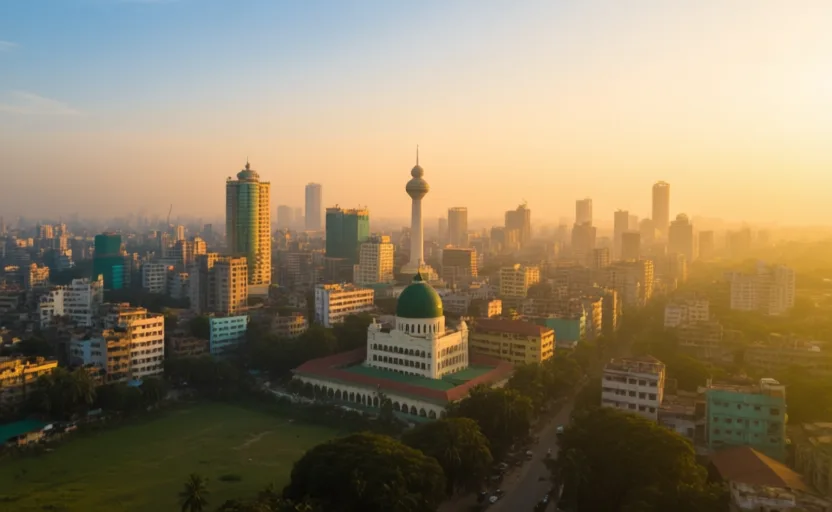
 Dhaka · AI city illustration · Artistic impression
City · South Asia
Dhaka
Also known as Dacca, ঢাকা
Saved in this browser — no account needed. Sign in later and it comes with you.
Where it is
Dhaka stands on the Buriganga, a channel of the lower Ganges–Brahmaputra system, near the middle of the Bengal delta. The city is a few metres above sea level on ground the rivers made and still remake; it is ringed by rivers on most sides, and the low ground between them floods. It is among the most densely populated large cities in the world, and the constraint on it is not land in the abstract but land that stays dry.
The land and water around it
The Burigangariver
The river the old city faces. It is severely polluted by tannery and industrial discharge, and dry-season flow is low, so what it carries is concentrated rather than diluted.
The delta floodplaindelta
Flat, low and wet. Roughly a fifth of the country floods in a normal year and far more in a bad one, which makes flooding a routine condition rather than an emergency.
The Madhupur tractplateau
Slightly raised older ground the city was founded on and has grown along. In a delta a few metres of elevation is the difference between a district and a floodplain, so the city's shape follows this terrace.
Its history, in short
Dhaka was the Mughal provincial capital of Bengal from 1610, when Bengal was among the wealthiest regions of the empire and its muslin was traded across Eurasia. The capital moved to Murshidabad in 1704 and the city declined; under Company and then British rule the muslin industry collapsed, for reasons argued over ever since. Dhaka became the capital of East Pakistan in 1947 and the focus of the Bengali language movement, whose 1952 killings are commemorated internationally. It became the capital of independent Bangladesh in 1971. Since the 1980s a garment industry has made it a centre of global clothing manufacture, with the growth, the migration and the industrial disasters that came with that.
Timeline
Dates are shown on a timeline rather than as changing shapes on the map. The globe draws modern boundaries only, and tinting a modern outline to stand for a historical one would state something we cannot source.
Early modern & oceanic
1610
Mughal capital of Bengal
Dhaka becomes the provincial capital, renamed Jahangirnagar. Bengal's revenues were the largest of any Mughal province, and its textiles were the region's export.
Well attestedEncyclopædia Britannica1704
The capital moves
The provincial capital shifts to Murshidabad and Dhaka's importance falls. The city shrinks substantially over the following century.
Well attestedEncyclopædia Britannica
Industrial & imperial
Early 19th century
The end of Dhaka muslin
The fine cotton textile industry collapses. British tariffs and the mechanisation of Lancashire are the usual explanations; the loss of Mughal court patronage and the disruption of the specialised supply chain also mattered. The old story that weavers' thumbs were cut off circulates widely and is not supported by evidence.
DisputedEncyclopædia BritannicaThe weight of British policy against mechanisation and the loss of patronage is argued between economic historians, and the account is politically charged in both Britain and Bangladesh.
Contemporary
1947
Capital of East Pakistan
Partition makes Dhaka the capital of a province separated from the rest of its state by a thousand miles of India, with a different language and a different economy.
Well attestedEncyclopædia Britannica21 February 1952
The language movement
Police fire on students demonstrating for Bengali to be a state language of Pakistan, and several are killed. The date is now International Mother Language Day, and the movement fed directly into the independence struggle.
Well attestedEncyclopædia Britannica1971
War and independence
The Pakistani army's crackdown begins in Dhaka in March. Nine months of war end with Bangladeshi independence in December. Death tolls for the war are given very differently by Bangladeshi and Pakistani sources and remain a live dispute.
DisputedEncyclopædia BritannicaBangladeshi accounts commonly cite three million dead; Pakistani official accounts give figures orders of magnitude lower. Independent estimates fall between and vary widely. The scale of atrocity is established; the number is not.
1980s onward
Garments
Export-oriented clothing manufacture grows rapidly, becoming the country's dominant export and drawing millions — a large majority of them women — into wage work for the first time.
Well attestedEncyclopædia Britannica24 April 2013
Rana Plaza
A building housing garment factories collapses outside Dhaka, killing 1,134 people. Cracks had been reported the day before and workers were told to return. It led to binding factory-safety agreements between brands and unions.
Well attestedEncyclopædia Britannica
Places that carry meaning
The Shaheed Minar1963, rebuilt
The monument to those killed in 1952, and the focus of 21 February each year. It has been demolished and rebuilt more than once, which is itself part of what it commemorates.
Lalbagh Fort1678, unfinished
A Mughal fort abandoned mid-construction after the governor's daughter died, according to the traditional account. It marks the city's Mughal high point and its interruption in the same structure.
The Historic Mosque City of Bagerhat15th century
A fifteenth-century city of mosques in the delta's south-west, built by a Muslim saint-administrator and later swallowed by forest. Inscribed as World Heritage in 1985.
Languages here
Places are usually multilingual. This lists what is actually spoken, not one language per border.
BengaliIndo-Aryan family
The national language, and the reason the country exists.
Bangladesh is unusual in being a state founded substantially on a language claim rather than a religious or ethnic one — the partition that created East Pakistan was religious, and the war that ended it was not.
Chittagonian and SylhetiIndo-Aryan family
Spoken in the south-east and north-east.
Officially treated as Bengali dialects, not readily mutually intelligible with the standard. Sylheti has a substantial diaspora in Britain, where its speakers are often recorded as Bengali speakers.
EnglishGermanic family
A language of higher education, business and law.
Retained in the courts and in much of the garment industry's international dealings, and a marker of class in schooling.
Learn the language here
- 1Understand which languages are spoken hereDhaka is multilingual. Start with which languages are used, by whom, and for what — the phrase list only covers one of them.Written by Globe Quest
- 2Learn 11 phrasesCurated everyday phrases for Dhaka, with audio and a written form.Written by Globe Quest
- 3Say them out loudSpeaking practice with pronunciation feedback, one phrase at a time.Globe Quest material, your own additions
- 4Come back to themSpaced review, so what you learned this week is still there next month.Written by Globe Quest
Check yourself
What makes Bangladesh's founding unusual?
It was founded substantially on a language claim rather than a religious one
The 1947 partition was religious; the 1971 war that separated East from West Pakistan was not.
Why has Dhaka grown along the Madhupur tract?
It is slightly raised, so it stays dry
In a delta a few metres of elevation decides what can be built on. The city's shape follows the terrace.
Worth arguing about
- A city that makes a large share of the world's clothes, at prices set elsewhere. Where should responsibility for a factory's safety sit?
- Two death tolls, orders of magnitude apart, for the same war. How should a reference work handle that?
What we have not established
These are open questions, listed rather than filled in. We would rather show a gap than a plausible guess.
How many people died in 1971?
Bangladeshi accounts commonly give three million; Pakistani official accounts give figures orders of magnitude lower; independent estimates fall between and vary widely. No count acceptable to all parties exists, and we do not choose one.
How many people live in Dhaka?
Figures differ by many millions depending on whether the city corporation, the metropolitan area or the wider urban region is meant, and the last census was taken in 2022 with a boundary that does not match common usage. We describe the density rather than assert a total.
Sources
- Britannica · DhakaEncyclopædia Britannica · encyclopedia · checked 2026-09-08
- Britannica · Bengali languageEncyclopædia Britannica · encyclopedia · checked 2026-09-08
- Britannica · BangladeshEncyclopædia Britannica · encyclopedia · checked 2026-09-08
- UNESCO · Historic Mosque City of BagerhatUNESCO World Heritage Centre · intergovernmental · checked 2026-09-08
Reviewed by Globe Quest editorial on 2026-09-08.