 Globe Quest
 Human Quest · LearningSign in
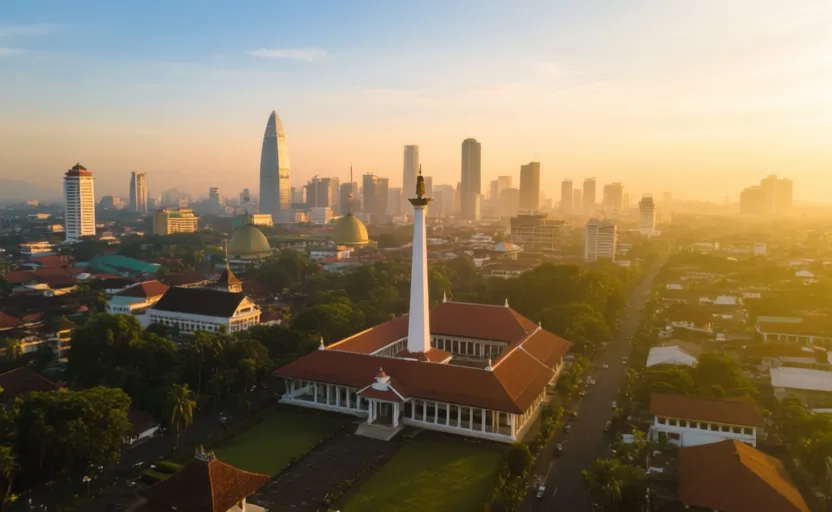 Yogyakarta · AI city illustration · Artistic impression
City · Southeast Asia
Yogyakarta
Saved in this browser — no account needed. Sign in later and it comes with you.
Where it is
Yogyakarta lies in the south-central part of Java, on the plain that runs from the southern slopes of Mount Merapi down towards the Indian Ocean. The city itself is small, about 33 square kilometres, but it is packed tightly around the sultan’s palace: roughly 11,500 people per square kilometre in 2020. Merapi, the most active volcano in Indonesia, is close enough that the northern edge of the urban area climbs its lower flank. The climate is tropical monsoon, with annual temperatures around 26 to 27 degrees Celsius and a wet season that peaks in January.
The land and water around it
Mount Merapivolcano
An active stratovolcano on the border of Central Java and the Yogyakarta region, its name meaning “mountain of fire”. It has erupted regularly since 1548, most recently in January 2024. Historians suggest an eruption of Merapi may have wrecked the old Mataram capital in the 920s, one proposed reason for the court moving to East Java. The Yogyakarta layout treats it as the northern pole of the city’s axis.
The Progo valley and its southern slopesvalley
The ground between Merapi and the sea was the core of the early Mataram kingdom, in the Progo River valley. Volcanic soil and a steady water supply from the mountain made it able to support the court centres and temple-building of the 8th to 10th centuries.
The Indian Ocean coastcoast
The southern end of the city’s six-kilometre axis points towards the Indian Ocean, which Javanese belief holds to be the realm of the sea’s queen. The sea and the volcano together frame how the palace and its landmarks are laid out.
Its history, in short
The land around Yogyakarta was a heartland of Hindu-Buddhist Java long before the city existed. Inscriptions place a kingdom called Mataram here in the 8th century, and the great temples of Borobudur and Prambanan belong to that era. A later Islamic Mataram Sultanate took its first capital at Kotagede, now a district of the city, and reached its height under Sultan Agung. After a succession war and Dutch involvement, the Treaty of Giyanti of 1755 split the realm, and Prince Mangkubumi became the first Sultan of Yogyakarta. His line, the House of Hamengkubuwono, still reigns. The court was sacked by a British force under Raffles in 1812. In the independence struggle the sultan sided with the new Republic, the city served as its capital from 1946 to 1948, and Yogyakarta kept a special status afterwards. Today it is both a living royal city and a major centre of universities, and it is the only city in Indonesia divided into districts called kemantren.
Timeline
Dates are shown on a timeline rather than as changing shapes on the map. The globe draws modern boundaries only, and tinting a modern outline to stand for a historical one would state something we cannot source.
Post-classical world
732
The Canggal inscription
An inscription dated 732 records the Medang kingdom established by King Sanjaya in the area known as Mataram. It was found in a Hindu temple about 40 kilometres from the present city, on the boundary between a Hindu dynasty and a Buddhist one.
Well attestedWikipediac. 929
The court leaves Central Java
King Mpu Sindok moves the seat of power to East Java. The exact reason is uncertain: a Merapi eruption and a power struggle with Srivijaya in Sumatra are the two explanations historians offer.
DisputedWikipediaHistorians reconstructing the move from inscriptions; no source states the cause directly
Early modern & oceanic
1587–1613
Kotagede as capital
Kotagede, today a district in the south-east of the city, is the first capital of the Mataram Sultanate. Under Sultan Agung (1613–1645) the sultanate becomes the greatest kingdom on Java.
Well attestedWikipedia13 February 1755
Treaty of Giyanti
The treaty, signed by Prince Mangkubumi, his nephew Pakubuwono III and the Dutch East India Company, creates the Yogyakarta Sultanate, with Mangkubumi enthroned as Hamengkubuwono I. The sultan and his family move into the palace in October 1756.
Well attestedWikipedia
Industrial & imperial
20 June 1812
The palace is stormed
Sir Stamford Raffles leads a force of 1,200 British troops against the kraton. It falls in a day and is sacked and burnt, an event the sources describe as a humiliation for the court.
Well attestedWikipedia1912
Muhammadiyah founded
K.H. Ahmad Dahlan founds the Islamic organisation Muhammadiyah in the Kauman quarter. Its central board is still headquartered in the city.
Well attestedWikipedia
Contemporary
1946–1948
Capital of the Republic
After Jakarta falls to the Dutch, Yogyakarta serves as the capital of the Indonesian Republic, with the Gedung Agung as the president’s office. Dutch forces invade in December 1948 and the capital moves to Bukittinggi.
Well attestedWikipedia1 March and 29 June 1949
The Dutch withdraw
A General Offensive on 1 March is counted as an Indonesian political and strategic victory, and by 29 June the city is cleared of Dutch forces under UN pressure. The city’s special status is the reward for its part in the Republic’s survival.
Well attestedWikipedia
Places that carry meaning
The Kraton and the Cosmological AxisFrom 1755
The Sultan’s palace stands on a six-kilometre line running south to north through the city, from the Indian Ocean side towards Merapi. The location was chosen by Mangkubumi in 1755 so that the capital would mirror the universe, and the axis is inscribed as a World Heritage property for its Javanese philosophy and ritual life.
Taman Sari1758
A former water castle and pleasure garden of the sultans. It was largely abandoned, then occupied by palace employees and their descendants; reconstruction began in 2004.
Prambanan8th–9th century
A group of temple compounds on the boundary between the Yogyakarta region and Central Java, with 508 stone temples in total. The Hindu Loro Jonggrang carries Ramayana reliefs; the Buddhist Sewu is the largest Buddhist complex in Indonesia. The temples were damaged by earthquake and eruption, and were rediscovered in the 17th century.
Kauman Great Mosque and the city’s places of worshipLong established
Mosques, churches and Chinese temples stand close together in the old city, among them Kauman Great Mosque, Kotabaru Catholic Church and the Tjen Ling Kiong temple. About 84 per cent of residents are Muslim and about 16 per cent Christian.
Languages here
Places are usually multilingual. This lists what is actually spoken, not one language per border.
JavaneseAustronesian family
The language of the court and the historic culture of the city.
Javanese is the language of the sultanate and of the classical arts of the city, such as wayang puppetry, poetry and ballet. Javanese people are the largest ethnic group in Indonesia, about 40 per cent of the population.
IndonesianAustronesian family
The official and national language, used between speakers of different languages.
Indonesian is a standard form of Malay, declared the language of national unity in 1928 and the official language from 1945. In a university city with students from across the archipelago it is the common language of study.
Learn the language here
- 1Understand which languages are spoken hereYogyakarta is multilingual. Start with which languages are used, by whom, and for what — the phrase list only covers one of them.Written by Globe Quest
- 2Learn 11 phrasesCurated everyday phrases for Yogyakarta, with audio and a written form.Written by Globe Quest
- 3Say them out loudSpeaking practice with pronunciation feedback, one phrase at a time.Globe Quest material, your own additions
- 4Come back to themSpaced review, so what you learned this week is still there next month.Written by Globe Quest
Check yourself
What event created the Yogyakarta Sultanate?
The Treaty of Giyanti of 1755
The Treaty of Giyanti split the old Mataram realm and made Prince Mangkubumi the first sultan of Yogyakarta; the same royal house still reigns.
Which two natural features does the city’s ceremonial axis connect?
Mount Merapi and the Indian Ocean
The axis runs for six kilometres between the volcano, regarded as home to guardian spirits, and the southern sea, ruled in Javanese belief by a sea queen.
Worth arguing about
- Yogyakarta is the only Indonesian city still governed in part by a reigning monarchy. What does a city gain, and risk, when a historic court and a modern republican government share it?
- A planned city was laid out as a model of the cosmos. How far should a modern city’s plan carry meaning of this kind, and who should decide what is kept?
What we have not established
These are open questions, listed rather than filled in. We would rather show a gap than a plausible guess.
Why did the Mataram court leave Central Java around 929?
A severe Merapi eruption and rivalry with Srivijaya are both proposed, but historians have not settled between them.
Sources
- Wikipedia · YogyakartaWikipedia · encyclopedia · checked 2026-11-24
- Wikipedia · IndonesiaWikipedia · encyclopedia · checked 2026-11-24
- UNESCO · The Cosmological Axis of Yogyakarta and its Historic LandmarksUNESCO World Heritage Centre · intergovernmental · checked 2026-11-24
- UNESCO · Prambanan Temple CompoundsUNESCO World Heritage Centre · intergovernmental · checked 2026-11-24
Reviewed by Globe Quest editorial on 2026-11-24. Drafted with AI assistance and checked against the sources above before publication.